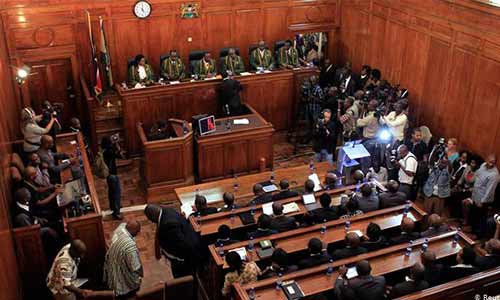
Kenya’s justice system faced widespread disruption on Wednesday as lawyers across the country boycotted court proceedings in protest against alleged judicial corruption, prolonged delays and what they described as a growing culture of impunity within the Judiciary.

The nationwide action was organised by the Law Society of Kenya and marked one of the strongest public confrontations between the country’s legal profession and the Judiciary in recent years.
The lawyers maintained that judicial independence should not be used as a shield against accountability, disciplinary investigation or public scrutiny.
LSK President Charles Kanjama said the boycott recorded overwhelming compliance across the country and followed months of unsuccessful engagements with judicial authorities over complaints concerning corruption, administrative inefficiency and weak disciplinary mechanisms.
The one-day action is also expected to serve as the first stage of a broader campaign against judges and magistrates accused of obtaining court orders to prevent investigations by the Judicial Service Commission and the Ethics and Anti-Corruption Commission.
The LSK directed lawyers not to appear before judicial officers accused of using court orders to frustrate disciplinary proceedings.
Instead, advocates were asked to seek adjournments, transfers of cases or the recusal of the affected judges and magistrates until the investigations against them were allowed to proceed.
The association said the boycott became necessary after several memoranda, consultations and Bar-Bench meetings failed to produce meaningful reforms.
According to the LSK, persistent allegations of judicial misconduct, corruption, delayed judgments, inefficient court registries and unreliable electronic filing systems have continued to weaken public confidence in the justice system.
The lawyers also complained about inconsistent case management and what they described as the inadequate handling of petitions and complaints against judicial officers.
“Judicial independence must go hand-in-hand with accountability, integrity, transparency and responsiveness to legitimate concerns raised by court users and the Bar,” Kanjama said.
The protest received support from prominent members of Kenya’s legal profession, including former LSK Presidents Faith Odhiambo and Nelson Havi, as well as Senior Counsel Ahmednasir Abdullahi.
They argued that judges and magistrates should not be permitted to prevent constitutionally established institutions from investigating allegations against them.
The East Africa Law Society also backed demands for reform and urged the anti-corruption commission to thoroughly investigate allegations involving judicial officers.
It maintained that the Judiciary must be held to the same constitutional standards of transparency and accountability that it expects from the Executive and Legislature.
Despite the boycott, Kenya’s Judiciary insisted that courts across the country remained open and functional.
It acknowledged that some cases were adjourned because lawyers failed to appear but said several other proceedings continued as scheduled.
The Judiciary rejected claims that judges and magistrates operate without oversight, pointing to the Judicial Service Commission and the Office of the Judiciary Ombudsman as institutions empowered to investigate complaints against judicial officers and court personnel.
It also cited a 104 per cent case-clearance rate as evidence that the courts had improved their efficiency and were resolving more cases than the number of new matters filed.
However, figures contained in the State of the Judiciary Report for 2023–2024 showed that the institution received 1,115 complaints during the reporting period.
The complaints included 141 petitions against judges and covered allegations ranging from ethical violations and judicial misconduct to the alleged abuse of court processes.
Concerns over judicial integrity intensified on the same day after Kenya’s anti-corruption agency announced the arrest of a magistrate accused of soliciting 170,000 Kenyan shillings, approximately $1,300, to influence the outcome of a criminal case.
The allegation against the magistrate remains under investigation and has not been determined by a court.
To limit the impact of the boycott on litigants, the LSK exempted urgent and time-sensitive matters from the protest.
Lawyers were permitted to file documents where statutory deadlines were approaching and appear in court only to extend interim orders or obtain new hearing dates.
The Law Society is expected to meet the Judicial Service Commission on July 31 to demand concrete reforms addressing corruption allegations, disciplinary procedures, case delays and administrative failures.
The association warned that wider and more prolonged industrial action could follow if the meeting failed to produce satisfactory commitments.
The dispute has developed beyond a disagreement over working conditions and has become a broader debate over the limits of judicial independence and the need for accountability within Kenya’s justice system.
[A MUST HAVE] Evidence Act Demystified With Recent And Contemporary Cases And Materials

Available now for NGN 40,000 at ASC Publications, 10, Boyle Street, Onikan, Lagos. Beside High Court, TBS. Email publications@ayindesanni.com or WhatsApp +2347056667384. Purchase Link: https://paystack.com/buy/evidence-act-complete-annotation
______________________________________________________________________ “Enhance Legal Practice With Authoritative Reports” — Alexander Payne Offers Comprehensive Law Reports, Spanning Over A Century Of Nigerian Jurisprudence Interested buyers are encouraged to place their orders and enquiries via:
0704 444 4777, 0704 444 4999, 0818 199 9888
Website: www.alexandernigeria.com
Interested buyers are encouraged to place their orders and enquiries via:
0704 444 4777, 0704 444 4999, 0818 199 9888
Website: www.alexandernigeria.com