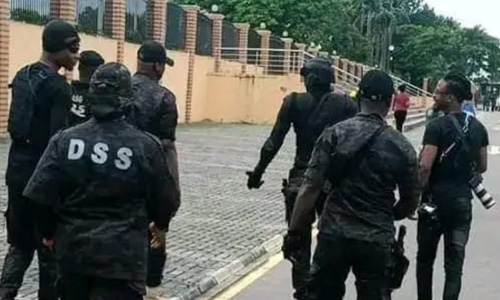
The Federal High Court in Abuja must remain accessible to lawyers and litigants with legitimate court business following judicial orders restraining the State Security Service (SSS), the Economic and Financial Crimes Commission (EFCC), the Inspector-General of Police and other affected security authorities from obstructing access to the court premises during high-profile trials.

The court also restrained the security agencies from blocking major roads around the Federal High Court, particularly the main road leading to Maitama and the road behind the judicial complex leading to Wuse 2, while directing them to maintain security around the premises in the interest of public order.
The orders followed a fundamental rights enforcement suit instituted by an Abuja-based legal practitioner, Sir Nkemakolam S.C. Okoro, who challenged the persistent barricading of the Federal High Court by heavily armed and masked security operatives whenever politically sensitive or high-profile criminal cases were scheduled for hearing.
Okoro alleged that the security arrangements subjected lawyers and litigants to inhuman and degrading treatment, restricted access to justice and caused serious traffic congestion around the court premises.
In its decision under Relief 10, the omnibus prayer contained in the application, the court restrained the first to fifth respondents from preventing lawyers who had established that they had business before the Federal High Court from gaining access to the various courts.
The court also restrained the first and fifth respondents from preventing litigants who had established that they were visiting the Federal High Court for filing or other litigation-related activities from gaining access to the premises.
In another order, the court restrained the first to fifth respondents from locking the main road leading to Maitama and the road behind the Federal High Court leading to Wuse 2, “in order to avoid disruption of traffic”.
The court further directed the first to fifth respondents to take necessary measures to secure the court and its surrounding environment “in the interest of public order”.
The first and second respondents in the suit are the SSS and its Director-General, while the third and fourth respondents are the EFCC and its Chairman.
The fifth respondent is the Inspector-General of Police, while the Attorney-General of the Federation (AGF) was joined as the sixth respondent.
However, the restraining orders concerning access to the court, road closures and security were directed against the first to fifth respondents and did not expressly extend to the AGF.
Okoro commenced the action through an application dated February 25, 2025, brought pursuant to Order 2, Rules 1 to 5 of the Fundamental Rights (Enforcement Procedure) Rules, 2009, and the inherent jurisdiction of the court.
The lawyer relied on Sections 34(1), 35(1), 40 and 41(1) of the Constitution of the Federal Republic of Nigeria, 1999, as amended, as well as Articles 5, 6, 7 and 10 of the African Charter on Human and Peoples’ Rights (Ratification and Enforcement) Act.
He sought declarations that the persistent invasion and barricading of the Federal High Court by heavily armed and masked security personnel unlawfully restricted his access to court as a legal practitioner and subjected him to inhuman and degrading treatment.
The applicant also challenged alleged threats by security operatives to arrest and detain him indefinitely whenever he complained about the restrictions.
According to him, the constant obstruction of access gates during high-profile trials disrupted the administration of justice and interfered with the constitutional rights of lawyers and litigants.
Okoro consequently sought a perpetual injunction restraining the first to fifth respondents from blocking, barricading or restricting his access to the Federal High Court on any trial date.
He also demanded a public apology to be published in at least three national newspapers.
In addition, the lawyer sought N100 million each from the first to fifth respondents as general and exemplary damages, bringing his total damages claim to N500 million.
He further demanded N5 million each from the respondents as litigation costs, amounting to N25 million.
Explaining the circumstances that prompted the action, Okoro recounted an incident on February 10, 2025, when he had three cases scheduled before Justice M.S. Liman of the Federal High Court in Abuja.
The cases were NACENN Nig. Ltd. v. Attorney-General of the Federation and Four Others; NACENN Nig. Ltd. v. Minister of Finance and Others; and NACENN Nig. Ltd. v. Minister of Finance and Four Others.
He alleged that despite leaving for court early that morning, he encountered what he described as “a too frequent spectacle” of heavily armed and masked SSS operatives barricading the court’s entrance.
According to the lawyer, the blockade caused heavy traffic around the Ahmadu Bello Way and Shehu Shagari entrances, forcing him to park his vehicle more than one kilometre away from the court premises.
Okoro said he was compelled to walk to the entrance, where he underwent repeated security checks despite identifying himself as a legal practitioner and carrying his wig and gown.
He alleged that he was treated “like a common criminal or a notorious terrorist” and subjected to checks at more than three different points.
The applicant further claimed that he stood for over 45 minutes before reaching the main gate and was threatened with arrest and detention when he complained.
He said another group of more than 20 heavily armed and masked security operatives confronted him at the entrance, where an officer demanded the name of his case and the courtroom in which it was listed.
According to Okoro, he waited for another 15 minutes before the officer confirmed that his matter appeared on the day’s cause list and permitted him to enter.
He described the narrow entrance through which lawyers were admitted as resembling the security arrangements of a maximum-security prison.
The lawyer also recalled a separate incident on February 24, 2025, when he and his legal team were scheduled to appear before Justice E.U. Akpan in Court 13 in the case of Lincoln Chukwu v. Inspector-General of Police and Others.
He alleged that EFCC and police operatives blocked access to the Federal High Court because of proceedings involving former Kogi State Governor, Yahaya Bello, who, according to him, had already been granted bail.
Okoro said he was again forced to walk more than one kilometre to the court premises and arrived at the entrance “sweating profusely”, only to encounter additional security checks.
He maintained that the incidents were not isolated but had become a recurring practice whenever cases involving prominent political figures or other high-profile defendants came before the Federal High Court.
The applicant specifically referred to proceedings involving Nnamdi Kanu, alleging that lawyers and litigants attending unrelated cases were frequently subjected to humiliating treatment because of security arrangements surrounding such trials.
According to him, it had “now turned out to be customary that any time the case of Nnamdi Kanu, or any other perceived high profile case is coming before the Federal High Court, lawyers and litigants alike will face humiliating treatment at the hands of security agencies”.
He argued that the actions of the security agencies obstructed the administration of justice and interfered with the exercise of judicial powers under Section 6 of the Constitution.
The lawyer maintained that although security agencies had responsibilities to maintain law and order, those responsibilities should not be exercised in a manner that unnecessarily prevented legal practitioners and litigants from accessing the courts.
Okoro was represented by C.C. Chukwu (Mrs.), I.A. Ayugu, N.J. Obiezu and Emmanuel C. Emerenini, while he was also listed among counsel.
Following consideration of the application, the court issued the orders protecting access to the Federal High Court and preventing the closure of the identified roads.
The decision requires the affected security authorities to allow lawyers and litigants who establish legitimate court business to gain access while continuing to secure the court premises and their surroundings.
The orders do not prohibit lawful security screening but restrain the respondents from using security arrangements to prevent authorised court users from carrying out their legitimate activities.
Although Okoro also sought damages, litigation costs, public apologies and declaratory reliefs, the orders supplied under Relief 10 do not establish that those additional requests were granted.
The ruling therefore addresses the need to maintain security around the Federal High Court while ensuring that lawyers and litigants are not unlawfully prevented from accessing judicial proceedings.
[A MUST HAVE] Evidence Act Demystified With Recent And Contemporary Cases And Materials

Available now for NGN 40,000 at ASC Publications, 10, Boyle Street, Onikan, Lagos. Beside High Court, TBS. Email publications@ayindesanni.com or WhatsApp +2347056667384. Purchase Link: https://paystack.com/buy/evidence-act-complete-annotation
______________________________________________________________________ “Enhance Legal Practice With Authoritative Reports” — Alexander Payne Offers Comprehensive Law Reports, Spanning Over A Century Of Nigerian Jurisprudence Interested buyers are encouraged to place their orders and enquiries via:
0704 444 4777, 0704 444 4999, 0818 199 9888
Website: www.alexandernigeria.com
“A Comprehensive Guide To Evidence Law” — Releases Second Edition In Three Volumes, Covering 4,051 Cases
For enquiries and orders, contact: 08035526491 Email: jerryamadisilk@gmail.com
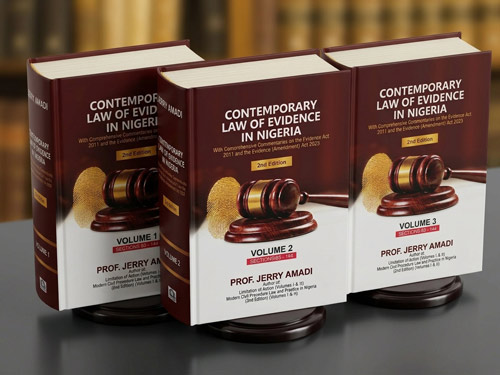 Prof. Jerry Amadi’s Evidence Law, Second Edition (2026), contains 3,314 pages in three volumes, covering the Evidence Act 2011, its 2023 amendment, and 4,051 Nigerian and English cases.