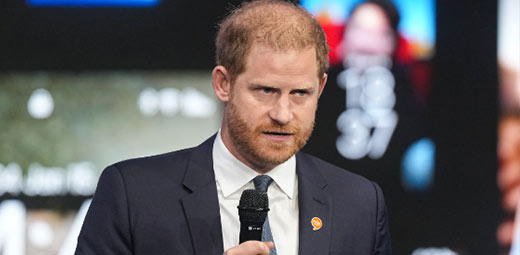
Prince Harry has lost his privacy lawsuit against Associated Newspapers Limited, publisher of the Daily Mail and Mail on Sunday, after a UK High Court dismissed claims that the newspaper group unlawfully gathered private information about him and other high-profile figures.

Justice Matthew Nicklin dismissed the case on Tuesday, holding that Harry and six other claimants failed to prove their allegations of unlawful information gathering against the publisher.
The Duke of Sussex had sued Associated Newspapers alongside other claimants, including Sir Elton John, David Furnish, Elizabeth Hurley, Sadie Frost, Baroness Doreen Lawrence and former lawmaker Simon Hughes.
The claimants alleged that the publisher engaged in unlawful methods to obtain information for stories, including phone hacking, landline tapping, use of private investigators and obtaining information by deception, popularly known as “blagging.”
They claimed the alleged activities formed part of a pattern of systematic unlawful information gathering by the newspaper group over several years.
However, Justice Nicklin ruled that the claimants did not provide sufficient evidence to establish their case.
The court held that the allegations relied heavily on inference and suspicion, rather than direct evidence showing that the articles complained of were obtained through unlawful means.
The judge also found that the information published in some of the challenged articles could have come from lawful sources, including friends, associates, official spokespeople or other legitimate channels.
Associated Newspapers had strongly denied wrongdoing throughout the proceedings, describing the allegations as false and insisting that its journalists acted lawfully.
Following the judgment, the publisher welcomed the decision, describing it as a vindication of its journalism.
The ruling marks a major setback for Prince Harry in his long-running legal battles against the British tabloid press.
Harry has repeatedly accused sections of the UK media of invading his privacy and causing harm to him and his family, including his wife, Meghan, Duchess of Sussex.
The Daily Mail case was one of the most closely watched media privacy cases in the UK, partly because it brought together several prominent claimants and raised allegations of historic unlawful news-gathering practices.
The decision also contrasts with Harry’s previous legal successes against other tabloid publishers.
In 2023, he won part of his phone-hacking case against Mirror Group Newspapers, while he later reached a settlement with News Group Newspapers, publisher of The Sun.
But in the case against Associated Newspapers, the court found that the claimants had not crossed the evidential threshold required to prove their claims.
The ruling may also expose the claimants to significant legal costs, with reports suggesting the total bill could run into tens of millions of pounds.
Harry was in the United Kingdom for an Invictus Games-related event when the judgment was delivered, but he did not immediately make any public comment on the ruling.
The judgment represents a major legal victory for Associated Newspapers and could have wider implications for future privacy and unlawful-information-gathering claims against media organisations.
The case has once again placed the balance between press freedom, public-interest journalism and the privacy rights of public figures at the centre of public debate in the United Kingdom.
[A MUST HAVE] Evidence Act Demystified With Recent And Contemporary Cases And Materials

Available now for NGN 40,000 at ASC Publications, 10, Boyle Street, Onikan, Lagos. Beside High Court, TBS. Email publications@ayindesanni.com or WhatsApp +2347056667384. Purchase Link: https://paystack.com/buy/evidence-act-complete-annotation
______________________________________________________________________ “Enhance Legal Practice With Authoritative Reports” — Alexander Payne Offers Comprehensive Law Reports, Spanning Over A Century Of Nigerian Jurisprudence Interested buyers are encouraged to place their orders and enquiries via:
0704 444 4777, 0704 444 4999, 0818 199 9888
Website: www.alexandernigeria.com
Interested buyers are encouraged to place their orders and enquiries via:
0704 444 4777, 0704 444 4999, 0818 199 9888
Website: www.alexandernigeria.com