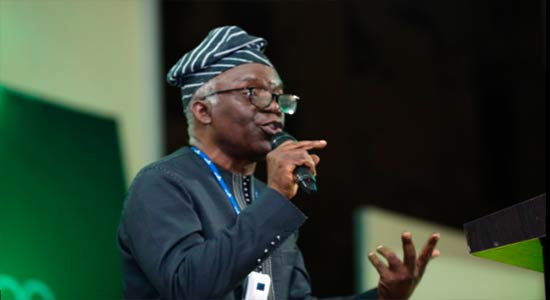
Human rights lawyer and Senior Advocate of Nigeria, Femi Falana, SAN, has called on the Independent National Electoral Commission (INEC) to direct state governments and the Federal Capital Territory Administration to cancel what he described as illegal and unconstitutional campaign billboard permit fees ranging from ₦100 million to ₦200 million ahead of the 2027 general elections.

Falana also urged INEC to establish dedicated investigation and prosecution units to prosecute electoral offenders, warning that the failure to address political violence and electoral misconduct could undermine the credibility of the forthcoming elections.
In a statement addressing the shrinking civic space and rising political violence across Nigeria, the senior lawyer accused the Federal Government and state governments of creating conditions that restrict opposition political activities and threaten democratic participation.
According to him, while INEC is constitutionally empowered to regulate political campaigns, some state governments and the FCT Administration have imposed prohibitive billboard charges and denied opposition parties access to publicly owned facilities for political activities.
He alleged that opposition political parties and candidates had been prevented from using state-owned stadia, hotels and event centres for their campaigns, while exorbitant permit fees had made political advertising increasingly difficult.
Falana observed that the restrictions had contributed to political tensions, with some disenchanted youths resorting to the destruction of campaign billboards and other materials belonging to ruling parties in certain states.
He recalled that INEC National Commissioner and Chairman of Voter Education and Publicity, Mohammed Haruna, had expressed the view that the Commission had limited powers to intervene in billboard charges because signage regulation fell within the responsibilities of state and local governments.
Falana also reacted to the position of the Minister of the Federal Capital Territory, Nyesom Wike, who defended the increased billboard charges as part of revenue-generation efforts rather than a deliberate attempt to disadvantage opposition parties.
Wike had argued that political campaigns were expensive globally and that parties could explore social media platforms to reach their supporters.
However, Falana disagreed with both positions, maintaining that they were inconsistent with the 1999 Constitution and the Electoral Act 2026.
“With respect, the positions of INEC and Mr. Wike are not in consonance with the provisions of the Constitution and the Electoral Act, 2026,” he stated.
Relying on Section 15, Part I of the Third Schedule to the 1999 Constitution, Falana argued that INEC has exclusive responsibility for organising, undertaking and supervising elections into the offices of President, Vice-President, Governor, Deputy Governor and the federal and state legislatures.
He further noted that the Constitution empowers the Commission to monitor political campaigns and prescribe rules and regulations governing political parties.
The senior lawyer also cited Section 99 of the Electoral Act 2026, which he said criminalises interference with the right of candidates and political parties to conduct lawful campaigns, as well as the denial of access to state apparatus in a manner that places political contestants at a disadvantage.
According to him, state governments cannot impose additional conditions that conflict with constitutional provisions or regulations issued by INEC.
Falana relied on the Supreme Court decisions in PDP v. Sylva (2012) 13 NWLR (Pt. 1316) 85 and NDP v. INEC (2013) 20 WRN 1 at 45, where he said the apex court affirmed INEC’s exclusive authority over the administration and supervision of general elections.
He maintained that state governments had no authority to impose campaign charges inconsistent with the legal framework governing elections.
“Since state governments have no role to play in the conduct of political campaigns that are set out in the Electoral Act, the expensive billboards fees fixed by them are illegal and unconstitutional,” Falana declared.
He added that courts had previously invalidated administrative fees imposed by state governments on candidates contesting local government elections where such charges contravened the Electoral Act.
“Consequently, INEC should direct state governments to cancel the expensive campaign fees or face the full wrath of the law,” he stated.
Turning to the prosecution of electoral offenders, Falana recalled that the Mohammed Uwais Electoral Reform Panel had recommended the establishment of an Electoral Offences Commission to investigate and prosecute violations of electoral laws.
He said that although the Federal Government accepted the recommendation, the National Assembly did not include provisions establishing the proposed commission in the Electoral Acts of 2010, 2022 and 2026.
Falana noted that despite INEC’s existing responsibilities, Section 148 of the Electoral Act 2026 empowers the Commission to prosecute electoral offences through its legal officers or legal practitioners appointed for that purpose.
He explained that the provision also allows electoral offences to be tried by Magistrates’ Courts or High Courts in the states where they occur or in the Federal Capital Territory.
The senior lawyer consequently urged INEC to establish an Investigation Unit and a Prosecution Unit and seek the deployment of trained police investigators from the Inspector-General of Police to support the investigation of electoral offences.
He also called on the Nigerian Bar Association (NBA) to collaborate with the Commission in prosecuting electoral offenders rather than limiting its involvement in the 2027 elections to election monitoring.
“Instead of monitoring the 2027 elections, the Nigerian Bar Association should liaise with INEC to bring indicted electoral offenders to book,” he stated.
Falana recalled that in 2011, he participated in efforts to persuade the leadership of the NBA and INEC to collaborate in prosecuting electoral offenders.
He maintained that the cooperation between the two institutions had contributed to the successful prosecution of several electoral offenders over the years.
Referring to recent concerns about voter registration irregularities, Falana said INEC had disclosed the alleged involvement of approximately 54 of its personnel in manipulation of voter registration procedures across 10 states.
He urged the Commission to ensure that the affected officials, as well as individuals arrested by the Police in connection with attacks on political candidates and the disruption of campaign rallies, were prosecuted where the evidence established electoral offences.
According to him, INEC should work with the NBA to ensure that persons implicated in electoral violence and other violations of the Electoral Act are brought before the appropriate courts.
Falana warned that failure to take decisive action against electoral misconduct could embolden political actors and encourage further attacks on opposition parties and candidates.
“Otherwise, the 2027 general election will be marred by electoral violence of monumental proportion,” he warned.
He maintained that protecting the right of political parties to campaign freely, removing unconstitutional restrictions and ensuring the prosecution of electoral offenders were essential to safeguarding Nigeria’s democracy ahead of the 2027 general elections.
[A MUST HAVE] Evidence Act Demystified With Recent And Contemporary Cases And Materials

Available now for NGN 40,000 at ASC Publications, 10, Boyle Street, Onikan, Lagos. Beside High Court, TBS. Email publications@ayindesanni.com or WhatsApp +2347056667384. Purchase Link: https://paystack.com/buy/evidence-act-complete-annotation
______________________________________________________________________ “Enhance Legal Practice With Authoritative Reports” — Alexander Payne Offers Comprehensive Law Reports, Spanning Over A Century Of Nigerian Jurisprudence Interested buyers are encouraged to place their orders and enquiries via:
0704 444 4777, 0704 444 4999, 0818 199 9888
Website: www.alexandernigeria.com
“A Comprehensive Guide To Evidence Law” — Releases Second Edition In Three Volumes, Covering 4,051 Cases
For enquiries and orders, contact: 08035526491 Email: jerryamadisilk@gmail.com
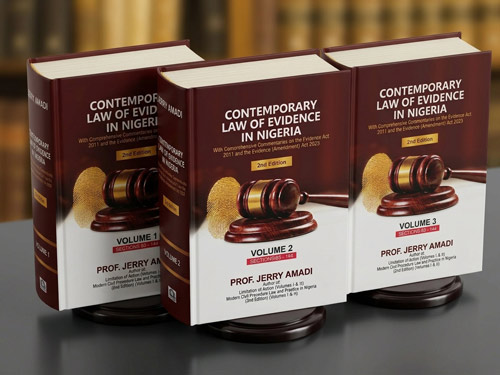 Prof. Jerry Amadi’s Evidence Law, Second Edition (2026), contains 3,314 pages in three volumes, covering the Evidence Act 2011, its 2023 amendment, and 4,051 Nigerian and English cases.