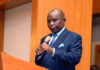
The National Publicity Secretary of the All Progressives Congress (APC), Felix Morka, has dismissed allegations that some individuals pay billions of naira to secure ministerial appointments, questioning why anyone who already possesses such wealth would seek a position in government.

Morka challenged the allegation that political appointees purchase ministerial positions and subsequently attempt to recover the money through their control of public resources.
His reaction followed claims by another APC spokesman, Hassan, who alleged that some individuals spend billions of naira to obtain ministerial appointments and later seek to recover their investments after assuming office.
Morka questioned the logic behind the allegation, asking why someone with billions of naira would be interested in becoming a minister in the first place.
He also challenged the suggestion that a minister could recover such an enormous amount of money through public office, raising questions about the basis of Hassan’s claims.
The APC National Publicity Secretary maintained that the remarks should be understood within their historical context rather than treated as evidence that appointments under the present administration were being sold.
His response has brought attention to disagreements within the ruling party over the allegations and the broader implications of suggesting that public offices are obtained through financial inducements.
Although Hassan’s allegations raise questions about possible corruption in the appointment process, no specific minister or government official has been identified as having paid or received money in exchange for an appointment.
There is also no evidence in the available account establishing that any ministerial position was purchased.
Under Nigerian law, the payment or receipt of money as an inducement for a public appointment could constitute a criminal offence, depending on the circumstances and evidence.
The relevant legal framework includes the provisions dealing with corrupt gratification, official corruption and the Code of Conduct for Public Officers contained in the Fifth Schedule to the 1999 Constitution.
Where proceeds of unlawful transactions are concealed, transferred or disguised, the applicable money laundering legislation may also become relevant.
However, the existence of these legal provisions does not establish that any offence has been committed.
The controversy has raised questions about whether Hassan possesses firsthand information concerning the alleged transactions or was making a general observation about political appointments.
If he has information about specific payments, such details could provide a basis for investigation by the Economic and Financial Crimes Commission (EFCC) or the Independent Corrupt Practices and Other Related Offences Commission (ICPC).
Investigators would need evidence identifying the individuals involved, the amounts allegedly paid, the recipients and the circumstances surrounding any transaction.
Morka’s position that the comments should be understood historically does not necessarily resolve whether any identifiable offence occurred.
Similarly, an allegation involving past conduct would not automatically prevent an investigation, although questions concerning prosecution and recovery of proceeds would depend on the applicable laws and circumstances.
The disagreement has also raised broader concerns about the possibility of public officials abusing their positions to recover money allegedly spent obtaining appointments.
Public procurement processes, contract approvals, project certification and payment authorisations are areas in which corruption risks may arise when established safeguards are circumvented.
Inflated contracts, contract splitting and payments for projects not executed are recognised forms of procurement irregularity.
However, the existence of such practices as general corruption risks does not establish that any minister has used them to recover money allegedly paid for an appointment.
For illustration, recovering a hypothetical ₦5 billion over four years would amount to ₦1.25 billion annually. The calculation demonstrates the financial scale of the allegation but does not prove that any such transaction occurred.
Beyond the controversy over ministerial appointments, Hassan’s comments on the implementation of government budgets have also attracted attention.
During the discussion, he was asked whether his position amounted to a deliberate policy under which the government approves a budget but subsequently declines to release the appropriated funds.
The proposition was put to him in the following terms:
“A conscious policy to say we have a budget, we approve it, but we’re not going to fund it.”
Hassan responded:
“Absolutely. I love it.”
His response has raised questions about whether he was endorsing the deliberate withholding of appropriated funds as government policy or expressing support for fiscal restraint under particular circumstances.
The distinction is important because an Appropriation Act authorises expenditure within specified limits but does not necessarily require the immediate or complete release of every approved allocation.
Budget implementation may be affected by revenue performance, borrowing conditions, cash-flow constraints and other legitimate fiscal considerations.
However, a deliberate policy of approving expenditure while systematically withholding funding for reasons unrelated to legitimate fiscal constraints could raise concerns about legislative oversight, transparency and the executive’s responsibility to implement approved programmes.
The issue is particularly relevant to public institutions that depend on government funding to carry out their statutory responsibilities.
Concerns about inadequate releases of appropriated funds have arisen within the judiciary and the correctional system.
The Chief Justice of Nigeria has raised concerns about funds appropriated for the judiciary but not released, while questions have also arisen over financial administration involving the Federal Capital Territory Judicial Service Committee.
The Nigerian Correctional Service has similarly faced concerns over capital funding, including an account that it received only 22.2 per cent of its approved capital allocation.
These developments illustrate the challenges that inadequate budget releases can create for public institutions.
Nevertheless, Hassan’s remarks alone do not establish that the funding difficulties experienced by those institutions resulted from a single deliberate government policy.
Establishing such a connection would require examination of budget implementation records, release warrants, cash-backing arrangements, revenue performance and explanations from the relevant authorities.
The controversy has also renewed attention to the constitutional relationship between the National Assembly’s appropriation powers and the executive’s responsibility for implementing approved expenditure.
While the National Assembly authorises public expenditure through the budget process, the executive is responsible for administering the release and application of funds in accordance with the Constitution and applicable financial laws.
A practice that consistently leaves approved expenditure unfunded could weaken legislative oversight and undermine the delivery of public services.
However, determining whether a particular decision to withhold funds is unlawful would require consideration of the legal framework, the reasons for the decision and any applicable statutory obligations.
The disagreement between Morka and Hassan therefore raises two separate questions concerning public accountability.
The first is whether credible evidence exists to support allegations that individuals pay billions of naira to secure ministerial appointments.
The second is whether Hassan’s comments about withholding appropriated funds reflect an official government policy, his personal political position or remarks made in a different context.
Morka’s rejection of the ministerial appointment allegation remains an important part of the controversy, particularly because no specific transaction or individual has been identified in support of the claim.
Further clarification from Hassan would also be necessary to establish the basis of his allegations and the precise meaning of his comments on budget implementation.
[A MUST HAVE] Evidence Act Demystified With Recent And Contemporary Cases And Materials

Available now for NGN 40,000 at ASC Publications, 10, Boyle Street, Onikan, Lagos. Beside High Court, TBS. Email publications@ayindesanni.com or WhatsApp +2347056667384. Purchase Link: https://paystack.com/buy/evidence-act-complete-annotation
______________________________________________________________________ “Enhance Legal Practice With Authoritative Reports” — Alexander Payne Offers Comprehensive Law Reports, Spanning Over A Century Of Nigerian Jurisprudence Interested buyers are encouraged to place their orders and enquiries via:
0704 444 4777, 0704 444 4999, 0818 199 9888
Website: www.alexandernigeria.com