*Says “INEC Paid Too Much Attention To Public Opinion And Social Media Propaganda”

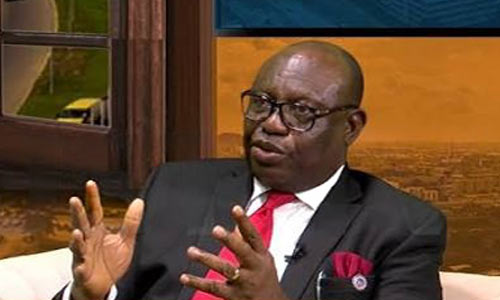
A former National Commissioner of the Independent National Electoral Commission (INEC) in charge of Information and Voter Education, Mr. Festus Okoye, has said that one of the principal failings of the commission in the 2023 general election was that it paid too much attention to public opinion and social media propaganda at the expense of its constitutional and statutory mandate.
Okoye, who was the public face of INEC throughout the 2023 elections, spoke in the first part of an interview on the programme Deep Insight, in which he reviewed the commission’s preparation, the failure of the real time upload of presidential results, the origin of the word “glitch,” the conduct of the election petitions, and what he described as the commission’s continuing battle with public distrust.
Asked to assess the commission’s performance, Okoye began with an unqualified defence of its preparations.
“If there’s any election that was well-packaged and the commission prepared well for it, it is the 2023 general election,” he said. “In terms of the administration of that election, the commission did very well. In terms of preparations, the commission did very well. In terms of training and recruitment of ad hoc staff, the commission did very, very well.”
He listed the logistical arrangements in support of that claim: “Ad hoc staff were recruited on time, and they were trained and properly trained. We engaged the Nigerian Air Force, and they moved the BVAS and electoral materials to the Central Bank in the various states on time. We also recruited all the collation officers and recruited them on time.”
On road logistics, he disclosed that the commission contracted the transport unions and that the arrangement held: “We entered into a memorandum of understanding with the National Union of Road Transport Workers and the National Association of Road Transport Employees in terms of logistics movement. And both parties kept to the spirit and letter of that particular memo we signed.”
Pressed on why, despite those preparations, execution failed, Okoye identified the lesson he said he has taken away from the exercise.
“One thing I’ve come to realise, especially with my background managing the information and voter education portfolio of the commission, is that the electoral management body should at all times pay attention to public opinion, but must remain within the confines and ambit of its constitutional and statutory mandates.”
He continued: “Part of the challenges we had was paying too much attention to public opinion, paying too much attention to what was going on in the social media, and trying to balance public opinion, social media propaganda with our constitutional and statutory responsibilities as an electoral management body.”
Asked whether he was saying INEC should not listen to public opinion at all, he clarified: “I’m talking about balance. Balance. You have to find a balance. But when it matters most, you must remain with your constitutional and statutory mandate.”
“We Led The Movement” On Technology
Okoye said the commission deliberately introduced technology into the process in stages, and that it acted ahead of the law rather than in response to it.
“In terms of voter registration, we introduced the INEC Voter Enrollment Device, through which Nigerians, especially the younger generation, could sit at home, enroll, and then go to the INEC offices and capture their biometrics. We also introduced the BVAS and the IReV into the electoral process because we wanted technology to be infused into the electoral process.”
Asked whether the gradual approach was the commission’s own choice or a requirement of the law, he was emphatic: “No, no, no, no. As at the time we brought in the BVAS, the law had not integrated it. It was much, much later that the Electoral Act was amended to integrate greater technology into the process. So we led the movement.”
Put to him that the commission was therefore already prepared by the time the law caught up, he agreed: “Exactly, exactly. That is the point.”
“Opportunistic And Pernicious Propaganda”
Confronted with the allegation that human elements within the commission were influenced by outside interests and did not allow the technology to run its course, Okoye rejected the claim outright.
“I think that that will be opportunistic and pernicious propaganda, because I was there and I knew what happened,” he said. “We even carried out test run of this technology in so many locations. I supervised Anambra, I supervised Benue, and I supervised Abia, and I went to all these locations when we were doing a test run of how to get the BVAS and how to upload polling unit level results into the IReV.”
He acknowledged the theoretical vulnerability while insisting the record does not support it: “We recognised that pernicious human interference can affect technology. But when it came to the brass tacks, nobody as at today questioned the fact that we prepared and prepared well in terms of our deployment. Nobody accused us of the fact that the BVAS didn’t work, because the reports we got was that the BVAS was top-notch in at least 80 per cent of all the locations where the BVAS was deployed.”
He also noted the limits of any machine: “Technology does not operate itself. Technology depends on human action in order for it to operate.”
“The Only Challenge Was The Presidential Election”
Narrowing the failure to a single item, Okoye stressed that three separate elections held on the same day and that only one of them had an upload problem.
“The only challenge as at today, looking back, was the challenge of uploading polling unit level presidential election results. You will understand that the election on that day was not only presidential election. Election to the House of Representatives took place on that day, elections to the Senate took place on that day, and presidential elections took place on the same day. The only challenge we had in terms of real time uploading of the polling unit level result was the presidential election.”
He added: “Nobody said that the House of Reps was not uploaded. Nobody said that the senatorial election was not uploaded.”
“They Told Him, We’re Going To Fix It In 10 Minutes”
Describing the events of the day itself, the former commissioner recounted how the problem escalated into a crisis.
“On that particular day, when we received reports that presidential election results were not uploading, the chairman just went to the room where the ICT people were, and they told him, ‘Oh, we’re going to fix it in 10 minutes. We’re going to fix it in 20 minutes.’ And it was not fixed in 20 minutes. And then in 20 minutes, it became a crisis.”
He said field officials were coming under physical attack as the delay lengthened: “Some of our presiding officers were calling on the phone. Some of them were being beaten up, some of them were held hostage and so on. So it became a crisis. That is the point. That is what really happened. The technology malfunctioned.”
He then made the admission at the centre of the commission’s credibility problem: “But people don’t believe that technology malfunctioned. That is the truth of the matter.”
Okoye noted that the results were not lost: “Eventually, the polling unit level results were uploaded.”
“That Was How The Issue Of Glitch Came Into The Equation”
In one of the most striking disclosures of the interview, Okoye revealed that he had pressed for the commission to announce the failure in plain language, and that the now notorious word “glitch” was the product of an internal disagreement over phrasing.
“When this issue happened, they said they’re having difficulty uploading presidential election results. I asked the question, I said, ‘When you say the system malfunctioned, what does it mean in practical terms? It means that we have challenge uploading presidential level polling unit results.’ They said yes.”
“I said, ‘Okay, we need to tell Nigerians that this is the difficulty we are having and that we are trying to fix it.’ And then a press statement was prepared, and I looked at it because it was written in scientific and technological jargons. I said, ‘No.’ I asked them, I said, ‘All these things you have written, all these things you are saying, is that we have challenges uploading presidential results into the IReV?’ They said yes.”
“I said, ‘Okay, let me tell Nigerians that we have challenge uploading presidential results.’ They said no, my language must have the face of technology, must be technical. And that was how the issue of glitch came into the equation.”
He added: “So for me, what happened was that technology disappointed us. And you must feel for some of us that we prepared and prepared well. We were not sleeping. We were sleeping in the office, we were getting ready, we were touring all the states of the federation, and then when it was moment of glory, just one technical hitch.”
“There Were All Sorts Of Cyber Attacks On Our Platforms”
Asked whether it was possible that officials working honestly were unaware of hands working behind the scenes to thwart the process, Okoye confined himself to what he said he could speak to.
“I can only talk about areas where I have expertise. In terms of technology, in terms of scientific issues, I don’t have too much knowledge. But I know that there was all sorts of cyber attacks on our platforms during that particular period.”
He declined to draw a conclusion from it: “But whether those cyber attacks influenced what happened at the end of the day, I’m not in a position to say.”
He pointed instead to the commission’s evidence before the tribunal: “All I know is that the deputy director in charge of ICT in the commission went before the election petition tribunal and explained to them what exactly happened,” adding that the officer was cross-examined on his account.
“They Anchored Their Matter On A Different Pedestal”
Okoye argued that the petitions arising from the presidential election never actually tested the upload failure, because the petitioners built their cases on an entirely separate question.
“If you look at the case that went before the court, you will find out that the two presidential candidates that went to court anchored their matter on a different pedestal. They anchored their matter on the fact that the incumbent president did not score a quarter of the votes in the Federal Capital Territory, and that the Federal Capital Territory, in terms of the trajectory of Nigeria, stands alone, and that for a presidential candidate to be declared as the winner you must win the Federal Capital Territory. That was the anchor of their case.”
“They didn’t go into what could have led us to the answer as to what really happened.”
He also recalled the fate of the expert evidence called on the technology question: “They brought somebody from Amazon to come and give an account of what happened. At the end of the day, they found out that the person who was brought as an expert was a candidate in the election.”
He noted the appellate structure within which the matter was determined, observing that presidential election petitions begin at the Court of Appeal as the court of first instance before proceeding to the Supreme Court.
“There Was Definitely A Communication Gap”
Asked whether INEC had failed to communicate adequately with the public, Okoye conceded the point without hesitation.
“Definitely there was a communication gap. Communication gap in the sense that the Independent National Electoral Commission could not compete effectively with people in the social media. There were some people who were sleeping inside the social media at that particular period, and there was no way we could compete effectively with them.”
“What we tried to do was we tried to communicate. We also asked the question, ‘Who and who are in the social media, and what type of messaging can influence them?’ But they were ahead, and their propaganda was slightly more vicious than what the commission could give out.”
He listed the conventional channels the commission relied upon: “In terms of strategic communication, I think that we tried our best. We had roadshows, we went to the markets, we used national youth corps members to reach the public. We used orthodox and conventional media. But the influence of the social media was so heavy, and there were too many Nigerians who were ready to believe what goes on in the social media and were not ready to believe what the commission was saying. So it was a big challenge that we faced up there.”
“The First Casualty Of That Budget Is Information And Voter Education”
Asked what could be done to bridge the gap before 2027, Okoye said the window has largely closed, and traced the weakness to budgeting practice within the commission.
“It’s slightly too late to talk about bridging the gap. This is because if you look at the budgeting, especially for the Independent National Electoral Commission, when the commission prepares this budget, the first casualty of that budget is the budget relating to information and voter education.”
“For you to communicate and engage effectively in the social media, you must also have what it takes to engage. You must also have the capacity to engage, and you must also have the personnel to engage. I think the commission does not have that capacity to engage. The commission has all sorts of social media handles and so on, but having social media handles does not translate to anything unless you have people who are ready to audit the commission’s social media handles, ask the question, ‘These young people, what is it that will interest them? What type of messaging can we put out?'”
He said the medium must match the audience: “Are they ready to read long speeches? Are they ready to read press statements? Or are we going to do a podcast for them? Are we going to do short clips for them? So you have to audit all these things.”
His conclusion was blunt: “There’s no way the commission can communicate and communicate effectively unless it is properly funded.”
Why INEC Is Wary Of Taking Money
Explaining the commission’s approach to external support, Okoye said the concern for independence shapes how it deals with third party funding.
“Because of its independence, the commission is always very wary, always very careful about collecting money from individuals or even from organizations or even from international donors. If you check, most of the donor organizations, the commission does not collect money from them. What happens is that if they want to support a program of the commission, they support it directly. They go and pay for the hotels, pay the speakers and so on and so forth.”
“The Albatross On The Neck Of INEC Is This Lack Of Confidence”
Turning to public perception, the former commissioner accepted that distrust of the commission is widespread and that it flows from the events of 2023.
“The albatross on the neck of INEC is this lack of confidence. We cannot deceive ourselves. I know as a matter of fact that very few people… if you were to go to the streets to ask ten people, ‘Do you believe INEC is going to be impartial? Do you believe INEC is going to do something without bias?’ Many of them, I don’t want to put a figure, many of them will say they don’t believe INEC. So this is the battle INEC is fighting, and we have had a lot of bias reports.”
“It Is Nigerians That Conduct Elections”
Asked how the commission should manage that perception, Okoye said the starting point is public understanding that election management is a shared enterprise.
“The first thing that needs to be done is to get Nigerians to understand that the organisation, management and supervision of elections is a multi-stakeholder venture. And that unless Nigerians agree to have free, fair, transparent, and credible elections, it will not happen.”
He then set out the staffing arithmetic that he said most Nigerians overlook: “The entire workforce of the commission is less than 11,000.” Asked whether that figure included ad hoc staff, he replied: “No, no. The ad hoc staff are not staff of the commission. But during the election, the commission recruits over 1.5 million ad hoc staff. And who are these ad hoc staff? These ad hoc staff are Nigerians.”
He broke down the categories: “The presiding officers are Nigerians doing their national youth service. The assistant presiding officer one, two, and three are students of tertiary institutions in their penultimate year. You will not see an INEC staff as an ad hoc staff. The supervisory presiding officers are staff of federal agencies and commissions. So you hardly see a staff of INEC during the election. So it is Nigerians that conduct the election.”
On the role of the national commissioners on polling day, he said: “The national commissioners on election day do not go out to the field. They stay in the International Conference Centre checking what is going on on television, and if there’s an intervention, they call and say, ‘Well, why hasn’t the vehicles for this particular registration area taken off?’ So you manage what you can from the situation room.”
“Vote And Die, Vote And Die”
Okoye said the second requirement is that political parties develop the democratic spirit necessary to let the process run, and the third is that voters be able to vote in safety.
“For an election to be free, fair, and transparent, the registered voters, those who do not have any impediment, must be in a position to leave their house in the morning and head to the polling unit, cast their votes, and go home without any harm befalling them.”
He then recounted an election he supervised in Anambra State.
“When I was moving out in the morning, I didn’t see any human beings. On the highways, some people overnight had used red paint to write, ‘Vote and die, vote and die, vote and die.'”
“If You Want Us To Deploy, You Have To Pay Us Insurance Money”
The former commissioner said he found the deployment in Oyi Local Government Area completely stalled hours after polls should have opened.
“I went to Oyi local government. As at 12:00 noon, all the vehicles were there. No vehicle had taken off. No polling unit had opened. And I asked the question, I said, ‘What’s going on here?’ The driver said, ‘Oga, this grammar not go help you.’ I said, ‘Well, haven’t we paid?’ They said, ‘You have paid. But some people say if we deploy, they will burn our vehicles. So if you want us to deploy, you have to pay us insurance money.'”
He said the commission paid. “And we paid. Then after they moved, I found out that 12 polling units had no presiding officer, no assistant presiding officer, nobody.”
“Your Security Is More Important Than This Thing You Are Going To Go And Do”
Okoye said he attempted to recruit corps members and students standing nearby, only to be stopped by their parents.
“There were corps members hanging around. There were students hanging around. I called one of them. I said, ‘Come. What is the problem? Don’t you want to serve?’ As I was interrogating her, the mother came out and said, ‘Oh, you are Barrister Okoye. She’s my daughter. If anything happens to her, I will come after you.’ So I left her.”
“And another boy came forward and said, ‘Sir, I’m ready to serve.’ The father came out. I asked him, ‘How much are they paying you?’ He said it’s 17,500. The father brought out 50,000 and gave to him and said, ‘Get out from here. Your security is more important than this thing you are going to go and do.'”
He drew the obvious conclusion: “So when people believe that if they go out to serve the nation, they may be in harm’s way, it becomes a problem.”
“The Security Agencies Themselves Must Show A Lot Of Neutrality”
The fourth condition he identified was the impartiality of the security services, and the limits of the commission’s control over them.
“The security agencies themselves must show a lot of neutrality. When people believe that the security agencies are not neutral, they are not likely going to come out to exercise their democratic franchise.”
“No matter how independent an electoral management body wants to be, if it cannot deploy, there’s no way it can conduct election, because it doesn’t control police, it doesn’t control army, it doesn’t control air force.”
In a trailer for the second part of the interview, the programme indicated that Okoye would speak to what he describes as fundamental challenges in the electoral system, including the inability of INEC to clean up a voter register he says is currently laced with fictitious names.
[A MUST HAVE] Evidence Act Demystified With Recent And Contemporary Cases And Materials

Available now for NGN 40,000 at ASC Publications, 10, Boyle Street, Onikan, Lagos. Beside High Court, TBS. Email publications@ayindesanni.com or WhatsApp +2347056667384. Purchase Link: https://paystack.com/buy/evidence-act-complete-annotation
______________________________________________________________________ “Enhance Legal Practice With Authoritative Reports” — Alexander Payne Offers Comprehensive Law Reports, Spanning Over A Century Of Nigerian Jurisprudence Interested buyers are encouraged to place their orders and enquiries via:
0704 444 4777, 0704 444 4999, 0818 199 9888
Website: www.alexandernigeria.com
Interested buyers are encouraged to place their orders and enquiries via:
0704 444 4777, 0704 444 4999, 0818 199 9888
Website: www.alexandernigeria.com