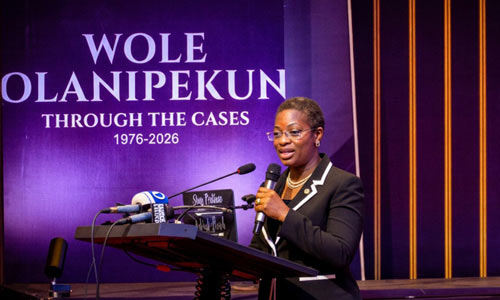
The President of the Nigerian Bar Association (NBA), Badejo-Okusanya, has paid tribute to former NBA President, Chief Wole Olanipekun, SAN, revealing that his leadership of the association in 2002 helped shape her understanding of the legal profession and inspired the commitment that eventually brought her to the office of NBA President.

Badejo-Okusanya said Olanipekun’s example demonstrated to young lawyers that the responsibility of the Bar extended beyond representing clients in court to defending constitutional democracy, protecting the rule of law and responding to issues affecting the wider society.
She made the remarks during an event celebrating Olanipekun’s 75th birthday, 50 years at the Nigerian Bar and 35 years since his elevation to the rank of Senior Advocate of Nigeria.
The occasion also featured the presentation of a six-volume publication documenting notable cases handled by the senior advocate and his contributions to the development of Nigerian law.
Reflecting on Olanipekun’s career, the NBA President drew inspiration from the Gospel of Matthew, Chapter 16, where Jesus Christ asked his disciples who people believed the Son of Man to be before posing a more personal question: “But who do you say that I am?”
She explained that the question emphasised the distinction between public reputation and personal knowledge of an individual.
“That word ‘you’ changes the conversation,” she said.
“It moves from the multitude to the individual. It asks for something more personal than a report of what others have said. It asks for an answer born of knowledge and experience.”
Applying the biblical illustration to Olanipekun, Badejo-Okusanya observed that the senior advocate was widely recognised for his courtroom advocacy, professional achievements and leadership of the Nigerian Bar Association.
However, she maintained that beyond his public reputation were personal experiences and examples that had influenced other members of the legal profession.
“As we celebrate Chief Wole Olanipekun at 75, that distinction seems particularly apt. There’s the Wole Olanipekun whom people know by reputation, the senior advocate, the former president of the Nigerian Bar Association, the formidable counsel whose name on a brief commands attention. Chief, who do they say that you are?” she asked.
Turning to the six-volume publication presented at the ceremony, the NBA President described the books as a record of Olanipekun’s advocacy and contributions to Nigerian jurisprudence.
According to her, the publication provides an opportunity to examine the lawyer’s professional legacy through the cases he argued and the legal principles developed through his work.
“An advocate spends his working life telling the court about other people. Today, the direction is reversed. The cases speak about the advocate,” she stated.
She explained that the volumes would allow readers to examine the legal questions Olanipekun brought before the courts, the arguments he advanced and the contributions of his advocacy to the continuing development of Nigerian law.
Badejo-Okusanya subsequently turned to her personal experience of Olanipekun’s leadership, recalling that she had only recently been called to the Nigerian Bar when he became NBA President.
“And so I turn to myself. Who do I say that you are? Chief, there’s something about your presidency that you may never have known. I was watching and I was listening,” she said.
The NBA President disclosed that she was called to the Bar in May 2002 and attended her first NBA Annual General Conference in August of the same year, when Olanipekun became the association’s 20th President.
According to her, the experience was particularly important because she was still learning the responsibilities associated with legal practice and the wider obligations of the profession.
“I was learning how to be a lawyer, and your presidency was teaching me what the bar was for,” she recalled.
Badejo-Okusanya noted that the period was a defining moment in Nigeria’s democratic development, coming only three years after the country’s return to civilian rule in 1999.
She explained that although democracy had formally been restored, the country was still confronting challenges associated with establishing respect for constitutional institutions and democratic principles.
“We were discovering how much longer it takes to establish the habits of democracy than to announce its return,” she stated.
The NBA President recalled the 2003 abduction of a sitting governor in Anambra State and the response of the Bar under Olanipekun’s leadership.
According to her, while attempts were made to characterise the incident as an internal political party dispute, the NBA recognised its wider constitutional implications.
She maintained that the association’s response demonstrated its willingness to defend constitutional governance rather than remain silent on matters affecting democratic institutions.
“In 2003, a sitting governor was abducted in Anambra State,” she recalled, adding that there were attempts to describe the incident as an internal party affair.
“The bar under your leadership insisted upon its constitutional gravity,” she stated.
Badejo-Okusanya also recalled Olanipekun’s involvement in litigation concerning fuel price disputes between organised labour and the Federal Government.
She said the former NBA President led lawyers who represented the Nigeria Labour Congress (NLC) during the legal confrontation.
“During the fuel price disputes, organized labor faced the federal government in court. You led lawyers to represent the Nigeria Labour Congress,” she recalled.
According to her, the intervention demonstrated that the legal profession had responsibilities extending beyond individual clients and private disputes.
“I watched a bar that understood that the public consequences of law were part of its business,” she said.
The NBA President explained that these experiences helped shape her understanding of legal advocacy and the responsibilities of professional leadership.
She maintained that Olanipekun’s conduct illustrated how senior lawyers could influence younger colleagues without necessarily knowing that their actions were being observed.
“You could not have known that every young lawyer was paying attention. And that is the mystery of example. We go about our work. We make our choices. We don’t know who is watching,” she stated.
Badejo-Okusanya urged members of the legal profession to reflect on the examples they were setting for future generations of lawyers.
“And so the question comes back to the rest of us. Who will they say that we are?” she asked.
Returning to the personal significance of Olanipekun’s leadership, the NBA President acknowledged that his example had influenced her professional aspirations and eventual emergence as the association’s leader.
She said the former NBA President had helped her understand the public responsibilities of legal practice at a formative stage in her career.
“You are the president whose example helped a newly called lawyer understand the public responsibility of her calling,” she declared.
“You are the president who helped shape, without even knowing it, the commitment that eventually brought me to this office. That young lawyer is now its president. And she remembers.”
Badejo-Okusanya’s remarks highlighted the role of mentorship through professional example, particularly the influence senior members of the Bar can have on lawyers entering the profession.
She maintained that Olanipekun’s leadership during difficult moments in Nigeria’s democratic development provided lessons in courage, professional responsibility and commitment to the rule of law.
The NBA President consequently congratulated the senior advocate on his birthday and professional milestones, expressing appreciation for his service to the association and the legal profession.
“And Chief, on behalf of the Nigerian Bar Association, I congratulate you on your 75th birthday and your 50 years at the Bar, and the publication of these volumes,” she said.
[A MUST HAVE] Evidence Act Demystified With Recent And Contemporary Cases And Materials

Available now for NGN 40,000 at ASC Publications, 10, Boyle Street, Onikan, Lagos. Beside High Court, TBS. Email publications@ayindesanni.com or WhatsApp +2347056667384. Purchase Link: https://paystack.com/buy/evidence-act-complete-annotation
______________________________________________________________________ “Enhance Legal Practice With Authoritative Reports” — Alexander Payne Offers Comprehensive Law Reports, Spanning Over A Century Of Nigerian Jurisprudence Interested buyers are encouraged to place their orders and enquiries via:
0704 444 4777, 0704 444 4999, 0818 199 9888
Website: www.alexandernigeria.com
“A Comprehensive Guide To Evidence Law” — Releases Second Edition In Three Volumes, Covering 4,051 Cases
For enquiries and orders, contact: 08035526491 Email: jerryamadisilk@gmail.com
 Prof. Jerry Amadi’s Evidence Law, Second Edition (2026), contains 3,314 pages in three volumes, covering the Evidence Act 2011, its 2023 amendment, and 4,051 Nigerian and English cases.