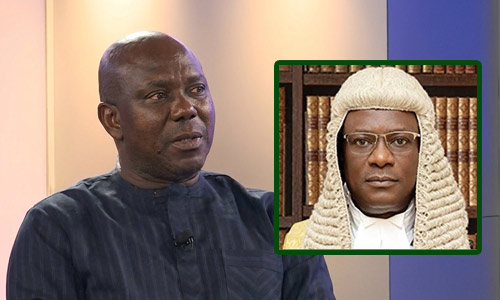
A lawyer and member of the African Democratic Congress (ADC), Kalu Kalu, Esq., has questioned the judgment delivered by Justice Peter O. Lifu of the Federal High Court, alleging that the judge nullified reports submitted by the Independent National Electoral Commission (INEC) supporting the emergence of Senator David Mark as the party’s National Chairman.

Kalu also challenged the court’s treatment of the tenure of the plaintiff, Nafiu Bala Gombe, arguing that the judgment delivered on November 5, 2026, recognised his continued membership of the ADC National Working Committee despite the expiration of his four-year tenure.
Speaking during the November 11, 2026 edition of Channels Television’s Politics Today, hosted by Seun Okinbaloye, Kalu maintained that Justice Lifu’s judgment in Gombe v. ADC & 4 Ors did not invalidate the presidential candidacy of former Vice President Atiku Abubakar or the nominations of other ADC candidates for the 2027 general elections.
However, the interview became contentious when Kalu made remarks about the judge that prompted the presenter to interrupt him and demand their withdrawal, describing the comments as a personal attack on a sitting judicial officer.
During the discussion, Kalu argued that INEC had monitored the entire process through which David Mark and other members of the ADC National Working Committee emerged.
According to him, the electoral commission did not identify any violation of the 1999 Constitution, the Electoral Act or the ADC Constitution during the process.
He maintained that INEC subsequently presented five processes before the court supporting the emergence of Mark and other members of the party’s leadership.
Kalu, however, expressed dissatisfaction with the treatment of those documents in the judgment.
“But what happened? Justice Lifu in his own wisdom nullified all the reports, all the positive reports made by INEC in support of the emergence of David Mark and their NWC members,” he stated.
He contended that INEC was constitutionally responsible for monitoring the activities of political parties and that its reports concerning such activities should carry weight in determining whether party procedures had been properly followed.
Kalu further argued that the former National Chairman of the ADC had communicated the processes leading to Mark’s emergence to INEC.
According to him, the commission monitored the proceedings and did not report any breach of the applicable laws or party constitution.
He also referred to an earlier case before Justice Liman, which he said had upheld the validity of the communication made to INEC regarding Mark’s emergence.
Kalu claimed that Justice Liman had held that the former National Chairman acted properly, that the communication to INEC was valid and that David Mark emerged constitutionally as National Chairman.
He said the court consequently directed INEC to recognise Mark.
Turning to the implications of Justice Lifu’s judgment for Atiku’s presidential ambition, Kalu insisted that no portion of the decision expressly nullified the former Vice President’s nomination.
He thanked the presenter for providing an opportunity to explain his interpretation of the judgment.
According to him, the decision of Justice Lifu “does not in any way void the candidacy of Atiku Abubakar for the presidential election coming up on the 16th day of January 2027.”
“There is no portion of that judgment that voids the candidacy of Atiku Abubakar and other candidates of the party. There is none. And we are placing it on record. Let the whole world go and read the judgment of Honourable Justice Peter Lifu,” Kalu stated.
Explaining his understanding of the ruling, Kalu maintained that the court’s declaration concerned actions taken by David Mark and other party officials from July 29, 2025.
“The best you could get from that judgment,” he said, “is a declarative order made by Honourable Justice Lifu that all actions, steps, activities taken by David Mark and [others] from the 29th day of July 2025 till date are null and void and of no effect whatsoever.”
He argued that some commentators were reading consequences into the judgment which, in his view, were not expressly stated by the court.
According to him, it would be legally incorrect to conclude that the nullification of Mark’s leadership automatically invalidated the nomination of Atiku and other ADC candidates.
“But that is not the law,” Kalu maintained.
In support of his position, he relied on the Supreme Court’s decision in Jegede v. INEC, reported in (2021) 14 NWLR (Pt. 1797) 409.
Kalu explained that the case concerned a challenge to the nomination of a governorship candidate based on the alleged disqualification of a political party official who participated in the nomination process.
He argued that the Supreme Court had established that the wrongful actions of national officers of a political party did not automatically invalidate the lawful nomination of candidates by party members.
“The wrongful act of national officers of a political party does not in any way invalidate the nomination of a candidate of a political party done by the people,” he said.
Kalu insisted that the ADC members who participated in the nomination process were responsible for choosing Atiku and other candidates, rather than the national officers whose actions were affected by the judgment.
When Okinbaloye asked whether Justice Lifu expressly nullified Atiku’s nomination, Kalu responded in the negative.
“None at all. It’s just people on the social media we have in Nigeria just importing what is not expressly stated in that judgment,” he stated.
The presenter subsequently pointed out that Justice Lifu had nullified the leadership headed by David Mark.
Kalu acknowledged that the judgment had made such a declaration.
“Yes, it was,” he responded when the presenter referred to the nullification of the leadership.
However, he maintained that the decision did not necessarily invalidate the candidates nominated by party members.
As the presenter pressed him on whether actions undertaken by the nullified leadership could affect Atiku’s nomination, Kalu made further remarks concerning the judge.
Okinbaloye immediately interrupted the lawyer, objecting to what he considered inappropriate language directed at the judicial officer.
“I would not allow you to use this platform to disparage a sitting judge… calling him personal names and attacking his personality. I’m sorry, I wouldn’t allow you to do that. Please, I will appreciate if you withdraw that statement,” the presenter said.
Kalu appeared to explain that he was referring to what the Court of Appeal had said in an earlier case.
However, Okinbaloye maintained that the television station was subject to professional and legal regulations concerning statements made during its programmes.
“I am regulated by law… I’m just living by the tenets of my profession and my practice… there are some things we are not allowed to be able to say right on this television,” the presenter explained.
He repeatedly requested that Kalu withdraw the remarks.
“Can we withdraw that statement?” Okinbaloye asked.
Kalu eventually complied.
“Because of time I do withdraw it,” the lawyer stated.
He subsequently indicated that any disagreement he had with the judge could be expressed through discussion of the substance of the case.
The interview then returned to the legal implications of the Federal High Court judgment for the ADC’s candidates.
When the presenter suggested that the declaration nullifying the actions of Mark and the National Working Committee could affect the nominations of Atiku and more than 1,400 other ADC candidates, Kalu maintained that the issue had already been resolved by the Supreme Court.
“The judgment says that the wrongful act of the national executive officers of a political party does not invalidate the lawful nomination of a candidate of a political party,” he argued, referring to Jegede v. INEC.
He insisted that the Constitution expressly provides for the qualifications and disqualifications applicable to candidates for elective offices.
According to him, the validity of a candidate’s nomination should not automatically depend on the status of the national party officials involved in forwarding nomination documents.
“What we are saying in this document is that, assuming without conceding that David Mark did not emerge from a validly conducted election that brought him as the national chairman of the party, the judgment of the Supreme Court in the case just referenced says the wrongful act of the national officers of a political party does not in any way void the nomination of a candidate validly nominated by the members of that political party,” Kalu stated.
“In this regard, the members of ADC nominated Atiku Abubakar and other candidates of the party.”
The lawyer also questioned the court’s findings concerning the tenure of Nafiu Bala Gombe.
According to him, the judgment recognised that Gombe was elected into the ADC National Working Committee on October 12, 2022, for a four-year tenure.
Kalu argued that the tenure consequently expired on October 11, 2026, before the court delivered its judgment on November 5, 2026.
He expressed disagreement with what he described as the court’s finding that Gombe’s tenure remained subsisting.
“In natural effect, the tenure of Gombe had long expired on the 11th day of October 2026, and the court now gave the judgment that now affirmed that Nafiu Gombe is still a member of the NWC on the 5th day of November 2026, when by their own depositions, by the findings of the court, it elapsed on the 11th day of October 2026,” he argued.
Kalu maintained that the apparent inconsistency strengthened his objections to the judgment.
“When they are scheming to remove some people from the ballot, God has a way of protecting the people whom he wants to include,” he stated.
The lawyer further disclosed that the ADC had challenged the Federal High Court judgment.
Asked whether an appeal had been filed, he answered in the affirmative.
“Yes, it has been appealed,” he confirmed.
He added that the party had also filed an application seeking a stay of execution.
“We didn’t just file an appeal. We also filed stay of execution of this judgment,” he stated.
However, Kalu did not establish during the interview that the application for a stay of execution had already been granted.
When asked whether any court had issued an order specifically protecting Atiku’s nomination, Kalu maintained that the question was based on an incorrect interpretation of Justice Lifu’s judgment.
“You are getting it wrong. That is a wrong narrative being put out by the media in the country,” he responded.
He challenged those claiming that the judgment disqualified ADC candidates to identify the specific portion containing such a declaration.
“Show me any portion of the judgment that voids the candidate or the other candidates of ADC. There is no such pronouncement. People are only importing,” he stated.
Kalu further argued that the nomination of candidates was a responsibility exercised by party members and not solely by national officers.
“The same judgment says that it is the members of the political party that do the nomination, not the national officers,” he said.
“So the people that elected Atiku Abubakar are members of the party at the ward level.”
Addressing concerns among voters about the possibility of Atiku’s name being excluded from the ballot, Kalu reiterated that the constitutional provisions governing candidates’ qualifications and disqualifications remained applicable.
He maintained that Justice Lifu’s ruling did not fall within those constitutional grounds.
Kalu also suggested that the court had not sufficiently considered the Supreme Court’s decision in Jegede v. INEC.
“This is the law. But they didn’t advert their minds to the decision of the Supreme Court in the case of Jegede,” he stated.
He insisted that his interpretation of the authorities supported the continued validity of Atiku’s nomination and those of other ADC candidates.
The lawyer’s statements represented his interpretation of the Federal High Court judgment and the Supreme Court authority he cited, rather than a fresh judicial determination of the ADC candidates’ eligibility.
Although the television exchange became heated over remarks directed at Justice Lifu, Kalu eventually withdrew the comments following repeated objections from the presenter.
His central position throughout the interview remained that the nullification of David Mark’s leadership did not, in itself, amount to an express order invalidating Atiku’s nomination or those of other ADC candidates.
[A MUST HAVE] Evidence Act Demystified With Recent And Contemporary Cases And Materials

Available now for NGN 40,000 at ASC Publications, 10, Boyle Street, Onikan, Lagos. Beside High Court, TBS. Email publications@ayindesanni.com or WhatsApp +2347056667384. Purchase Link: https://paystack.com/buy/evidence-act-complete-annotation
______________________________________________________________________ “Enhance Legal Practice With Authoritative Reports” — Alexander Payne Offers Comprehensive Law Reports, Spanning Over A Century Of Nigerian Jurisprudence Interested buyers are encouraged to place their orders and enquiries via:
0704 444 4777, 0704 444 4999, 0818 199 9888
Website: www.alexandernigeria.com
“A Comprehensive Guide To Evidence Law” — Releases Second Edition In Three Volumes, Covering 4,051 Cases
For enquiries and orders, contact: 08035526491 Email: jerryamadisilk@gmail.com
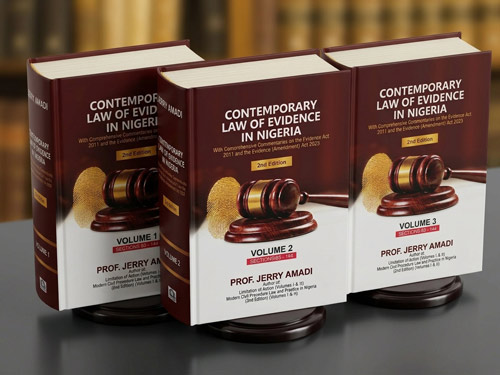 Prof. Jerry Amadi’s Evidence Law, Second Edition (2026), contains 3,314 pages in three volumes, covering the Evidence Act 2011, its 2023 amendment, and 4,051 Nigerian and English cases.