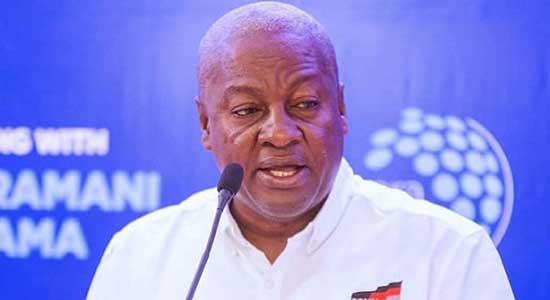
Ghana’s government has accepted a recommendation to extend the country’s presidential term from four to five years as part of a broader constitutional reform programme aimed at restructuring key provisions of the 1992 Constitution.

Attorney-General and Minister for Justice, Dominic Ayine, announced the government’s position, saying the term of Parliament would also be extended to five years to align with the proposed new presidential tenure.
The government said the extension is intended to give administrations more time to govern, arguing that the current four-year cycle leaves little room for full policy implementation because the early months of every government are spent on transition matters, while the final year is largely dominated by elections.
“The early months of every administration are consumed by transition matters, and the final year is largely consumed by elections,” Ayine said.
The proposal is part of recommendations made by a constitutional review committee set up by President John Dramani Mahama to examine Ghana’s 1992 Constitution and propose amendments. The Constitution came into force in January 1993 and established the country’s Fourth Republic.
Unlike some constitutional amendments in parts of Africa that have been used to remove presidential term limits or prolong incumbents’ stay in office, Ghana’s proposal does not alter the existing two-term limit. It would only increase each presidential term from four years to five years.
Mahama is currently serving what the existing Constitution treats as his second and final presidential term, having first led Ghana between 2012 and 2017 before returning to office in January 2025.
The government also accepted in principle the recommendation to lower the minimum age for presidential candidates. While the review committee proposed reducing the age from 40 to 30, the government settled for 35, saying the current threshold excludes qualified citizens based on an arbitrary age restriction.
Another major accepted proposal is the movement of presidential and parliamentary elections from December to the first week of November. The government said this would create a wider gap between elections and the January 7 inauguration date, allowing more time for transition processes and the resolution of electoral disputes.
Under the proposed reforms, presidential election petitions must be filed within 14 days of the declaration of results and determined by the Supreme Court within 30 days.
The five-year term and lower age requirement form only part of a much wider reform package. The government’s position paper responded to more than 147 proposed amendments and about 59 proposed new constitutional provisions.
The constitutional review committee consulted more than 500 experts and practitioners, engaged groups representing more than 21,500 people and received 785 written submissions before making its recommendations.
Among the other major proposals accepted is a plan to cap Ghana’s Parliament at 300 members. The country currently has 276 constituency lawmakers. Under the government’s model, those 276 seats would remain, while 24 additional seats would be filled through proportional representation and allocated among women, young people and persons with disabilities.
The government described the parliamentary cap as a cost-saving measure that would prevent the continued proliferation of constituencies. It also plans to commission a study on how the additional proportional representation seats would be allocated.
The government also accepted a recommendation that Ghanaian citizens by birth should no longer be barred from Parliament simply because they hold another nationality.
Under the proposal, qualifying dual citizens would be allowed to contest parliamentary elections without first renouncing their second citizenship. The government said the current restriction is inconsistent with Ghana’s growing engagement with its diaspora and reduces the pool of qualified candidates available for public office.
Another proposal would create a constitutional right of abode for people of African descent in the diaspora, subject to conditions to be determined by Parliament.
The government linked the measure to Ghana’s Year of Return and Beyond the Return initiatives, which seek to deepen relations with Africans and people of African heritage outside the continent. Parliament would determine the conditions for residence and any pathway to citizenship.
The reform package also addresses economic governance and public accountability. The review committee recommended stronger disclosure rules for public debt, government guarantees, public-private partnerships and liabilities arising from state-owned enterprises.
It also proposed allowing Parliament to establish an independent fiscal council to examine the sustainability of government finances.
However, the government said some of those objectives could be achieved through existing public financial management laws rather than being entrenched in the Constitution.
This approach reflects a broader pattern in the government’s response, with some recommendations accepted as constitutional amendments and others redirected to ordinary legislation to avoid creating rigid or expensive new institutions.
The government also supported proposals to establish a Public Ethics Commission and a body to regulate political parties and campaign financing.
However, it rejected proposals to constitutionally establish some other commissions, saying their responsibilities could be handled by existing institutions or through ordinary legislation.
The government said creating several new constitutional bodies would come with significant staffing, accommodation and operational costs at a time when Ghana must balance institutional reforms with spending on infrastructure, health, education and social protection.
Ghana’s latest reform process is not the country’s first attempt to amend the 1992 Constitution. A commission established in 2010 submitted its report in 2011, followed by a government White Paper in 2012 and the creation of an implementation committee, but the recommendations were not fully implemented.
A later attempt to hold a referendum on local government reforms in 2019 was also cancelled after political consensus collapsed.
The new proposals are therefore not yet law. The government plans to appoint a Constitution Review Implementation Committee to prepare two amendment bills simultaneously: one dealing with non-entrenched provisions and another covering entrenched sections of the Constitution.
Non-entrenched amendments require the support of at least two-thirds of all Members of Parliament, while entrenched provisions must go through a national referendum.
For the referendum to succeed, at least 40 per cent of registered voters must participate, and at least 75 per cent of valid votes cast must support the proposed amendments.
The amendment bills are expected to be ready by October 2026, while the referendum on entrenched provisions is expected to take place in 2027.
The government’s endorsement marks only the beginning of a difficult constitutional process, but the proposed five-year presidential term is expected to test whether Ghana can build the political and public consensus required to implement its most extensive governance reforms in years.
[A MUST HAVE] Evidence Act Demystified With Recent And Contemporary Cases And Materials

Available now for NGN 40,000 at ASC Publications, 10, Boyle Street, Onikan, Lagos. Beside High Court, TBS. Email publications@ayindesanni.com or WhatsApp +2347056667384. Purchase Link: https://paystack.com/buy/evidence-act-complete-annotation
______________________________________________________________________ “Enhance Legal Practice With Authoritative Reports” — Alexander Payne Offers Comprehensive Law Reports, Spanning Over A Century Of Nigerian Jurisprudence Interested buyers are encouraged to place their orders and enquiries via:
0704 444 4777, 0704 444 4999, 0818 199 9888
Website: www.alexandernigeria.com
Interested buyers are encouraged to place their orders and enquiries via:
0704 444 4777, 0704 444 4999, 0818 199 9888
Website: www.alexandernigeria.com