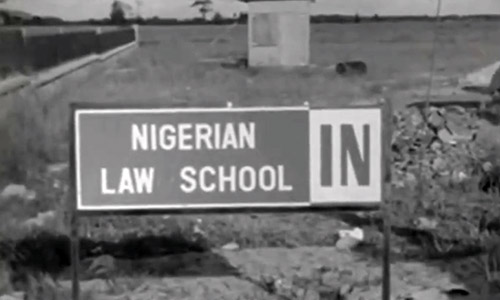
In 1969, Nigeria’s Chief Justice, Sir Adetokunbo Ademola, opened the Nigerian Law School’s permanent campus at Victoria Island, Lagos, marking a further stage in the growth of professional legal education in the country.

Six decades later, the institution he opened has expanded to seven campuses and produces thousands of lawyers a year. Yet the question now dominating discussion of legal education in Nigeria is not how many the school trains, but how many it turns away, and on whose authority.
Before The School
The Nigerian Law School was established under the Legal Education Act of 1962, which also created the Council of Legal Education. Its founding followed a deliberate effort to build a system of professional legal training suited to Nigeria’s own needs.
Until then, Nigerians seeking to qualify as lawyers were trained largely in the United Kingdom, through the English or Irish Bar or as solicitors. Admission to practice at home depended on an education acquired abroad and shaped by another jurisdiction’s concerns.
Eight Pioneer Students On Igbosere Road
In January 1963, the Nigerian Law School admitted its first eight students at temporary premises at 213A Igbosere Road, Lagos.
The pioneer students were S.A. Ajuyah, J.S. Anyanwu, S.O. Chinke, I.A. Idamiebi, O.C. Obi, N.N. Onuoha, I.O. Sonoiki and N.N. Wachukwu. All eight had already been called to the English Bar and were required to take an initial three-month course acquainting them with Nigerian legal practice, including local procedure, customary law and Islamic law. The regular one-year programme commenced in October 1963.
As enrolment grew, the school outgrew Igbosere Road and moved to St. Joseph’s Hall, Broad Street, in 1966. Continued expansion led to the permanent campus at Victoria Island in 1969.
The Campus By The Lagoon
The new campus stood on the northern shore of Victoria Island, facing the lagoon that separates the island from Ikoyi.
The complex was planned around a quadrangle, with the main lecture theatre to the north and administrative offices running along the west and south. The design also provided additional lecture theatres and a moot court.
What The 1969 Ceremony Actually Marked
The opening did not mark the establishment of the Nigerian Law School. The school was already seven years old in law and six years old in practice, with students trained on Igbosere Road and Broad Street before a single lecture was delivered at Victoria Island. What the ceremony marked was the institution’s settlement into a permanent Lagos home.
Lagos To Bwari
The school remained in Lagos until December 1997, when the Federal Government moved it to Bwari, Abuja. In 1999, a multi-campus structure was introduced, with Lagos, Enugu and Kano established as campuses and Abuja serving as headquarters. The Victoria Island premises became the Lagos Campus.
Nigeria now has seven operational campuses: Abuja (Bwari), Lagos, Enugu, Kano, Yola, Yenagoa and Port Harcourt. Additional campuses approved through legislative proposals are yet to become operational.
@thenigerialawyer When Ademola Opened The Law School’s Victoria Island Campus In 1969
The Numbers Now
The 2026 Call to Bar ceremonies, held in Abuja from July 7 to July 10, admitted 6,010 new lawyers, bringing the estimated number of legal practitioners in the country to about 250,000. That followed 5,725 called in July 2025, adding more than 11,000 practitioners within two years.
NBA data puts active registered membership at over 140,000 lawyers, while 82,213 were cleared as eligible voters for the 2026 NBA national election. The Council of Legal Education also confirmed that 1,955 candidates sat the May 2026 Bar Final resit examination.
Where The Gate Now Stands
The route from the classroom to the Bar runs through two doors controlled by the Council of Legal Education: accreditation of the university’s law faculty, and the admission quota attached to it.
In a public notice dated August 14, 2026, the Council released a list of 122 universities approved to admit students for the LL.B programme and warned that institutions running unapproved programmes risk sanctions, while affected students will miss Nigerian Law School admission. It warned that graduates of unaccredited law faculties will not be eligible for admission into the Nigerian Law School, regardless of the qualifications obtained from such institutions.
The Council has continued to expand capacity while tightening enforcement. It approved five universities to begin offering Law from the 2026/2027 session, Amadeus University, Amazi; Akwa Ibom State University; European University of Nigeria, Abuja; Oduduwa University, Ipetu-Modu; and Peaceland University, Enugu, with an initial quota of 50 students each at 100 Level. Existing faculties also received increases: Bowen, Ajayi Crowther and Topfaith from 50 to 100; North-Eastern University from 50 to 75; Elizade from 70 to 120; Chrisland from 50 to 70; and, for 2027/2028, Joseph Ayo Babalola from 50 to 100 and Olabisi Onabanjo from 170 to 220.Maranatha University, Ibeju-Lekki, was refused approval to commence a Law programme after the Council identified what it described as numerous deficiencies during verification.
Atiba University, Oyo State, was placed under a 10-year moratorium after the Council found that it breached regulatory requirements. Moratoriums stopping new LL.B admissions also apply at Baze University, Lead City University and the Nigeria Police Academy.
Those Left Outside
The quota is not an abstraction for the students caught behind it.
The Body of Benchers has attributed the bottleneck to faculties that admit beyond their approved quota, saying that some graduates wait up to three years or more before gaining admission into the Nigerian Law School because there is no space to accommodate them under the quota provision made by the school. It said the Law School, working with the Body of Benchers, had to introduce two streams of admission, with lecturers overstretched and additional financial and logistical costs incurred, while rejecting the suggestion that qualified graduates are deliberately denied admission.
The pattern is not new. TheNigeriaLawyer earlier reported that Baze University, Abuja, exceeded its quota by admitting more than 750 students, a number that would have taken the institution 15 years to reach under its allocation, and was placed under a moratorium for repeated violations. The Chairman of the NBA Lagos Branch, Bisi Makanjuola, argued then that the quota exists so that students can be adequately catered for at Law School, and that periodic checks by JAMB or the Council should confirm that faculties are not exceeding their allocation.
A separate and larger group has been shut out on different grounds. Graduates of the National Open University of Nigeria say more than 4,000 qualified graduates have been denied entry into the mandatory professional training programme since 2020, and their national president, Adefowora Adedeji, has said the non-admission has subjected them to years of uncertainty, financial hardship and emotional distress. The group, which protested at the National Assembly and at the office of the Attorney-General of the Federation in July, argues that the NUC accredited NOUN’s law programme, that earlier sets were admitted through a special arrangement, and that the 2018 amendment to the National Open University Act resolved the earlier legal concerns.In a petition earlier this year, the graduates put their number at over 4,150 and said many had waited an average of more than five years, that some had died waiting, and that the exclusion offends section 42 of the 1999 Constitution.
The Legal Education Act answered a real question in 1962: whether a Nigerian lawyer should be finished in London or in Lagos. That question was settled, and settled well. Eight men on Igbosere Road became a national system with seven campuses.
The question that has replaced it is narrower and harder. The Act made the Council of Legal Education the gatekeeper of professional training, and a gate is only as legitimate as the rule it applies. Three difficulties now sit on that rule.
The first is that the person punished is rarely the person at fault. Where a faculty admits 750 students against a quota of 50, the breach is the university’s, but the consequence falls on the graduate who paid fees, sat examinations and holds a valid LL.B. The Body of Benchers is right that the faculties created the backlog. It does not follow that the students should carry it.
The second is the distance between quota as a quality control and quota as a rationing device. On the Council’s own account, the allocation exists so that the Law School can properly train those it receives. But an intake ceiling set by the capacity of Bwari, Lagos, Enugu, Kano, Yola, Yenagoa and Port Harcourt is a physical constraint, not an academic standard. Where a graduate waits three or five years for space, the profession is not filtering for competence. It is queuing.
The third is the NOUN question, which is now squarely a legal one. If the NUC has accredited the programme, if earlier sets were admitted, and if the 2018 amendment cured the statutory objection, then the continued exclusion of over 4,000 graduates requires a stated legal basis, not an administrative silence. Section 42 arguments of the kind the graduates are making do not improve with age, and a body exercising statutory discretion is obliged to say on what ground it exercises it.
There is also the fabric itself. The 1969 quadrangle, the main lecture theatre and the moot court were designed for an intake measured in dozens. They now serve a system calling more than 6,000 lawyers a year. How much of that original structure survives, in what condition, and whether the plant across all seven campuses matches the numbers pushed through it, is a question that bears directly on the quality of what the school produces, and on how many can be admitted at all.
An institution is remembered by the buildings it opens. It is judged by whether those buildings still do the work for which they were built, and by whether the door is shut for a reason the person outside can be told.
[A MUST HAVE] Evidence Act Demystified With Recent And Contemporary Cases And Materials

Available now for NGN 40,000 at ASC Publications, 10, Boyle Street, Onikan, Lagos. Beside High Court, TBS. Email publications@ayindesanni.com or WhatsApp +2347056667384. Purchase Link: https://paystack.com/buy/evidence-act-complete-annotation
______________________________________________________________________ “Enhance Legal Practice With Authoritative Reports” — Alexander Payne Offers Comprehensive Law Reports, Spanning Over A Century Of Nigerian Jurisprudence Interested buyers are encouraged to place their orders and enquiries via:
0704 444 4777, 0704 444 4999, 0818 199 9888
Website: www.alexandernigeria.com
Interested buyers are encouraged to place their orders and enquiries via:
0704 444 4777, 0704 444 4999, 0818 199 9888
Website: www.alexandernigeria.com