The Federal High Court in Abuja has ruled against popular online loan provider Okash, holding it accountable for bombarding a lawyer with unsolicited automated marketing calls.

The judgment, delivered on December 3, 2025, by Hon. Justice Obiora Egwuatu, declares the company’s actions a “gross and brazen violation” of constitutional privacy rights and imposes hefty penalties.
The case, Ebenezer Amadi v. Blue Ridge Microfinance Bank Ltd (trading as Okash) & 4 Ors (Suit No. FHC/ABJ/CS/1563/2024), was brought by Ebenezer Amadi, a legal practitioner who represented himself in court. Amadi accused Okash of harvesting his phone number without consent and subjecting him to relentless robocalls pre-recorded messages delivered via auto-dialing systems from July 16, 2024, onward. These calls, originating from over 25 different numbers, promoted Okash’s loan services and persisted despite his objections.
“The intrusion was relentless and invasive, turning my phone into a tool of harassment rather than communication,” Amadi stated in court filings. The suit also named regulatory bodies as respondents: the Nigeria Data Protection Commission (NDPC), National Information Technology Development Agency (NITDA), Nigeria Communications Commission (NCC), and Federal Competition and Consumer Protection Commission (FCCPC). While the court focused its ruling on Okash, it dismissed preliminary objections from the defendants, affirming that administrative remedies under the Nigeria Data Protection Act 2023 (NDPA) do not bar direct access to constitutional courts.
In a detailed four-page judgment order, Justice Egwuatu granted Amadi four major reliefs against Okash:
- Declaration of Privacy Breach: The court affirmed that Okash’s automated calls to Amadi’s number (08061194337) without consent violated Section 37 of the 1999 Constitution (as amended), which guarantees the right to privacy and family life.
- Perpetual Injunction: Okash, its officers, agents, assigns, and representatives are permanently barred from further calling or texting Amadi for marketing purposes using any phone numbers.
- Damages Award: Okash must pay ₦500,000 (Five Hundred Thousand Naira) in compensation and general damages for the infringement.
- Mandatory Apology: Within 14 days of the judgment, Okash is ordered to issue an unreserved formal apology letter to Amadi for the “unlawful infringement” of his privacy rights.
Other reliefs sought by Amadi were refused. The judgment was issued under the court’s seal on December 3, 2025, and signed by Registrar Michael Akpiri.
Counsel for Okash, D.Y. Ali Esq., and representatives for the other respondents including Macdonald Kurere Esq. for NDPC and Sunusi Musa SAN for NITDA had urged dismissal, citing counter-affidavits filed between December 2024 and March 2025. However, the court sided unequivocally with Amadi after hearing arguments on October 22, 2024.
This ruling extends beyond Amadi’s personal grievance, marking a pivotal moment for consumer protection in Nigeria’s booming fintech sector. Justice Egwuatu’s decision underlines that digital tools like auto-dialers cannot override fundamental rights, explicitly referencing the NDPA. In rejecting Okash’s bid to channel the dispute through administrative processes, the court invoked Section 46(1) of the Constitution, emphasizing unimpeded access to justice.
“This is a clarion call to all digital service providers: unsolicited automated marketing is not just annoying it’s unconstitutional,” said a legal expert familiar with the case, speaking on condition of anonymity. “It reinforces that personal data, including phone numbers, is shielded by both the Constitution and the NDPA, and victims can seek swift court intervention.”
CTC judgment Ebenezer vs okashThe judgment arrives amid rising complaints about aggressive loan app tactics in Nigeria, where platforms like Okash have faced scrutiny for data misuse.
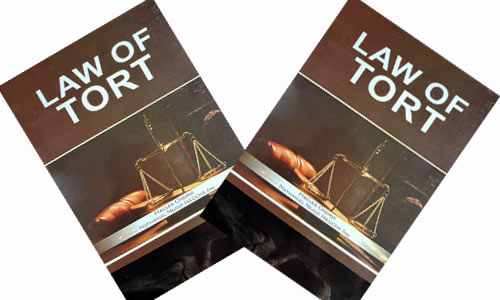 The book, titled The Law of Torts in Nigeria: A Functional Approach, authored by Professor Hagler Sunny Okorie Ph.D and Ikeocha, Nathaniel Ngozi Esq, offers law students, practitioners, and academics a comprehensive guide to understanding and applying tort law in Nigerian courts. Interested buyers can place orders via the following contact numbers: 08028636615, 08037667945, 08032253813, or +234 902 196 2209.
_______________________________________________________________________
The book, titled The Law of Torts in Nigeria: A Functional Approach, authored by Professor Hagler Sunny Okorie Ph.D and Ikeocha, Nathaniel Ngozi Esq, offers law students, practitioners, and academics a comprehensive guide to understanding and applying tort law in Nigerian courts. Interested buyers can place orders via the following contact numbers: 08028636615, 08037667945, 08032253813, or +234 902 196 2209.
_______________________________________________________________________
 ARTIFICIAL INTELLIGENCE FOR LAWYERS: A COMPREHENSIVE GUIDE
Reimagine your practice with the power of AI “...this is the only Nigerian book I know of on the topic.” — Ohio Books Ltd
Authored by Ben Ijeoma Adigwe, Esq., ACIArb (UK), LL.M, Dip. in Artificial Intelligence, Director, Delta State Ministry of Justice, Asaba, Nigeria.
Bonus:
Get a FREE eBook titled “How to Use the AI in Legalpedia and Law Pavilion” with every purchase.
ARTIFICIAL INTELLIGENCE FOR LAWYERS: A COMPREHENSIVE GUIDE
Reimagine your practice with the power of AI “...this is the only Nigerian book I know of on the topic.” — Ohio Books Ltd
Authored by Ben Ijeoma Adigwe, Esq., ACIArb (UK), LL.M, Dip. in Artificial Intelligence, Director, Delta State Ministry of Justice, Asaba, Nigeria.
Bonus:
Get a FREE eBook titled “How to Use the AI in Legalpedia and Law Pavilion” with every purchase.
How to Order: 📞 Call, Text, or WhatsApp: 08034917063 | 07055285878 📧 Email: benadigwe1@gmail.com 🌐 Website: www.benadigwe.com
Ebook Version: Access directly online at: https://selar.com/prv626
________________________________________________________________________ The Law And Practice Of Redundancy In Nigeria: A Practitioner’s Guide, Authored By A Labour & Employment Law Expert Bimbo Atilola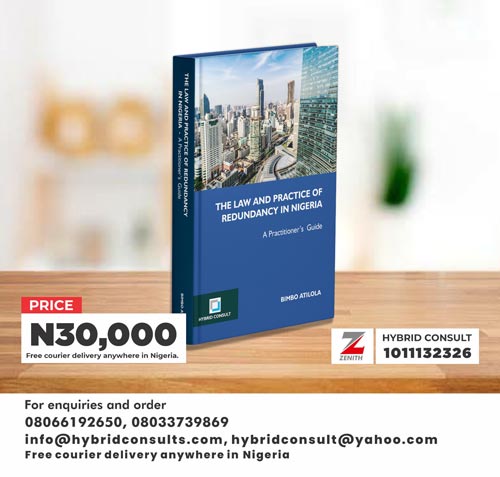 _______________________________________________________________________
[A MUST HAVE] Evidence Act Demystified With Recent And Contemporary Cases And Materials
_______________________________________________________________________
[A MUST HAVE] Evidence Act Demystified With Recent And Contemporary Cases And Materials