FIFA has abandoned its controversial proposal to transfer the commercial rights of the World Cup and other competitions into a new entity partly owned by private investors following widespread opposition from football stakeholders and threats of a boycott by major continental confederations.

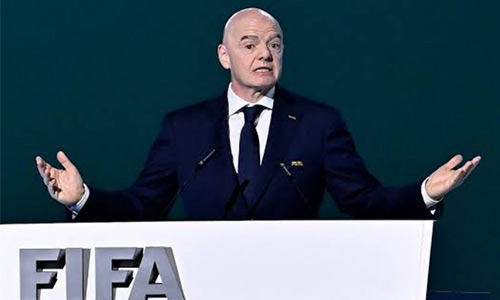
FIFA President Gianni Infantino confirmed that the proposal, known as the FIFA Forward Enterprise project, would no longer proceed after consultations revealed deep divisions within the global football community.
The proposed arrangement would have involved FIFA selling an estimated 20 per cent stake in a new commercial arm valued at about $20 billion, potentially raising as much as $4.2 billion from outside investors.
The new entity was expected to control some of FIFA’s most valuable revenue-generating assets, including television rights, sponsorship agreements, licensing and ticketing for the World Cup and other competitions.
New York-based Thrive Capital, founded by venture capitalist Joshua Kushner, was reportedly expected to serve as a major investor in the transaction, while JPMorgan was said to be advising on the proposed deal.
Kushner is the brother of Jared Kushner, United States President Donald Trump’s son-in-law and diplomatic adviser.
Announcing the withdrawal of the proposal, Infantino said the project had originally been conceived to provide additional financial support to FIFA’s 211 member associations, particularly countries where football development funding was most urgently needed.
“The FIFA Forward Enterprise project was intended to provide a basis for further strengthening our FIFA Member Associations and our sport worldwide, especially in those countries where support is most needed,” he said.
Infantino explained that the plan was always subject to consultations with FIFA member associations, the FIFA Council, continental confederations and other relevant stakeholders.
“Having listened carefully to all the views, it has become clear that the project has created divisions of a nature that, regardless of the level of support, are no longer in the interest of the objective set out in the first place,” he stated.
“Our purpose has always been—and will always be—to unite and improve. As a result, this proposal will not proceed.”
The FIFA president said the organisation would continue engaging stakeholders in the coming weeks to identify alternative ways of growing football and increasing financial assistance to countries requiring greater support.
The withdrawal followed fierce opposition from the Union of European Football Associations, which reportedly warned that its member associations could boycott the World Cup and other FIFA competitions if private investors were permitted to acquire an interest in the commercial rights of global football tournaments.
The Asian Football Confederation and the Confederation of North, Central America and Caribbean Association Football also opposed the proposal, significantly weakening its prospects of approval.
European football officials were particularly concerned that allowing private investors to hold a stake in FIFA’s competitions could alter the governance, ownership and future direction of world football.
The opposition carried substantial commercial implications because clubs, national teams and leagues from England, Spain, France, Germany and Italy generate a significant proportion of international football’s television, sponsorship and audience revenue.
Without the participation of leading European nations and players, the commercial value of the World Cup and other FIFA competitions could fall sharply, potentially discouraging broadcasters, sponsors and investors.
Infantino had reportedly given FIFA’s 211 member associations until September 19 to indicate support for the proposal, with each association potentially receiving payments reportedly reaching $40 million.
Critics described the proposed payments as an attempt to secure support for the transaction, while FIFA maintained that the money would have strengthened national football associations and expanded development programmes.
Before the proposal was formally withdrawn, FIFA publicly insisted that “nobody is selling football” and said the initiative was merely intended to introduce a more efficient commercial structure capable of generating additional resources for member associations.
However, the controversy spread beyond FIFA’s external stakeholders and reportedly caused divisions among the organisation’s senior executives.
FIFA Chief Operating Officer Kevin Lamour said senior officials felt deceived by what he described as a lack of transparency surrounding the development of the proposal.
“The project that has sparked so much controversy and debate is not a FIFA project. It is the project of one person,” Lamour said.
He criticised what he called a “lie by omission over many months” and accused FIFA’s leadership of demonstrating a lack of trust, transparency, discernment, good governance and respect.
Lamour acknowledged that his public criticism could result in his dismissal but said he was prepared to accept the consequences.
“Then so be it. At least I’ll sleep well tonight,” he said.
Carlos Cordeiro, a senior adviser to Infantino and former Goldman Sachs partner, also resigned over the proposal.
“I cannot stand by while FIFA considers selling a stake in the World Cup,” Cordeiro said in announcing his resignation.
The controversy has also reportedly intensified questions over Infantino’s political future ahead of FIFA’s next presidential election.
Some member associations are said to be reconsidering their support for him, while European officials have reportedly begun discussing the possibility of backing an alternative candidate.
Paris Saint-Germain president Nasser Al-Khelaifi has been mentioned as a possible challenger, although no formal candidacy has been announced.
Former Nigeria Football Federation President Amaju Pinnick was among those who publicly supported the proposal before it was withdrawn.
Pinnick, who serves as Deputy Chairperson of FIFA’s Men’s National Teams Competitions Committee, urged critics to assess the proposal on its merits rather than reject it without proper consideration.
He argued that Infantino had previously introduced reforms that benefited FIFA’s member associations and said the proposed commercial structure could substantially increase financial support for national football bodies.
According to Pinnick, each member association could potentially have received up to $20 million in additional funding alongside existing allocations under the FIFA Forward Programme.
Despite that support, the mounting resistance from UEFA, the AFC, Concacaf, national associations, senior FIFA officials and other football stakeholders ultimately forced the governing body to abandon the initiative.
With private investment now off the table, FIFA is expected to continue managing and selling its broadcasting, sponsorship, licensing and ticketing rights through its existing structure.
The governing body is also expected to rely heavily on revenue generated from the expanded 48-team World Cup hosted by the United States, Canada and Mexico.
The collapse of the proposal sends a strong signal to private equity and investment firms seeking greater access to global football that political and institutional resistance to private ownership of major competitions remains significant.
It also leaves FIFA facing renewed pressure to improve transparency, internal consultation and governance when considering major structural changes affecting the commercial future of the sport.
[A MUST HAVE] Evidence Act Demystified With Recent And Contemporary Cases And Materials

Available now for NGN 40,000 at ASC Publications, 10, Boyle Street, Onikan, Lagos. Beside High Court, TBS. Email publications@ayindesanni.com or WhatsApp +2347056667384. Purchase Link: https://paystack.com/buy/evidence-act-complete-annotation
______________________________________________________________________ “Enhance Legal Practice With Authoritative Reports” — Alexander Payne Offers Comprehensive Law Reports, Spanning Over A Century Of Nigerian Jurisprudence Interested buyers are encouraged to place their orders and enquiries via:
0704 444 4777, 0704 444 4999, 0818 199 9888
Website: www.alexandernigeria.com
Interested buyers are encouraged to place their orders and enquiries via:
0704 444 4777, 0704 444 4999, 0818 199 9888
Website: www.alexandernigeria.com