*As Ministry Of Works Accounts For Largest Share With N5.39bn Allocation

The Federal Government has proposed to spend N6.12bn on judgement debts and related liabilities across three ministries in the proposed 2026 budget, a review of the appropriation bill shows.
An analysis of the figures indicates that the total allocation for judgement debts in 2026 stands at N6.12bn, compared with N6.05bn provided in the proposed 2025 budget.
This reflects an increase of about N75.06m year on year, suggesting that overall obligations from court judgements and outstanding liabilities have not reduced despite lower provisions for some ministries.
The Federal Ministry of Works accounts for the largest share of the proposed 2026 allocation. The ministry is to receive a combined N5.39bn for judgement debts, comprising N1.4bn listed broadly as judgment debt and an additional N3.99bn specifically tied to a legal case identified as Suit No. LD/7036GCM/2023.
In the 2025 budget, the Ministry of Works was allocated N5bn for judgement debts, meaning its provision rises by about N390m in 2026, largely due to the inclusion of the specific court case.
The Federal Ministry of Education headquarters is proposed to receive N700m in 2026 for outstanding capital liabilities and judgement debts. This represents a reduction from the N1bn allocated to the ministry for the same purpose in the 2025 budget, indicating a lower provision for unresolved claims linked to education projects.
The Federal Ministry of Health and Social Welfare headquarters has the smallest allocation among the three ministries. The ministry is expected to receive N34.86m for judgement debts in 2026, down from N49.8m in the previous year. The decline reflects a lower budgetary provision for court-related liabilities compared with 2025.
Despite reductions in allocations to the education and health ministries, the overall increase in the 2026 figure is driven by higher provisions under the Ministry of Works. The data show that judgement debts remain concentrated in infrastructure-related ministries, where contractual disputes and compensation claims are more prevalent.
In October 2025, the Minister of Works, Dave Umahi, disclosed that the Federal Government’s concession plan on the Lagos–Ibadan Expressway has been stalled by a court case.
Speaking with journalists after inspecting the Sagamu–Ijebu Ode–Benin Expressway and Section Two of the Lagos–Ibadan Expressway, which runs from Sagamu Interchange to Ojoo in Ibadan, the minister said the legal dispute had delayed the planned concession to private operators for maintenance.
“The Federal Government has always been willing to ensure CCTV is installed on the road. It is our plan to concession the Lagos–Ibadan road, but someone took us to court,” Umahi said.
“We want the private sector to take up some of these completed projects, operate and maintain them, but the matter is still in court. Somebody said he was going to build this road, operate and transfer it, but we never knew what happened under the past administration, so it didn’t work, and he went to court.
“We are, however, telling the court that once an order is made, it is the citizens who will suffer. So we are saying that the court should not make any order that will impact negatively on the welfare of the people.”
The controversy dates back to 2009, when the Federal Government awarded a 25-year concession to Bi-Courtney Highway Services Limited to reconstruct, expand, and manage the highway under a public-private partnership model.
Although the deal—ratified in 2011—allowed Bi-Courtney to recover its investment through tolling, it was terminated in 2012 for alleged non-performance. The firm challenged the termination in court, accusing the government of breaching due process by awarding a new concession to Motorway Assets Limited without following laid-down procedures.
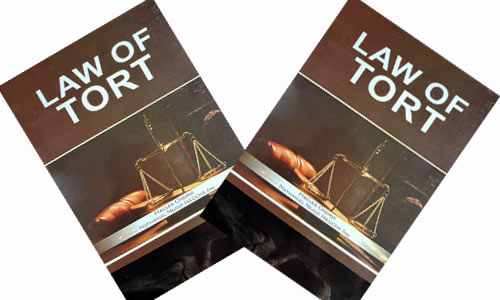 The book, titled The Law of Torts in Nigeria: A Functional Approach, authored by Professor Hagler Sunny Okorie Ph.D and Ikeocha, Nathaniel Ngozi Esq, offers law students, practitioners, and academics a comprehensive guide to understanding and applying tort law in Nigerian courts. Interested buyers can place orders via the following contact numbers: 08028636615, 08037667945, 08032253813, or +234 902 196 2209.
______________________________________________________________________
[A MUST HAVE] Evidence Act Demystified With Recent And Contemporary Cases And Materials
The book, titled The Law of Torts in Nigeria: A Functional Approach, authored by Professor Hagler Sunny Okorie Ph.D and Ikeocha, Nathaniel Ngozi Esq, offers law students, practitioners, and academics a comprehensive guide to understanding and applying tort law in Nigerian courts. Interested buyers can place orders via the following contact numbers: 08028636615, 08037667945, 08032253813, or +234 902 196 2209.
______________________________________________________________________
[A MUST HAVE] Evidence Act Demystified With Recent And Contemporary Cases And Materials

 ARTIFICIAL INTELLIGENCE FOR LAWYERS: A COMPREHENSIVE GUIDE
Reimagine your practice with the power of AI “...this is the only Nigerian book I know of on the topic.” — Ohio Books Ltd
Authored by Ben Ijeoma Adigwe, Esq., ACIArb (UK), LL.M, Dip. in Artificial Intelligence, Director, Delta State Ministry of Justice, Asaba, Nigeria.
Bonus:
Get a FREE eBook titled “How to Use the AI in Legalpedia and Law Pavilion” with every purchase.
ARTIFICIAL INTELLIGENCE FOR LAWYERS: A COMPREHENSIVE GUIDE
Reimagine your practice with the power of AI “...this is the only Nigerian book I know of on the topic.” — Ohio Books Ltd
Authored by Ben Ijeoma Adigwe, Esq., ACIArb (UK), LL.M, Dip. in Artificial Intelligence, Director, Delta State Ministry of Justice, Asaba, Nigeria.
Bonus:
Get a FREE eBook titled “How to Use the AI in Legalpedia and Law Pavilion” with every purchase.
How to Order: 📞 Call, Text, or WhatsApp: 08034917063 | 07055285878 📧 Email: benadigwe1@gmail.com 🌐 Website: www.benadigwe.com
Ebook Version: Access directly online at: https://selar.com/prv626
________________________________________________________________________ “Enhance Legal Practice With Authoritative Reports” — Alexander Payne Offers Comprehensive Law Reports, Spanning Over A Century Of Nigerian Jurisprudence Interested buyers are encouraged to place their orders and enquiries via:
0704 444 4777, 0704 444 4999, 0818 199 9888
Website: www.alexandernigeria.com
Interested buyers are encouraged to place their orders and enquiries via:
0704 444 4777, 0704 444 4999, 0818 199 9888
Website: www.alexandernigeria.com