*Details “Historic” Rescue Of US Airmen

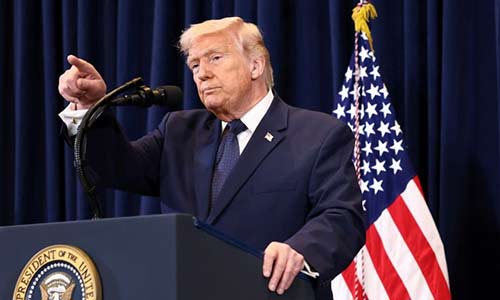
US President Donald Trump warned Monday that all of Iran could be “taken out” Tuesday at the expiry of a deadline he issued for the Islamic republic to reopen the key Strait of Hormuz waterway.
“The entire country could be taken out in one night, and that night might be tomorrow night,” Trump told a news conference at the White House on Monday.
The president detailed the “historic” rescue of two US airmen shot down over Iran and repeated threats to destroy Iran’s bridges, power plants, and civilian infrastructure by midnight tomorrow.
In his comments to reporters, Trump repeated his threat to destroy Iran’s infrastructure, saying he would bomb the country back into “the stone ages.”
“We have a plan, because of the power of our military, where every bridge in Iran will be decimated by 12 o’clock tomorrow night, where every power plant in Iran will be out of business — burning, exploding, and never to be used again,” he said.
“I mean complete demolition by 12 o’clock, and it will happen over a period of four hours.”
“Do I want to destroy their infrastructure? No,” Trump added. “It will take them 100 years to rebuild right now, if we left today, it would take them 20 years to rebuild their country, and it would never be as good as it was. And the only way they’re going to be able to rebuild their country is to utilize the genius of the United States of America.”
Trump said that he extended the deadline to tomorrow rather than have it expire today because he “thought it was inappropriate the day after Easter.”
“They have till tomorrow,” Trump said. “Now we’ll see what happens. I can tell you, they’re negotiating, we think in good faith, we’re going to find out. We’re getting the help of some incredible countries that want this to be ended, because it affects them also.”
Asked whether he was winding down the war with Iran or escalating it, Trump declined to say.
“I can’t tell you,” he said. “I can’t tell you. I don’t know.”
“It depends what they do,” he added.
Trump provided intricate details of the rescue over the weekend of the second airman in Iran.
“This is a rescue that’s very historic,” he said.
Trump explained that the airman, a colonel, had landed in Iran a “significant distance away from the pilot” who had been rescued on Friday.
“He was injured quite badly and stranded in an area teeming with terrorists from the Islamic Revolutionary Guard Corps — rough group — as well as besieged military, militia and local authorities,” Trump said.
Trump described how the injured airman evaded capture for nearly 48 hours.
“Despite the peril, the officer followed his training and climbed into the treacherous mountain terrain and started climbing toward a higher altitude, something they were trained to do in order to evade capture,” he said.
Trump said the airman scaled cliffs and was “bleeding rather profusely,” treating his own wounds. The airman “contacted American forces to transmit his location” using what Trump described as a “very sophisticated beeper-type apparatus” that “saved his life.”
“We immediately mobilized a massive operation to retrieve him from the mountain hold-out,” Trump said.
The rescue operation involved 155 aircraft, including four bombers, 64 fighters, 48 refueling tankers, and 13 rescue aircraft.
“The heroic F-15 weapons system officer had evaded capture on the ground in Iran for almost 48 hours,” he said.
“In a breathtaking show of skill and precision, lethality and force, America’s military descended on the area,” Trump said, adding that the US “engaged the enemy” and “rescued the stranded officer, destroyed all threats and exited Iranian territory while taking no casualties of any kind.”
Trump revealed complications during the extraction.
“Then we also had a problem leaving Iran because of the ‘wet sand’ and the ‘weight of the plane,'” he said.
“Then we also had all the men jumping back onto the planes, and they got pretty well bogged down. And we had a continued contingency plan which was unbelievable.”
Trump said that “lighter, faster aircraft” flew in to take the Americans out of Iran with the airman. The US destroyed the aircraft that were stuck in the sand.
Gen. Dan Caine, the chairman of the Joint Chiefs of Staff, described significant enemy fire during the first rescue operation.
Caine said that the search and rescue task force came “under fire” en route to rescuing the pilot of the plane that was shot down in Iran. He said that remotely piloted aircraft, drones, and other tactical aircraft “were violently suppressing and engaging the enemy in a close in gun fight to keep them away from the front-seater and allow the pick-up force to get into the objective area.”
Caine explained that one of the pilots in the rescue operation “was hit by enemy fire.”
“This pilot continued to fight, continued the mission, and then upon exit, flew his aircraft into another country and determined that the airplane was not landable,” Caine said. “This was one of our A-10 Sandy aircraft. The pilot then made the decision to eject over friendly territory, and was quickly and safely recovered and is doing fine.”
He added, “The trailing aircraft took several hits. The crew sustained minor injury, and they are going to be fine.”
CIA Director John Ratcliffe said that the CIA deployed “both human assets and exquisite technologies” to find the second US service member in what he likened to “hunting for a single grain of sand in the middle of a desert.”
Ratcliffe confirmed that the CIA embarked on a deception campaign to confuse Iranians who were looking for the service member.
“This was a no fail mission,” he said. “That was the spirit in which the president put us to work, and we were determined not to let him down, or our airman down.”
Defense Secretary Pete Hegseth laid out details about the timing of the two rescue missions.
The first mission was an “audacious daylight, thunder run right up the middle,” Hegseth said, adding that the mission was authorized less than two hours after the military determined where the first service member was located.
Hegseth said a coordination call was held open for nearly 46 hours between the F-15 fighter jet crashing and the second service member being rescued.
“From the moment our pilots went down, our mission was unblinking,” he said. “The call never dropped. The meeting never stopped. The planning never ceased.”
Trump said that someone leaked information about the rescue of the first service member before the second one had been brought to safety, adding, “we’re looking very hard to find that leaker.”
Trump said Iran did not know that a second service member was missing until the leaker shared information.
“All of a sudden, they know that there’s somebody out there,” he said of the Iranians. “They see all these planes coming in. It became a much more difficult operation because a leaker leaked that we have one, we’ve rescued one, but there’s another one out there that we’re trying to get.”
“So actually, the country Iran put out a major notice — you all saw it — offering a very big award for anybody that captures the pilot,” Trump said.
He threatened: “Give it up or go to jail.”
Asked about his comments that he would like to take Iran’s oil but Americans want troops to come home, Trump repeated the point.
“If I had my choice, yeah, because I’m a businessman first,” he said.
He referred to the “old days” when the spoils of war would go to the “winner.”
“To the winner belong the spoils, go the spoils,” he said.
“And I’ve said, ‘Why don’t we use it?’ To the victor, go the spoils, and we don’t have that — we haven’t had that in this country probably in 100 years.”
A reporter asked Trump whether threatening to hit Iran’s infrastructure and cut off their power would punish the people for the actions of the regime.
“They would be willing to suffer that for their freedom,” Trump said.
The president said Iranians want the US strikes to continue and that Iranians “want freedom.”
“They have lived in a world that you know nothing about,” he added. “It’s a violent, horrible world, where if you protest, you are shot.”
Trump said that former President Barack Obama “chose Iran over Israel” in that administration’s nuclear agreement with Tehran and questioned how Jews in the US can vote for Democrats because of how he has prioritized Israel.
“If you’re Jewish in New York City or anyplace else in this country, how you can vote for a Democrat is unbelievable,” he said.
Trump said that some “military people, very professional, preferred not doing it,” referring to embarking on the rescue operation.
“There were military people that said, ‘You just don’t do this,'” he said.
He said that hundreds of people were involved in the mission, adding, “hundreds of people could have been killed.”
“So we had people that were within the military that said, ‘This is not a wise’ — and I understood that, but I decided to do it,” he said.
The price of US crude oil jumped from $112 to about $114 per barrel just since Trump began his news conference. The price of international Brent crude also rose, although less so.
The Dow, Nasdaq, and S&P 500 stock indexes also gave up their gains and turned lower for the day.
President Trump’s ultimatum to Iran — with a deadline of midnight Tuesday — represents one of the most significant escalations in US-Iran tensions in decades.
The threat to destroy “every bridge” and “every power plant” within four hours would constitute one of the most devastating military campaigns in modern history if carried out.
The detailed account of the rescue operations demonstrates both the capabilities of the US military and the significant risks involved in such missions.
For global markets, the immediate spike in oil prices reflects the uncertainty created by the standoff. The Strait of Hormuz is one of the world’s most critical oil shipping routes, and any disruption would have far-reaching economic consequences.
The coming hours will determine whether diplomatic negotiations can avert what Trump has described as the potential “complete demolition” of Iranian infrastructure — or whether his threats will be carried out.
 Interested buyers are encouraged to place their orders and enquiries via:
0704 444 4777, 0704 444 4999, 0818 199 9888
Website: www.alexandernigeria.com
Interested buyers are encouraged to place their orders and enquiries via:
0704 444 4777, 0704 444 4999, 0818 199 9888
Website: www.alexandernigeria.com
 Reimagine your practice with the power of AI “...this is the only Nigerian book I know of on the topic.” — Ohio Books Ltd
Authored by Ben Ijeoma Adigwe, Esq., ACIArb (UK), LL.M, Dip. in Artificial Intelligence, Director, Delta State Ministry of Justice, Asaba, Nigeria.
Bonus:
Get a FREE eBook titled “How to Use the AI in Legalpedia and Law Pavilion” with every purchase.
Reimagine your practice with the power of AI “...this is the only Nigerian book I know of on the topic.” — Ohio Books Ltd
Authored by Ben Ijeoma Adigwe, Esq., ACIArb (UK), LL.M, Dip. in Artificial Intelligence, Director, Delta State Ministry of Justice, Asaba, Nigeria.
Bonus:
Get a FREE eBook titled “How to Use the AI in Legalpedia and Law Pavilion” with every purchase.
How to Order: 📞 Call, Text, or WhatsApp: 08034917063 | 07055285878 📧 Email: benadigwe1@gmail.com 🌐 Website: www.benadigwe.com
Ebook Version: Access directly online at: https://selar.com/prv626
_______________________________________________________________________ [A MUST HAVE] Evidence Act Demystified With Recent And Contemporary Cases And Materials
 ______________________________________________________________________
“Bridging Theory And Courtroom Practice” — Hagler Sunny Okorie, Nathaniel Ngozi Ikeocha Unveil ‘Functional’ Tort Law Book For Nigerian Legal System
______________________________________________________________________
“Bridging Theory And Courtroom Practice” — Hagler Sunny Okorie, Nathaniel Ngozi Ikeocha Unveil ‘Functional’ Tort Law Book For Nigerian Legal System
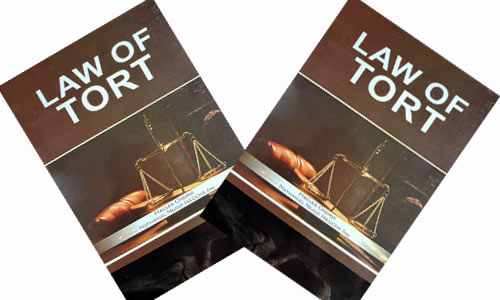 The book, titled The Law of Torts in Nigeria: A Functional Approach, authored by Professor Hagler Sunny Okorie Ph.D and Ikeocha, Nathaniel Ngozi Esq, offers law students, practitioners, and academics a comprehensive guide to understanding and applying tort law in Nigerian courts. Interested buyers can place orders via the following contact numbers: 08028636615, 08037667945, 08032253813, or +234 902 196 2209.