
*Tells Appeal Court Lifu Ignored 25 Days’ Notice to INEC, Misapplied Electoral Act and Ignored Earlier Liman Judgment
*Faults Justice Lifu’s Signature Comparison, Challenges Forgery Finding On Nafiu Bala Gombe’s Resignation Letter

The African Democratic Congress (ADC) has approached the Court of Appeal in Abuja, seeking to overturn the November 5, 2026 judgment of the Federal High Court, which recognised Hon. Nafiu Bala Gombe in the party’s leadership dispute and invalidated the emergence of Senator David Mark and Ogbeni Rauf Aregbesola as national officers of the party.
The ADC is also asking the appellate court to declare the entire proceedings before Justice Peter O. Lifu null, void and of no effect, insisting that the Federal High Court lacked jurisdiction to determine what it described as an internal political party leadership dispute.
In its Notice of Appeal dated November 16, 2026, marked CA/ABJ/CS/1254/2026 and arising from suit number FHC/ABJ/CS/1819/2025, the party challenged the entire judgment, including the dismissal of its preliminary objections to the trial court’s jurisdiction.
The judgment had granted Gombe eight reliefs contained in his amended originating summons filed on May 11, 2026, including declarations concerning the leadership of the ADC, the validity of resolutions passed at its 99th National Executive Committee (NEC) meeting and the recognition of the affected officers by the Independent National Electoral Commission (INEC).
The respondents in the appeal are Hon. Nafiu Bala Gombe, Senator David Mark, Ogbeni Rauf Aregbesola, INEC and Chief Ralph Nwosu.
Mark and Aregbesola were described in the amended proceedings as having been sued in their personal capacities and on behalf of persons who purportedly became members of the National Working Committee (NWC) at the party’s 99th NEC meeting in July 2025.
The appeal was filed by Chief J. S. Okutepa, SAN, alongside Shaibu Enejoh Aruwa, SAN, and other lawyers from J. S. Okutepa SAN & Co., Eleojo Court, Apo, Abuja.
In the 17 grounds of appeal, the ADC alleged that Justice Lifu wrongly assumed jurisdiction over the dispute, improperly resolved contested factual issues, failed to evaluate material evidence and granted declarations and injunctions that allegedly exceeded the controversy before the court.
The party’s first complaint concerns the amendment of Gombe’s originating summons and the capacity in which Mark and Aregbesola were sued.
According to the ADC, the original originating summons filed on September 2, 2025, sued both individuals in their personal capacities. However, the amended process introduced a representative capacity by describing them as being sued “for themselves and on behalf of persons who purportedly became members of the National Working Committee.”
The party argued that the alteration was made without a specific application and order of court authorising the change in the capacity of the parties.
It relied on In Re: Apeh v. PDP (2017) 11 NWLR (Pt. 1576) 252 and Ajose-Adeogun v. Olojede (2024) 13 NWLR (Pt. 1956) 537 to support its argument that parties cannot unilaterally alter the constitution of a case.
The ADC further contended that the trial judge failed to examine the effect of Section 83(5) of the Electoral Act 2026 on the amended originating summons.
It argued that the court ought to have compared the original and amended processes in light of the applicable repeal and saving provisions and Section 6 of the Interpretation Act, particularly to determine whether the amendments sought to bring an internal leadership dispute within the court’s jurisdiction.
On its second ground, the party maintained that the subject matter of the suit was an intra-party dispute arising from its 99th NEC meeting held on July 29, 2025, during which the existing NWC was dissolved and another leadership structure constituted.
According to the appellant, the controversy did not arise from an independent breach of a specific statutory duty owed by INEC to Gombe.
It argued that reliance on Sections 223(1)(a) and 228(a) and (b) of the 1999 Constitution, Section 82 of the Electoral Act 2022 and the Regulations and Guidelines for Political Parties 2022 could not convert a dispute over internal party leadership into a statutory cause of action.
The party maintained that joining INEC as a defendant and alleging a failure to monitor party activities did not change the essential character of the dispute.
It cited Aguma v. APC (2021) 14 NWLR (Pt. 1796) 351, Anyanwu v. Emmanuel & Ors (2025) LPELR-80882(SC) and Oni v. Oyebanji (2023) 13 NWLR (Pt. 1902) 507.
In its third ground, the ADC raised the doctrine of res judicata, arguing that substantially the same issues had already been determined in an earlier Federal High Court action.
It identified the earlier proceedings as suit number FHC/ABJ/CS/1637/2025, Hon. Leke Joseph Abejide v. ADC & 4 Ors, decided by Justice M. S. Liman in July 2026.
According to the party, the earlier suit concerned the validity of the July 29, 2025 NEC meeting and was dismissed for want of merit and jurisdiction.
The ADC maintained that Abejide was an NEC member and that the parties involved in the earlier proceedings were substantially the same, except for Gombe.
It argued that Justice Lifu, being a judge of coordinate jurisdiction with Justice Liman, could not sit on appeal over or disregard the earlier decision.
The party stated that the earlier judgment was brought to Justice Lifu’s attention through a motion filed on October 2, 2026, but alleged that he failed to consider its legal implications.
On the fourth ground, the ADC challenged Gombe’s locus standi to institute the action.
The party maintained that Gombe had resigned as Deputy National Chairman and from membership of the ADC through a letter dated May 17, 2025, which took effect on May 26, 2025.
It argued that the alleged resignation preceded the disputed NEC meeting by more than two months.
The ADC relied on Exhibit ADC1, described as a certified true copy of the resignation letter, and Exhibit ADC2, described as a certified true copy of INEC’s notification of the resignation.
It also maintained that Gombe’s former office had been dissolved by an NEC resolution.
According to the party, Gombe failed to establish a subsisting legal interest in the leadership dispute and did not prove that his previous position as Deputy National Chairman conferred a superior right to assume the party’s national chairmanship.
It further argued that the Electoral Act 2022 did not automatically confer standing on him merely because of his previous membership or office.
The fifth ground challenges Justice Lifu’s finding that the resignation letter tendered as Exhibit ADC1 was fictitious or fabricated.
The ADC argued that the judge reached that conclusion substantially through visual comparison of signatures, without sufficient evidential foundation.
It alleged that although Gombe denied signing the resignation letter, he did not plead particulars of forgery or present sufficient evidence to establish that the document was forged.
The party also complained that the judge did not identify the comparison documents by their dates, titles or exhibit numbers, or establish that the signatures used for the comparison were admitted or proved to be Gombe’s.
According to the ADC, the signatures appearing on Gombe’s originating summons affidavit, Exhibits NB3 and NB4, his amended summons affidavit and Exhibit NBG1, his membership card, differed from one another.
It further maintained that the signature on Exhibit ADC1 resembled the signature appearing on Exhibit NB3.
The appellant relied on Garba v. Garba & Ors (2017) LPELR-43154(CA) and Odunewu v. Martins & Ors (2010) LPELR-4683(CA), arguing that the finding of fabrication substantially influenced the trial court’s conclusions on Gombe’s resignation, membership, tenure and entitlement to the reliefs sought.
Closely connected to that complaint, the ADC argued in its sixth ground that the court adopted an inappropriate procedure for resolving disputed questions of fact.
It maintained that the competing allegations concerning the authenticity of the resignation documents could not properly be determined on affidavit evidence alone.
The party stated that Gombe had himself sought an order for pleadings and oral evidence pursuant to Section 116 of the Evidence Act 2011.
It alleged that Justice Lifu declined that request, thereby denying the parties the opportunity to test the disputed evidence through cross-examination.
In its seventh ground, the ADC challenged the trial court’s conclusion that Gombe was not required to exhaust the party’s internal dispute resolution mechanisms before instituting the action.
It relied on Articles 21 and 22 of the ADC Constitution 2022, arguing that Gombe had not demonstrated that he explored or exhausted the remedies provided under those provisions.
The party consequently maintained that the suit was premature.
On the eighth ground, the appellant disputed the finding that Mark, Aregbesola and other national officers emerged at the 99th NEC meeting without a democratic election as required by Section 82(3) of the Electoral Act 2022.
The ADC relied on Article 19(14) of its Constitution, which it said empowered the NEC to exercise certain functions of the national convention between conventions.
It also relied on resolutions passed at the party’s 97th and 98th NEC meetings.
The party argued that Justice Lifu failed to determine whether the dissolution and reconstitution of the NWC amounted to an election into substantive offices, the filling of vacancies contemplated by Section 82(3), or the establishment of an interim or caretaker administrative arrangement.
It maintained that the distinction was essential to determining whether the NEC acted within its constitutional powers.
The appellant cited PDP v. Sheriff & Ors (2017) 15 NWLR (Pt. 1588) 219 and Aguma v. APC in support of its position.
In its ninth ground, the ADC accused the trial judge of failing to properly interpret Sections 223(1)(a) and 228(a) and (b) of the 1999 Constitution alongside Section 82(3) of the Electoral Act 2022.
It argued that the judge did not identify the specific provision of Article 19(14) of the party’s Constitution that conflicted with the Electoral Act or demonstrate how the decisions taken at the 99th NEC meeting violated the applicable statutory provisions.
According to the ADC, the judgment relied on a general invocation of constitutional supremacy without sufficiently examining the interaction between the statutory provisions and the party’s internal rules.
The tenth ground concerns what the party described as contradictory findings on the statutory notice given to INEC before the disputed NEC meeting.
The ADC stated that Justice Lifu acknowledged on page 57 of his judgment that INEC received 25 days’ notice of the meeting and monitored its proceedings.
It pointed out that Section 82(1) of the Electoral Act 2022 prescribed a minimum of 21 days’ notice.
The party further noted that the judge acknowledged on page 60 that giving notice to INEC and conducting a democratic election were separate legal requirements.
However, the ADC argued that the court subsequently declared INEC’s attendance, monitoring report and recognition of the affected officers wrongful, null and void, partly on the basis that the requisite notice had not been given.
It maintained that the judge failed to identify any specific defect in the notice or reconcile the allegedly conflicting findings.
On the eleventh ground, the party alleged improper evaluation of documentary evidence.
The ADC identified the resolutions of the 97th and 98th NEC meetings, Exhibits ADC6 and ADC8 containing the notice to INEC and its monitoring report, and Gombe’s Exhibits NBG-6, NBG-7, NBG-8 and NBG-10 as documents that allegedly received inadequate judicial consideration.
It also complained that the trial judge failed to properly evaluate the provisions of the ADC Constitution.
According to the appellant, the absence of evidence of voting at the disputed meeting was wrongly treated as conclusive proof that the leadership arrangement was unlawful.
In its twelfth ground, the party challenged the court’s interpretation of INEC’s constitutional responsibilities concerning political parties.
It argued that the judge wrongly interpreted Paragraph F15(c), Part I of the Third Schedule to the Constitution, which concerns INEC’s monitoring of political party organisation and operations, including conventions, congresses and primaries.
According to the ADC, the trial court treated that monitoring function as conferring a general supervisory and enforcement authority over the internal leadership of political parties.
The party particularly challenged Declaration 2 of the judgment, which restrained INEC from giving effect to the outcome of any party meeting not conducted in accordance with the cited legal provisions.
It argued that the declaration extended beyond the specific 99th NEC meeting and the facts placed before the court.
The thirteenth ground concerns the burden of proof in actions seeking declaratory reliefs.
The ADC maintained that Gombe’s first five reliefs were declaratory and that he was therefore required to establish his entitlement to them through the strength of his own evidence.
It argued that Gombe’s evidence indicated that the emergence of Mark and Aregbesola was ratified at the July 29, 2025 meeting and that INEC received notice and attended the proceedings.
The party further maintained that there was insufficient evidence establishing that delegates were denied participation in the meeting.
It accused the trial court of relying on perceived weaknesses in the defence rather than requiring Gombe to independently establish the declarations he sought.
In its fourteenth ground, the ADC challenged the scope of the reliefs granted by Justice Lifu.
It argued that Declaration 2 was framed broadly enough to affect any meeting of the party, rather than being confined to the particular NEC meeting under consideration.
The party also challenged Declaration 5, which recognised Gombe as entitled to supervise the affairs of the ADC.
According to the appellant, Gombe’s alleged tenure had expired on October 11, 2026, before the Federal High Court delivered its judgment on November 5, 2026.
It consequently argued that the court granted a declaration concerning a leadership tenure that had already expired.
The fifteenth ground concerns the renewal of Gombe’s party membership.
The ADC stated that Mark and Aregbesola had argued before the trial court that Gombe failed to renew his membership for more than six months, contrary to Article 7, Rule 1 of the party’s Constitution.
It maintained that although the judge acknowledged the contention, he did not determine its effect on Gombe’s continuing membership and entitlement to exercise leadership functions.
The party argued that this omission was material because the declaration recognising Gombe’s leadership rights depended on his subsisting status within the ADC.
In its sixteenth ground, the party challenged the nullification of all acts undertaken by Mark, Aregbesola and other affected officers from July 29, 2025.
It argued that Justice Lifu reached that decision without considering the de facto officer doctrine or distinguishing between the validity of a person’s title to an office and the legal effect of acts performed while occupying that office.
The ADC relied on Marwa v. Nyako (2012) 6 NWLR (Pt. 1296) 199, maintaining that the doctrine should have been considered before invalidating the actions of the affected party officials.
It also challenged the setting aside of the 99th NEC resolutions and the perpetual injunctions granted against INEC, Mark, Aregbesola and the other affected officers.
According to the appellant, those orders were not sufficiently confined to the process through which the disputed leadership emerged.
The party referred to the trial judge’s finding that decisions taken by the officers, “insofar as they depend upon the validity of their emergence as officers, cannot be sustained merely on the strength of the NEC’s general powers or INEC’s subsequent recognition.”
It argued that the sweeping consequential orders did not reflect the qualification contained in that finding.
In its seventeenth and final ground, the ADC maintained that the judgment was against the weight of evidence.
Apart from challenging the November 5 judgment, the party is also pursuing a separate appeal against the trial court’s earlier ruling of July 24, 2026, which granted Gombe leave to amend his originating summons.
In an Appellant’s Amended Brief of Argument dated November 16, 2026, settled by Chief J. S. Okutepa, SAN, the ADC challenged the competence of the amendment and the trial court’s decision to defer determination of the preliminary objections to its jurisdiction.
The brief traced the dispute to September 2, 2025, when Gombe instituted the original action, claiming that Mark and Aregbesola had emerged or imposed themselves as interim National Chairman and National Secretary on July 2, 2025.
Gombe’s case, as recounted in the brief, was that following the resignation of the former National Chairman and Deputy National Chairmen, he was entitled to take charge of the party’s affairs pending the convening of a proper meeting to choose new officers.
The ADC and the other defendants opposed the action through preliminary objections challenging the Federal High Court’s jurisdiction.
Their objections included the contention that the dispute concerned the internal affairs of a political party and fell outside Section 251(1) of the Constitution.
They also argued that Gombe had failed to exhaust internal remedies, disclosed no reasonable cause of action and raised questions that were vague, academic, hypothetical or moot.
Other objections were that the suit relied on an allegedly invalid ADC Constitution tendered as Exhibit NB1, that Gombe lacked locus standi and that issue estoppel applied.
According to the brief, the Federal High Court heard Gombe’s ex parte application on September 4, 2025, refused the request for an interim injunction and directed the defendants to show cause.
Senator David Mark subsequently challenged the proceedings before the Court of Appeal, but his appeal was dismissed, prompting a further appeal to the Supreme Court.
On April 30, 2026, the Supreme Court, in appeal number SC/CV/180/2026, Senator David Mark v. Hon. Nafiu Bala Gombe & 4 Ors, allowed Mark’s appeal and directed the parties to return to the Federal High Court for accelerated hearing and determination of all pending processes, including Gombe’s originating summons.
However, the ADC argued that Gombe filed a fresh motion on notice seeking leave to amend his originating summons on May 11, 2026, eleven days after the Supreme Court’s decision.
The party maintained that the application was not among the processes pending before the trial court when the Supreme Court gave its directive.
It further alleged that the amendment documents, identified at pages 704 to 759 of Volume 2 of the record, altered the capacity in which the third defendant was sued.
The ADC quoted the amended description as referring to “Ogbeni Rauf Aregbesola (2nd and 3rd Defendants sued for themselves and on behalf of persons who purportedly became members of the National Working Committee of the ADC at the July 2025 99th NEC meeting).”
It argued that the representative capacity introduced into the proceedings was not properly authorised.
The trial court heard the amendment motion alongside the pending preliminary objections on June 30, 2026.
On July 24, 2026, Justice Lifu granted Gombe leave to amend the originating summons but deferred his ruling on the jurisdictional objections until the judgment stage.
Dissatisfied, the ADC filed a Notice of Appeal on August 5, 2026, containing four grounds.
The record of appeal was transmitted on August 26, 2026, while the party subsequently applied on November 11, 2026, to amend its Notice of Appeal to incorporate five grounds.
In the amended brief, the ADC formulated two issues for determination, which it argued together.
The first concerns whether Gombe’s May 11 amendment motion was competent to confer jurisdiction on the trial court, considering the alleged alteration of the parties’ capacities, the Supreme Court’s earlier orders and the decision to defer determination of the jurisdictional objections.
The second concerns whether the trial judge was right to grant leave to amend the originating summons despite the outstanding jurisdictional challenges and the ADC’s allegation that the amendment overreached the defendants.
On the alleged alteration of parties, the ADC relied on Order 9 Rules 6 and 15 of the Federal High Court (Civil Procedure) Rules 2019, arguing that parties cannot be changed, varied or added without the court’s leave.
The party maintained that the original summons named the ADC, Mark, Aregbesola, INEC and Nwosu as defendants, and that the same parties remained in the proceedings through the earlier appeals to the Court of Appeal and Supreme Court.
It cited Apeh v. PDP (2016) 7 NWLR (Pt. 1810) 183, Ayebakuro v. Tariah & Ors (2014) LPELR-22675(CA), In Re: Apeh v. PDP (2017) 11 NWLR (Pt. 1576) 252 and Nteile v. Irawaii (2021) 16 NWLR (Pt. 1803) 411 in support of its contention that a party cannot unilaterally change the constitution of a suit.
It also relied on Alaro v. Jimba & Ors (2026) LPELR-83495(SC), arguing that an incompetent originating process cannot be validated through amendment.
On the Supreme Court’s April 30 directive, the ADC submitted that the apex court expressly ordered the determination of “all pending processes.”
It contended that a motion filed after that decision could not properly be regarded as one of the pending processes covered by the order.
The party consequently argued that the trial court’s decision to entertain the subsequent amendment amounted to acting contrary to or reviewing the directive of the Supreme Court.
It cited Section 287(1) of the Constitution, Okonkwo v. A.G. Federation & Anor (2017) LPELR-51365(CA) and Ogboru & Anor v. Uduaghan & Ors (2013) LPELR-20805(SC).
The ADC also maintained that the Federal High Court should have resolved the objections challenging its jurisdiction before granting the amendment.
It argued that jurisdiction was a threshold issue that ought to have been determined before the court proceeded with any other substantive step.
In support, it relied on Madukolu & Ors v. Nkemdilim (1962), Macauley & Ors v. Ata & Ors (2013) LPELR-20883(CA), Oshiomhole & Ors v. Fulani & Ors (2019) LPELR-46882(CA), NDIC v. CBN (2002) 7 NWLR (Pt. 766) 272 and A.G. Federation v. Abubakar (2007) 10 NWLR (Pt. 1041) 1.
According to the party, Justice Lifu acknowledged the jurisdictional questions at pages 1001 to 1003 of Volume 2 of the record but deferred their determination.
The appellant further argued that the dispute was not justiciable because it concerned the internal leadership and administration of a political party.
It relied on decisions including Inakoju v. Adeleke (2007) 4 NWLR (Pt. 1025) 427, Adeyemi v. Opeyori (1976) 9–10 SC 31, Elabanjo v. Dawodu (2006) 15 NWLR (Pt. 1001) 75 and Waziri v. PDP (2022) LPELR-59174(SC).
Other authorities cited were PDP v. Ogwulegbo & Ors (2022) LPELR-59168(SC), Tumbido v. INEC & Ors (2023) LPELR-60004(SC), Anyanwu v. Ogunewe (2014) 8 NWLR (Pt. 1410) 437, Ufomba v. INEC (2017) 13 NWLR (Pt. 1582) 175, Abayomi v. Oyebanji & Ors (2023) LPELR-60699(SC) and Onuoha v. Okafor (1983) 2 SCNLR 244.
The ADC also referred to an observation attributed to Rhodes-Vivour, JSC, in AGL v. PDP, that a political party “is like a club,” whose decisions on domestic affairs are final.
It maintained that Section 84(14) of the Electoral Act 2022, which permits an aspirant to challenge certain nomination processes before the Federal High Court, did not extend to questions concerning ordinary party membership or internal leadership.
The party further challenged the validity of Exhibit NB1, the version of the ADC Constitution relied upon in Gombe’s originating summons.
It argued that a suit founded on an invalid constitutional document could not be cured by amendment.
On the applicable principles governing amendments, it relied on Yusuf v. Mobil Oil (Nig.) Plc (2019) LPELR-55272(SC), Jessica Trading Co. Ltd v. Bendel Insurance Co. Ltd (1993) 1 NWLR (Pt. 271) 538, Akaninwo v. Nsirim (2008) 9 NWLR (Pt. 1093) 439 and Abdullahi Adamu v. Mumkaila Isa (2014) LCN/7219(CA).
Another central argument concerns the Electoral Act 2026.
The ADC submitted that the legislation came into force on February 18, 2026, after Gombe’s original action had been instituted under the Electoral Act 2022.
It argued that Section 83(5) of the 2026 Act restricted judicial intervention in internal political party disputes, subject to the provision’s subsection (3).
According to the appellant, the amendment granted on July 24, 2026, improperly enabled Gombe to recast an internal party dispute in a manner intended to avoid the statutory restriction.
The party maintained that Justice Lifu ought to have compared the original and amended summons rather than merely concluding that the defendants would have an opportunity to respond to the amended claims.
The ADC’s position was that the Federal High Court had lost jurisdiction over the dispute from February 18, 2026, when the new Electoral Act came into force.
Consequently, in the separate appeal against the July 24 ruling, the party urged the Court of Appeal to set aside the order granting Gombe leave to amend his originating summons.
It also asked the appellate court to hold that there was no competent amendment motion before the trial court and that the dispute fell outside its jurisdiction under Section 83(5) of the Electoral Act 2026.
The ADC further urged the Court of Appeal to invoke its powers under Section 15 of the Court of Appeal Act to determine the outstanding preliminary objection and dismiss Gombe’s suit.
The amended brief, dated November 16, 2026, was settled by Chief J. S. Okutepa, SAN, and filed alongside Shaibu Enejoh Aruwa, SAN, and other members of the party’s legal team.
The processes identified Gombe’s counsel as Robert Emukpoeruo, SAN, Lukman O. Fagbemi, SAN, and Luka Musa Haruna, SAN, of Lukman Oyebanji Fagbemi & Co.
Senator David Mark was listed as represented by Dr. Sulaiman Usman, SAN, of Suleiman Usman SAN & Co., also known as Gamzaki Law Chambers.
Ogbeni Rauf Aregbesola was listed as represented by M. E. Sheriff, Esq., of M. E. Sheriff & Co.
INEC’s counsel were listed as Tanimu M. Inuwa, SAN, Alhassan A. Umar, SAN, Sulayman O. Ibrahim, SAN, and Wendy N. Kuku, SAN, while Chief Ralph Nwosu was listed as represented by P. I. Oyewole, Esq., of Crystal Chambers.
Meanwhile, the November 5 judgment being challenged had found that the emergence of Mark and Aregbesola at the 99th NEC meeting was not shown to have complied with Section 82(3) of the Electoral Act 2022.
Justice Lifu also declared INEC’s attendance at the meeting, its monitoring report and its recognition of the affected officers wrongful, null and void.
The court further held that INEC could not validate the outcome of a party meeting conducted contrary to the applicable legal provisions.
It nullified acts undertaken by the affected officers from July 29, 2025, recognised Gombe as the only elected member of the NWC whose tenure subsisted and declared him entitled to supervise the party’s affairs.
The Federal High Court also set aside the resolutions of the disputed 99th NEC meeting and granted perpetual injunctions against INEC, Mark, Aregbesola and the other affected officials.
The ADC, however, maintained that the judgment and the orders flowing from it were legally unsustainable because the trial court allegedly lacked jurisdiction and failed to properly determine the factual, constitutional and statutory questions raised by the parties.
In its substantive appeal, the party is seeking four principal orders: an order allowing the appeal; a declaration that the entire proceedings before Justice Lifu were null, void and of no effect for want of jurisdiction; an order setting aside the November 5 judgment; and an award of costs.
The two appellate challenges therefore place before the Court of Appeal both the competence of the amendment allowed by the Federal High Court in July 2026 and the validity of its final judgment delivered in November 2026.
The grounds also raise questions concerning the limits of judicial intervention in political party affairs, the legal effect of disputed resignation documents, the exhaustion of internal party remedies, INEC’s role in monitoring party meetings, the requirements for determining contested facts and the scope of consequential orders affecting political party leadership.
While the ADC is asking the appellate court to invalidate the proceedings and overturn the declarations recognising Gombe, the arguments contained in its notices and briefs remain submissions for judicial determination.
[A MUST HAVE] Evidence Act Demystified With Recent And Contemporary Cases And Materials

Available now for NGN 40,000 at ASC Publications, 10, Boyle Street, Onikan, Lagos. Beside High Court, TBS. Email publications@ayindesanni.com or WhatsApp +2347056667384. Purchase Link: https://paystack.com/buy/evidence-act-complete-annotation
______________________________________________________________________ “Enhance Legal Practice With Authoritative Reports” — Alexander Payne Offers Comprehensive Law Reports, Spanning Over A Century Of Nigerian Jurisprudence Interested buyers are encouraged to place their orders and enquiries via:
0704 444 4777, 0704 444 4999, 0818 199 9888
Website: www.alexandernigeria.com
“A Comprehensive Guide To Evidence Law” — Releases Second Edition In Three Volumes, Covering 4,051 Cases
For enquiries and orders, contact: 08035526491 Email: jerryamadisilk@gmail.com
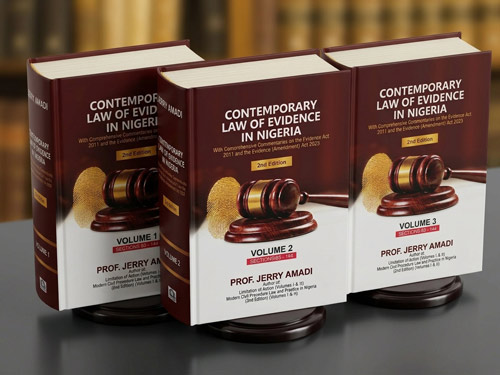 Prof. Jerry Amadi’s Evidence Law, Second Edition (2026), contains 3,314 pages in three volumes, covering the Evidence Act 2011, its 2023 amendment, and 4,051 Nigerian and English cases.