“Ebola Attacks Patient’s Vital Organs” — NCDC Confirms Multi-Organ Failure As Diplomat’s Wife Battles Deadly Virus In Abuja

Fresh details have emerged concerning the identity, travel history and medical condition of the woman diagnosed with Ebola virus disease in Abuja, after health officials disclosed that her condition had deteriorated into multi-organ failure, while the Africa Centres for Disease Control and Prevention (Africa CDC) subsequently identified her as the wife of a diplomat.
The development has raised questions about differing accounts of the patient’s nationality, movements before arriving in Nigeria and current medical condition, as health authorities intensify efforts to contain the Bundibugyo strain of Ebola detected in the Federal Capital Territory.
On Wednesday, October 21, 2026, an official speaking during an emergency incident management meeting in Abuja disclosed that the patient had developed multi-organ failure, a life-threatening condition in which two or more vital organ systems are unable to function adequately.
The official described the patient as a diplomat but did not disclose her nationality or identify the organs affected.
The Director of Public Health Laboratory Services at the Nigeria Centre for Disease Control and Prevention (NCDC), Olajumoke Babatunde, separately confirmed that laboratory investigations had identified the Bundibugyo strain of Ebola virus.
“We did three levels of tests, but all were molecular. The strain was Bundibugyo,” Babatunde said.
The confirmation established that the infection was caused by the same Ebola virus species associated with the ongoing outbreak in the Democratic Republic of the Congo.
However, on Thursday, October 22, the Director-General of Africa CDC, Jean Kaseya, provided further details about the patient, identifying her as the wife of a diplomat who had travelled to Kampala, Uganda, for a holiday.
According to Kaseya, the woman was originally from Uganda but resided in Abuja and returned to Nigeria on October 3, 2026.
The clarification differed from the earlier description of the patient as a diplomat.
Kaseya explained that the woman began experiencing symptoms shortly after returning to Nigeria and initially sought treatment at a private hospital, believing that she was suffering from malaria.
When her condition failed to improve, she visited another private hospital, where she was admitted on October 11.
“She went to the first hospital, a private hospital, thinking that she had malaria, and then she went to the second private hospital. She was admitted on the 11th,” Kaseya said during an interview with the BBC’s Newshour programme.
Further details provided by the Coordinating Minister of Health and Social Welfare, Professor Muhammad Ali Pate, indicated that the 42-year-old woman had spent approximately two and a half weeks in Kampala before travelling back to Abuja through Addis Ababa, Ethiopia, where she had a two-hour stopover.
According to the minister, the patient remained in Abuja after returning to Nigeria.
Pate said health authorities were alerted on October 19 after the woman’s condition failed to improve, leading to further investigations and laboratory testing.
The infection was confirmed on October 20 following three laboratory tests.
However, while officials at Wednesday’s emergency meeting disclosed that the patient had developed multi-organ failure, Pate gave a more reassuring assessment in a separate interview, describing her as stable and responding to treatment.
“She’s stable, she’s improving,” the minister said.
The differing accounts have not been publicly reconciled, and it remains unclear whether they reflect assessments made at different stages of the patient’s treatment.
Medical experts recognise multi-organ failure as a serious complication that can occur in severe Ebola virus disease, particularly where the infection causes extensive inflammation, circulatory problems and damage to vital organ systems.
The condition may involve the kidneys, liver, lungs or cardiovascular system, although Nigerian health officials have not publicly identified which organs were affected in this particular case.
The Bundibugyo virus was first identified in Uganda in 2007 and is one of the viruses capable of causing Ebola virus disease in humans.
The infection spreads primarily through direct contact with the blood or other bodily fluids of an infected person who has developed symptoms, as well as through materials contaminated with such fluids.
The incubation period generally ranges from two to 21 days, while early symptoms may include fever, headache, weakness, muscle pain, vomiting and diarrhoea.
Severe infections can progress to dehydration, circulatory shock, bleeding complications and organ dysfunction.
The World Health Organisation has confirmed that the current outbreak involves the Bundibugyo strain, for which there is no approved strain-specific vaccine or antiviral treatment.
Medical management therefore relies heavily on supportive care, including maintaining fluid and electrolyte balance, monitoring organ function and treating complications as they arise.
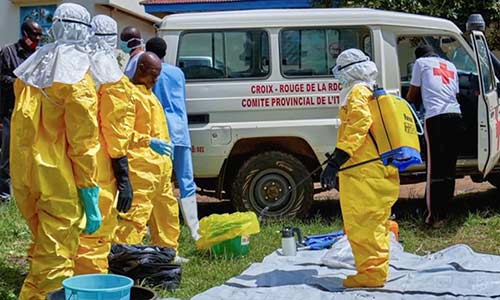
Meanwhile, Nigerian authorities have identified 44 persons who may have had contact with the infected woman and placed them under monitoring.
The contacts include healthcare workers, patients, caregivers and individuals connected to the patient’s travel history.
Pate explained that the authorities had deliberately adopted a broad approach to contact identification to reduce the possibility of undetected transmission.
“Not all of them have been in close proximity. We cast the net wide so that we contain it as broadly as possible,” he said.
The minister disclosed that none of the identified contacts, including the person who travelled with the patient, had developed symptoms at the time of his statement.
He added that the Federal Government was collaborating with Uganda, Ethiopia and regional public health authorities to establish the woman’s complete travel history and determine where she might have contracted the infection.
The investigation has become particularly important because accounts provided by Nigerian and Ugandan authorities differ.
Uganda’s Ministry of Health had earlier described the patient as a Nigerian national who travelled to eastern Democratic Republic of the Congo for business before passing through Uganda on her way back to Nigeria.
Ugandan authorities maintained that the country had no active confirmed Ebola cases and cautioned that the woman’s passage through Uganda did not establish that she became infected there.
The latest account from Africa CDC, however, describes her as originally from Uganda and says she travelled to Kampala for a holiday.
The conflicting descriptions leave unresolved questions about the patient’s nationality, the precise purpose of her travel and the location where she was exposed to the virus.
Pate said Nigeria was working with other affected countries to clarify the circumstances.
“We respect our sister nation of Uganda. We have very strong solidarity, we are all in it together,” he said.
Kaseya also called for stronger information-sharing among African countries to support contact tracing, disease surveillance and investigations into the movement of infected persons across borders.
The Nigeria case comes amid a wider outbreak of Bundibugyo Ebola virus disease in the Democratic Republic of the Congo and other countries.
According to figures cited by the European Centre for Disease Prevention and Control, the DRC had recorded more than 9,500 cases and 4,602 deaths as of October 19, 2026.
Kenya, which confirmed an imported Ebola case earlier in October, had recorded nine cases by Tuesday, with health authorities indicating that the infections belonged to a known cluster.
Uganda also experienced Ebola infections earlier in 2026 but subsequently declared its outbreak over after completing the required period without new confirmed cases.
Nigeria’s latest case has revived memories of the 2014 Ebola outbreak, which began after an infected traveller arrived in Lagos from Liberia.
That outbreak resulted in 20 confirmed and probable cases and eight deaths, including healthcare workers involved in the response.
The World Health Organisation declared Nigeria free of Ebola transmission on October 20, 2014, after the country completed 42 days without a new case.
Health authorities have since strengthened surveillance and emergency response arrangements, particularly at international airports and healthcare facilities.
Following confirmation of the latest infection, the NCDC and other relevant agencies intensified contact tracing, laboratory surveillance and infection prevention measures.
The WHO also disclosed that infection prevention and control procedures were being strengthened at the private hospital where the patient initially received treatment.
The latest developments underscore the importance of timely diagnosis, accurate public communication and coordinated international disease surveillance, particularly where infected persons have travelled across several countries before receiving a confirmed diagnosis.
As of October 22, Nigerian health authorities had not publicly reconciled the differing descriptions of the patient’s diplomatic status, nationality and medical condition.
The patient remains the subject of medical care and public health monitoring, while investigations continue to establish her exposure history and prevent further transmission.
[A MUST HAVE] Evidence Act Demystified With Recent And Contemporary Cases And Materials

Available now for NGN 40,000 at ASC Publications, 10, Boyle Street, Onikan, Lagos. Beside High Court, TBS. Email publications@ayindesanni.com or WhatsApp +2347056667384. Purchase Link: https://paystack.com/buy/evidence-act-complete-annotation
______________________________________________________________________ “Enhance Legal Practice With Authoritative Reports” — Alexander Payne Offers Comprehensive Law Reports, Spanning Over A Century Of Nigerian Jurisprudence Interested buyers are encouraged to place their orders and enquiries via:
0704 444 4777, 0704 444 4999, 0818 199 9888
Website: www.alexandernigeria.com