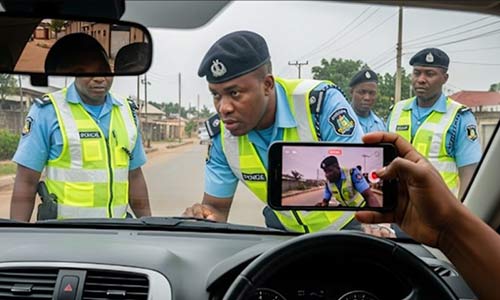
The Federal High Court sitting in Warri, Delta State, has delivered a comprehensive 36-page landmark judgment containing 10 declarations and orders affirming the constitutional right of Nigerian citizens to record police officers performing public duties, declaring anonymous policing unlawful, and ordering the Nigeria Police Force and the Police Service Commission to take immediate steps to ensure officer identification and discipline defaulters.

The judgment, delivered on Tuesday, March 17, 2026, by Justice H. A. Nganjiwa in Suit No. FHC/WR/CS/87/2025, Maxwell Nosakhare Uwaifo v. Inspector-General of Police & 3 Ors., resolved the sole issue for determination in favour of the applicant and against all the defendants.
The Case
The applicant, Maxwell Nosakhare Uwaifo Esq., a legal practitioner based in Warri, Delta State, commenced the suit by way of an Originating Summons dated and filed on July 31, 2025. He appeared in person to prosecute his own case, adopting his processes and urging the court to grant the reliefs sought when the matter came up for hearing on January 19, 2026.
The suit was brought against four respondents: the Inspector-General of Police, the Nigeria Police Force, the Police Service Commission, and the Attorney-General of the Federation. Uwaifo sued for himself and in the interest of the Nigerian public under the Fundamental Rights Enforcement Procedure Rules, 2009.
Respondents’ Participation
The judgment records that only the 4th Respondent, the Attorney-General of the Federation, represented by learned counsel O.F. Ezekhaigbe Esq., filed a written address and participated actively in the proceedings, urging the court to dismiss the suit.
The 1st to 3rd Respondents — the Inspector-General of Police, the Nigeria Police Force, and the Police Service Commission — filed no process whatsoever despite being served with the originating processes. Their failure to file any counter-affidavit meant that the applicant’s 32-paragraph affidavit evidence stood unchallenged and uncontroverted.
The Background Facts As Found By The Court
Justice Nganjiwa recounted the background facts as established by the unchallenged affidavit evidence. On May 10, 2025, the applicant was travelling from Benin to Warri when, immediately after Sapele roundabout in Delta State, he encountered a group of men who blocked the road with a black Toyota Sienna vehicle that had no plate number or any police markings for identification. The men were stopping cars in a manner that appeared to be a police checkpoint.
They flagged the applicant down and without any lawful basis or reasonable suspicion of wrongdoing, began to question him in a harsh and aggressive manner which gave the impression of extortion or harassment. The men did not wear any name tags and did not identify themselves or disclose the reason for the stop and search exercise.
When the applicant brought out his mobile phone to record the encounter, one of the men, dressed in black and appearing to be a police officer, threatened to arrest him and demanded he put his phone away. Because of the hostile and intimidating interaction, the applicant complied and quietly left for fear of being manhandled or arrested.
The court noted a similar occurrence at Effurun Roundabout in Warri sometime in June 2025, where armed police officers conducting checks displayed no name tags, badges, or force numbers on their uniforms and operated with an unmarked Toyota Hilux with no police insignia, plate number, or department markings.
The applicant deposed that these encounters caused him emotional trauma, fear, and psychological distress, and that he had spoken to many Nigerians who shared similar experiences and fears of being unable to identify officers who violated their rights.
The AGF’s Arguments — Rejected
The 4th Respondent’s counsel argued that the AGF was not a proper party to the suit, that the court should not interfere with police operations, that Section 66 of the Police Act did not require officers to wear name tags, that the suit was frivolous, and that citizens cannot record police officers performing public duties.
Justice Nganjiwa dealt with each of these arguments comprehensively.
Court Holds AGF Is A Proper Party
On whether the AGF was a proper party, Justice Nganjiwa cited the Supreme Court decision in Yohanna v. Gabriel (2020) and Gassol v. Tutare (2025), holding that the test for determining a necessary party is whether the judgment will affect the party and whether their presence is needed to put an end to parallel litigations.
The judge further cited F.A.A.N v. Bi Courtney Ltd (2025), where the Supreme Court held that the federal government exercises executive powers on behalf of the federation, and by virtue of Section 150(1) of the Constitution, the AGF functions in dual capacity as the chief law officer and a minister, making them a necessary and proper party in suits involving constitutional interpretation.
Justice Nganjiwa held that having considered the applicant’s affidavit evidence, particularly paragraphs 3 to 31, the questions for determination, and the reliefs sought, he was convinced that the 4th Respondent is a proper party whose presence was necessary for the court to effectively adjudicate the matter.
Section 66 Is Mandatory, Not Discretionary
On the critical question of whether officers must wear identification, Justice Nganjiwa examined Section 66(1) of the Nigeria Police Act 2020, which provides that a police officer while on uniform duty shall at all times wear a name tag and identification number clearly displayed on his uniform.
He also examined Sections 49(1) and 50(4) of the Police Act, holding that while police officers are empowered under Sections 49, 50, and 51 to carry out stop and search on vehicles, persons, or places if they reasonably suspect criminal activity, Section 50(4) makes it mandatory that for any police officer to exercise the power of stop and search, he shall be in uniform or wear visibly a valid police identity card.
Justice Nganjiwa held that the word “shall” in these provisions makes compliance mandatory, not discretionary. He cited the Court of Appeal in FGN v. Zebra (2002) which held that when a matter is clearly spelt out in a statute and the procedure for carrying it out is laid down, a party has no choice but to comply fully with the provisions. He also cited Agbi v. F.R.N (2020) where the Court of Appeal stated that when a law provides a particular way of doing a thing, whatever is done in contravention amounts to a nullity and of no effect whatsoever.
The judge declared: “To me any act done by a police officer exercising the power of stop and search, without complying with the mandatory requirement of being in police uniform or wearing visibly a police identity card, then such action amount to illegality and abuse of power and I so hold.”
Recording Is A Constitutional Right
On the right to record, Justice Nganjiwa agreed with the applicant that Nigerian citizens have the right to record police officers performing their duties during road searches or traffic stops, in order to document and disseminate that information for accountability purposes, provided the citizen does not obstruct or interfere with the police physically.
The judge held that the act of recording falls within Section 39(1) of the Constitution, which guarantees freedom of expression including the freedom to receive and impart ideas and information without interference. He also invoked Section 84(2) of the Evidence Act 2011, holding that in the digital era, computer-generated evidence has become one of the means by which a litigant or claimant can prove their case, and that this provision allows any person to use their phone to record the exercise or search by police officers for accountability and fairness.
He also agreed with the applicant that in accordance with a citizen’s right to privacy, citizens can record acts of police officers as they relate to the search of their vehicle or property.
Unchallenged Evidence Must Be Accepted
Justice Nganjiwa emphasized that where a party refuses to file a counter-affidavit to contradict facts deposed in an affidavit served on them, those facts stand unchallenged and uncontroverted, and the court is bound to accept them as true. He cited Ezechukwu v. Onwuka (2016) and FGN v. Zebra (2002) in support.
Since the 1st to 3rd Respondents filed no counter-affidavit, the applicant’s evidence of being stopped without lawful basis, threatened for attempting to record, and subjected to anonymous policing on multiple occasions stood as established facts before the court.
The 10 Declarations And Orders
Having resolved the sole issue in favour of the applicant, Justice Nganjiwa made the following declarations and orders:
1. A declaration that the applicant and all Nigerian citizens are entitled under Section 39 of the Constitution to freely express themselves, including by recording and publishing matters of public interest, particularly the conduct of law enforcement agents performing public duties in public spaces.
2. A declaration that any attempt by officers of the Nigeria Police Force to prevent or punish such acts or recording, under threat of arrest, harassment or seizure of devices, is unconstitutional, unlawful, and a violation of fundamental rights under Sections 34, 35, and 39 of the Constitution.
3. An order of perpetual injunction restraining the respondents, their officers, agents, privies, or any person acting under their instructions from further harassing, intimidating, threatening, arresting, or otherwise infringing the rights of the applicant or any Nigerian for video recording police officers on duty in public.
4. A declaration that the acts of police officers engaging in patrols, stop and search operations, and other public interactions without wearing uniforms that visibly display their names and force numbers is unconstitutional, illegal, and a breach of Sections 34, 35, and 36 of the Constitution and the Police Act.
5. An order of perpetual injunction restraining the respondents, their agents, officers, or privies from further engaging in stop and search or checkpoint operations without ensuring all operatives wear uniforms bearing their full names and force numbers.
6. An order directing the 1st to 3rd Respondents to issue a clear directive and training guideline to all officers of the Nigeria Police Force affirming the public’s right to record and report police activities conducted in public spaces, including at checkpoints and during stop and search.
7. An order mandating the 2nd and 3rd Respondents to discipline any officer found to have acted in breach of this right.
8. An order mandating the 3rd Respondent (Police Service Commission) to issue a circular or directive mandating all officers on public engagement duties to wear full uniforms with identification and to initiate disciplinary action against any defaulters.
9. The sum of N5,000,000 (Five Million Naira) only is awarded as compensation in favour of the applicant and against the respondents jointly and severally for infringing the fundamental rights of the applicant as guaranteed under Sections 34(1), 35(1), 37, and 39(1) of the Constitution.
10. Cost is assessed at N2,000,000 (Two Million Naira) for prosecuting the case.
Appearance
The judgment records that the applicant was present in court and appeared in person. There was no appearance for the respondents.
Maxwell v. IGP Judgment TheNigerialawyerThe judgment was signed by Justice H. A. Nganjiwa on March 17, 2026, and a certified true copy was issued by the Federal High Court, Warri Division.
 ARTIFICIAL INTELLIGENCE FOR LAWYERS: A COMPREHENSIVE GUIDE
Reimagine your practice with the power of AI “...this is the only Nigerian book I know of on the topic.” — Ohio Books Ltd
Authored by Ben Ijeoma Adigwe, Esq., ACIArb (UK), LL.M, Dip. in Artificial Intelligence, Director, Delta State Ministry of Justice, Asaba, Nigeria.
Bonus:
Get a FREE eBook titled “How to Use the AI in Legalpedia and Law Pavilion” with every purchase.
ARTIFICIAL INTELLIGENCE FOR LAWYERS: A COMPREHENSIVE GUIDE
Reimagine your practice with the power of AI “...this is the only Nigerian book I know of on the topic.” — Ohio Books Ltd
Authored by Ben Ijeoma Adigwe, Esq., ACIArb (UK), LL.M, Dip. in Artificial Intelligence, Director, Delta State Ministry of Justice, Asaba, Nigeria.
Bonus:
Get a FREE eBook titled “How to Use the AI in Legalpedia and Law Pavilion” with every purchase.
How to Order: 📞 Call, Text, or WhatsApp: 08034917063 | 07055285878 📧 Email: benadigwe1@gmail.com 🌐 Website: www.benadigwe.com
Ebook Version: Access directly online at: https://selar.com/prv626
________________________________________________________________________ The Law And Practice Of Redundancy In Nigeria: A Practitioner’s Guide, Authored By A Labour & Employment Law Expert Bimbo Atilola _______________________________________________________________________
[A MUST HAVE] Evidence Act Demystified With Recent And Contemporary Cases And Materials
_______________________________________________________________________
[A MUST HAVE] Evidence Act Demystified With Recent And Contemporary Cases And Materials