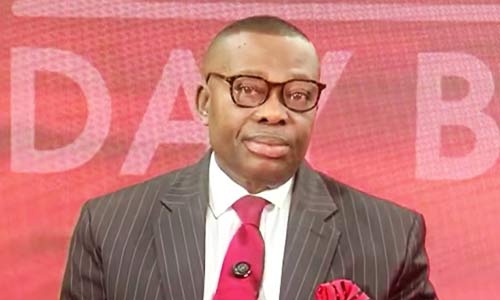
Senior Advocate of Nigeria, Dr Monday Onyekachi Ubani, has said that the omission of primary and secondary school certificates from the documents submitted to INEC does not, by itself, disqualify a presidential candidate, explaining that the presentation of a university degree raises a presumption that the holder passed through the earlier stages of education, and that the presumption, while rebuttable, is “a very onerous one” to displace.

He spoke on Arise News’ Newsday programme following INEC’s publication of the personal particulars and credentials of the presidential candidates for the 2027 general elections.
Ubani began by explaining the statutory purpose of the exercise.
“The position of the law is that INEC owes the responsibility of publishing the full particulars of the candidates who have actually applied for the job next year in terms of running for an elective position,” he stated.
“The purpose of publishing those names is just to ensure that we are running a very transparent system, and that those who have any issue with whatever information those candidates have supplied have a right under the Electoral Act to approach the court in order to ventilate their grievances,” Ubani said.
Asked whether he anticipated objections from the parties, Ubani acknowledged the public debate but urged that it be conducted on legal rather than emotional terms.
“There are people whose names are not consistent. It is being discussed in the public space. There are those who omitted certain information, maybe schools, and all that has been debated in the public space. But my own take is that if there is a provision of the law with regard to whatever grievance, that is the way you have to address it,” he stated.
“I see sentiment all over the place. Somebody asked me: if you are going for an interview, they ask you to bring your certificates and your originals. How come, for the presidency, somebody did not disclose his certificate? I said, look at the position of the Constitution,” Ubani said.
“Don’t bring sentiment, because I see sentiment all over the place. But if we have to discuss, let’s discuss like lawyers and talk about what the law has provided. If there is any amendment, let’s amend the law. But this is what the position of the law is now,” he stated.
Ubani walked through the constitutional provisions in detail.
“If you read Section 131(d), and then Section 318(1), which is the interpretative section, it gives you what the provision of the qualification is all about. It says you must have been educated up to school certificate level or its equivalent,” he stated.
He then set out each limb of the definition in Section 318(1): production of a school certificate, or a Grade Two Teacher’s Certificate, or a trade test certificate or its equivalent; or education up to school certificate level, “in that one, there is no issue of certificate”; or primary school education combined with experience in the private or public sector, evidence of ability to speak good English, and evidence of attendance at a course of not less than one year.
Ubani drew attention to a limb of the provision he said is being overlooked entirely.
“Even the one that people are not talking about: ‘any other’ is a different one. It stands on its own. Any other qualification that is acceptable to INEC,” he stated.
“In other words, even if you don’t have all this, and you now tender a certificate that is acceptable to INEC, go and look at it there; the interpretative section says any other certificate acceptable to INEC. You qualify to run for the office of the presidency,” Ubani said.
Asked by the presenter whether that clause leaves room for a loophole, and what metrics determine what is acceptable to INEC, Ubani conceded the subjectivity but located the responsibility elsewhere.
“It’s subjective. If INEC says that this certificate is okay, it’s a constitutional provision. It’s not INEC’s problem. You don’t place it on INEC; INEC is there as an administrative body. Somebody wrote a law, wrote a constitution, and said INEC has the right to say this certificate is okay. It has given INEC a responsibility. So in their own fair assessment and judgment, they will say this certificate satisfies,” he stated.
He added that the clause has never in practice been tested: “We have not come to that level. We have not had that issue at all where people do not present anything at all. Most of the candidates from 1999 to date have, one way or another, presented something, either secondary school certificate or university.”
Ubani then addressed the specific controversy directly.
“What the current president, who is now in power, has done is that he omitted that of primary, he omitted that of the secondary, but he presented a degree. So that is a presumption that he must have passed through,” he stated.
“But that presumption can be rebuttable. So if you have any evidence that he didn’t pass through those journeys, I mean primary school, secondary school, it’s for you now to present it before the court in order to rebut that that degree is not attained as a result of passing through these processes,” Ubani said.
“So it’s a rebuttable presumption. It’s a very onerous one for you to prove,” he added.
Ubani’s most consequential point concerned who may actually go to court.
“The Electoral Act says the candidate will be disqualified. But as I said earlier, the standing of whoever is going to court is an issue. The Electoral Act has been very, very specific and restrictive,” he stated.
“For you to succeed in challenging any person who has presented false information under Section 29 of the Electoral Act, one, you must be an aspirant. That means you must have contested that primary election with the person you are suing. Then secondly, he must be a candidate of the same political party,” Ubani said.
“So it’s not open, unlike a previous act that says any person. But now they have restricted it to only candidates who are, and then of the same political party. So you have to satisfy that requirement of standing before you can even sue. And Nigerians need to know that,” he stated.
Asked whether the scrutiny window was long enough for genuine legal challenges given the pace of Nigerian courts, or whether it was merely a window opened for optics, Ubani disagreed with the premise.
“No, you have time. Within 14 days, you have a right to go to court. And what has happened over time is that any of these pre-election or post-election issues are given priority by the courts. They will give it a timeline. There’s a timeline within which to have these issues decided,” he stated.
“They have made this issue of qualification now to be a pre-election issue. So it will be determined before the election next year. It’s not going to be a post-election issue anymore. Anything that has to do with qualification is a pre-election issue,” Ubani said.
“Within 14 days, they have published it. If you have any grievance, you go to court. Before you know it, Court of Appeal and the Supreme Court. Before January, all these cases would have been disposed of,” he stated.
Ubani closed by directing the argument toward reform rather than litigation.
“If we have any issue, we address the issue of constitutional amendment in order probably to enlarge, to increase, because of the complexity of running a country. You say maybe let’s have it as a degree and all that. But for now, this is what the Constitution has provided, so that people should know and understand the provisions of the Constitution before coming on television or any other area in order to ventilate their personal grievances about the provision of the Constitution, or maybe against a candidate who has complied, but not in the manner they would have wanted,” he stated.
“They have complied in accordance with the provision of the Constitution; that is very key. So I’m not here to defend any person. What I am here to do is to make sure we educate people and also talk about what the law is saying, so that sentiment will really, really be buried in our system,” Ubani concluded.
[A MUST HAVE] Evidence Act Demystified With Recent And Contemporary Cases And Materials

Available now for NGN 40,000 at ASC Publications, 10, Boyle Street, Onikan, Lagos. Beside High Court, TBS. Email publications@ayindesanni.com or WhatsApp +2347056667384. Purchase Link: https://paystack.com/buy/evidence-act-complete-annotation
______________________________________________________________________ “Enhance Legal Practice With Authoritative Reports” — Alexander Payne Offers Comprehensive Law Reports, Spanning Over A Century Of Nigerian Jurisprudence Interested buyers are encouraged to place their orders and enquiries via:
0704 444 4777, 0704 444 4999, 0818 199 9888
Website: www.alexandernigeria.com
Interested buyers are encouraged to place their orders and enquiries via:
0704 444 4777, 0704 444 4999, 0818 199 9888
Website: www.alexandernigeria.com