Nigeria’s Ministry of Interior has moved to clarify key terms of the new migration agreement with the United Kingdom, confirming that Nigerians deported under the deal will retain their rights under domestic law, be treated with dignity, and may re-enter the UK in the future if they meet applicable immigration requirements.

The clarification comes as the agreement — signed during President Bola Tinubu’s state visit to the UK — continues to generate intense public debate, speculation about the possible repatriation of convicted former Deputy Senate President Ike Ekweremadu, and what the presidency described as a misinformation campaign about the scope and nature of the deal.
The agreement, signed by Interior Minister Olubunmi Tunji-Ojo and UK Home Secretary Shabana Mahmood, creates a framework for the return of Nigerians who no longer have legal grounds to remain in the UK — including failed asylum seekers, visa overstayers, and convicted offenders.
A critical element of the deal is Nigeria’s agreement to recognise UK-issued letters — identification documents issued to individuals without valid passports — as an alternative to emergency travel documents. This removes one of the major administrative hurdles that had previously slowed deportation proceedings.
In a statement posted on X on Friday, the Interior Ministry outlined the specific provisions of the agreement.
“This arrangement includes the use of secured travel documentation, case-by-case identity verification, and safeguards for vulnerable individuals and potential victims of trafficking,” the ministry stated.
“This framework also sets out clear definitions, scope, and areas of cooperation, including information sharing, capacity building, training, and joint research on migration management and border security.”
The ministry emphasised that the deal guarantees that returnees will be treated with dignity and that their rights will be preserved under Nigerian law.
“The deal guarantees that returnees will be treated with dignity, rights retention under domestic law, and may re-enter in the future if they meet the applicable immigration requirements,” the ministry stated.
In a bid to counter what the presidency described as misinformation about the agreement, Temitope Ajayi, Senior Special Assistant to the President on Media and Publicity, issued a pointed clarification that the deal applies exclusively to Nigerian nationals.
“The Nigerian government is not taking back non-Nigerians. The UK government is not compelling Nigeria to take those who are not our citizens,” Ajayi stated.
“This clarification becomes necessary because of those who have already revved up their misinformation machinery,” he added, suggesting that political opponents were attempting to distort the terms of the agreement for partisan purposes.
The clarification addresses speculation that Nigeria might be compelled to accept deportees of other nationalities under the arrangement — a concern that had circulated on social media following the announcement of the deal.
Officials indicate that no fewer than 2,071 Nigerians who have exhausted their asylum appeal rights, as well as convicted offenders awaiting deportation, could be affected by the arrangement. Thousands of Nigerians live and work legally in the UK, but many also overstay their visas, have been convicted of crimes, or have had asylum requests denied.
The agreement is expected to make it significantly easier to return these categories of individuals to Nigeria, as the recognition of UK-issued identification letters eliminates the previous requirement to wait for emergency travel documents before deportation could proceed.
However, key aspects of the agreement, including its start date and duration, have not been made public.
The agreement has revived intense speculation about the possible repatriation of former Deputy Senate President Ike Ekweremadu, who was convicted in March 2023 and sentenced to nine years and eight months imprisonment by the Old Bailey in London for organ trafficking under the UK’s Modern Slavery laws.
The conviction followed an attempt to bring a 21-year-old Lagos street vendor, David Nwamini, to the UK for a kidney transplant for his daughter. His wife, Beatrice, was sentenced to four years and six months, while Dr. Obinna Obeta received a 10-year term. Beatrice completed her sentence and returned to Nigeria in January 2025.
The Federal Government had previously attempted to secure Ekweremadu’s transfer. On November 10, 2025, Foreign Affairs Minister Yusuf Tuggar and Attorney-General Lateef Fagbemi reportedly led a delegation to the UK, but British authorities declined, citing concerns that Nigeria might not guarantee the former lawmaker would continue serving his sentence if transferred.
The new bilateral framework has now raised the question of whether the transfer could be reconsidered.
A senior government official, speaking on condition of anonymity, acknowledged that Ekweremadu could potentially be returned under the agreement but stressed that no such move was currently under consideration.
“It may happen; I cannot overrule it. But at the moment, nothing of that nature is on the table. Any such arrangement would require coordination between the relevant legal authorities in both countries,” the official stated.
Another highly placed official was more supportive: “It will be good for him if he benefits from it,” though he added he could not comment officially.
A spokesperson for the Ministry of Foreign Affairs, Kimiebi Ebienfa, said the ministry was not aware of any direct link between the agreement and efforts to repatriate Ekweremadu.
Senior lawyer Bankole Akomolafe said while Ekweremadu could potentially be transferred under the framework, any such move would require strict adherence to legal procedures and mutual agreement between both countries.
“He has been tried and convicted; that is the judicial process. A bilateral agreement cannot nullify a valid court sentence. If he is transferred, the terms must be respected. It would be a breach of agreement for him to be released without completing his sentence, except through lawful processes such as a pardon,” Akomolafe warned.
The Alaigbo Development Foundation, through its National President Professor Ukachukwu Awuzie, said it would not be out of place for Ekweremadu to be repatriated, arguing he had already faced significant consequences. However, Awuzie opposed Ekweremadu continuing his sentence in Nigerian correctional facilities, describing them as inadequate, and suggested he could be considered for a possible pardon.
Tony Obizoba, a former Ohanaeze Ndigbo official, cautioned against reducing the entire agreement to Ekweremadu’s case. “Ekweremadu is just one individual. The agreement has wider implications for Nigerians in the UK and should not be reduced to a single case,” he stated.
He noted that earlier transfer efforts failed partly due to the absence of a formal bilateral framework, suggesting the new agreement could provide a basis for future cooperation.
The agreement raises complex questions about Nigeria’s obligations under the deal. If Ekweremadu were transferred, Nigeria would almost certainly be required to guarantee continuation of his sentence. Any perception that the transfer was being used to secure early release could damage the credibility of the entire bilateral arrangement and undermine future cooperation.
The Interior Ministry’s emphasis on dignity, rights retention, and the possibility of future re-entry to the UK suggests the Nigerian government is positioning the deal as a balanced arrangement rather than a punitive deportation mechanism. However, the sheer number of Nigerians potentially affected — over 2,000 — and the speed with which the UK can now process returns means the practical impact could be significant.
For the thousands of Nigerians legally residing and working in the UK, the agreement does not change their status. But for those in irregular situations — overstayers, failed asylum seekers, and convicted offenders — the new framework represents a fundamental shift in the ease and speed with which the UK can enforce their removal.
 ARTIFICIAL INTELLIGENCE FOR LAWYERS: A COMPREHENSIVE GUIDE
Reimagine your practice with the power of AI “...this is the only Nigerian book I know of on the topic.” — Ohio Books Ltd
Authored by Ben Ijeoma Adigwe, Esq., ACIArb (UK), LL.M, Dip. in Artificial Intelligence, Director, Delta State Ministry of Justice, Asaba, Nigeria.
Bonus:
Get a FREE eBook titled “How to Use the AI in Legalpedia and Law Pavilion” with every purchase.
ARTIFICIAL INTELLIGENCE FOR LAWYERS: A COMPREHENSIVE GUIDE
Reimagine your practice with the power of AI “...this is the only Nigerian book I know of on the topic.” — Ohio Books Ltd
Authored by Ben Ijeoma Adigwe, Esq., ACIArb (UK), LL.M, Dip. in Artificial Intelligence, Director, Delta State Ministry of Justice, Asaba, Nigeria.
Bonus:
Get a FREE eBook titled “How to Use the AI in Legalpedia and Law Pavilion” with every purchase.
How to Order: 📞 Call, Text, or WhatsApp: 08034917063 | 07055285878 📧 Email: benadigwe1@gmail.com 🌐 Website: www.benadigwe.com
Ebook Version: Access directly online at: https://selar.com/prv626
________________________________________________________________________ The Law And Practice Of Redundancy In Nigeria: A Practitioner’s Guide, Authored By A Labour & Employment Law Expert Bimbo Atilola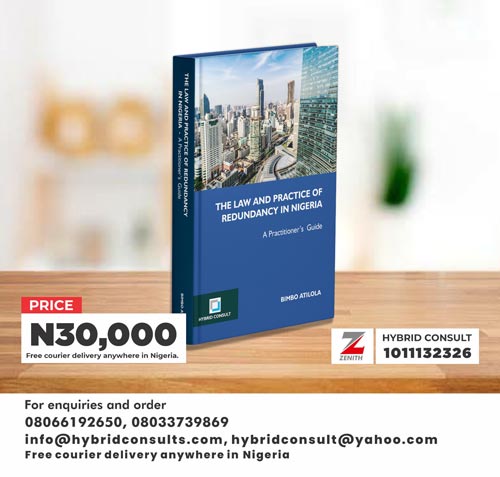 _______________________________________________________________________
[A MUST HAVE] Evidence Act Demystified With Recent And Contemporary Cases And Materials
_______________________________________________________________________
[A MUST HAVE] Evidence Act Demystified With Recent And Contemporary Cases And Materials