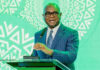
The Chairman of the Senate Committee on Media and Public Affairs, Senator Yemi Adaramodu, has hit back at Civil Society Organisations (CSOs) criticising the Senate over the passage of the Electoral Act Amendment Bill, accusing them of disparaging the National Assembly and relying on lawmakers to make their living.

Adaramodu made the remarks during an interview on Arise Television, responding to criticisms from CSOs and other stakeholders over the Senate’s rejection of mandatory real-time electronic transmission of election results and the reduction of electoral timelines.
The Senate spokesman did not hide his displeasure with the CSOs.
“The National Assembly will not condone all this kind of personal cheese who are just disparaging us. They are making their living through us. They rely on us to make their living,” Adaramodu stated.
“They would have had Clement, they would have had Clement in one call for example saying that he was really really angry because we know that he’s a consultant to you people. We know that they are educated enough to know that the process of lawmaking is not something that just through the snap of your fingers, then it is done.”
The reference to “Clement” appears to be directed at Clement Nwankwo, Executive Director of Policy and Legal Advocacy Centre (PLAC) and Convener of the Civil Society Situation Room, who has been vocal in criticising the Senate’s position on electronic transmission of results.
The Senate spokesman’s reaction comes after some civil society organisations released a joint statement on Thursday criticising the Senate for rejecting key provisions in the ongoing Electoral Act amendment process.
In the joint statement, the CSOs raised concerns over the Senate’s refusal to approve compulsory real-time electronic transmission of election results — a reform widely seen as critical to reducing disputes and enhancing public trust in Nigeria’s electoral process.
“The Senate vote represents a setback for electoral integrity. The undersigned civil society organisations express deep concern over the Nigerian Senate’s vote on key electoral amendment proposals, which have resulted in the rejection of some of the most consequential legal changes required to strengthen electoral transparency, inclusion, and credibility,” the statement read.
“The Senate rejected provisions allowing voters to download missing or unissued voter cards, blocked electronic transmission of election results, and significantly compressed critical electoral timelines.”
The statement was signed by Centre for Media and Society (CEMESO), Kukah Center, International Press Centre (IPC), Elect Her, Nigerian Women Trust Fund, TAF Africa, and Yiaga Africa.
Adaramodu defended the Senate’s decision to reduce the notice period for elections from 360 days to 180 days.
“We have found out that just after election, after swearing, then there is always this tendency that politicians have only two and a half years into their four years when politics will start. Then when you now have 360 days, that’s a whole year for an election to hold before that person is sworn in,” he explained.
“When you use that whole year with the six months after the election when you will be sworn in, that is one and a half years, meaning that you have only two and a half years to work for the people, to work to justify the mandate. So we are now saying instead of complaining every time that it is politics, politics, politics, that campaign has already started, let us now shorten it.”
He added: “Within 180 days we must be able to do that one because nobody is coming from Jupiter, none is coming from Mercury or Venus to come and contest. The laws are already there.”
On the contentious issue of electronic transmission, Adaramodu maintained that the Senate retained what was already in existence.
“What the majority said that day was that we are adopting what had been in existence. When you are transmitting, you should have collated before you transmit. Machines do not collate. Form EC8A had already been there. Presiding officers and poll clerks will now generate the Form EC8A. Then we now have party agents who will be there. Election results will be counted while everybody is there,” he said.
“So you will already know the results of your party, for your party and candidates in every polling unit. It is after it that it is transmitted to wherever. Either you call it IREV, you call it MREV, you call it TREV, whatever REV you call it. It is there because we are not doing electronic voting.”
He cited Supreme Court decisions: “The Supreme Court have held that, look, IREV cannot form collation. Collation is done in situ at every polling unit. And once it is done, then it can now be transferred.”
The CSOs had warned that the compressed timelines will severely limit public scrutiny, hamper logistical planning by the Independent National Electoral Commission (INEC), and create fertile ground for electoral manipulation.
They also criticised the rejection of a proposed 10-year ban on offenders, arguing that the absence of tougher sanctions weakens the fight against vote-buying and electoral corruption.
“Stronger sanctions, including electoral disqualification, are necessary to protect the integrity of the ballot and restore public confidence in democratic institutions,” the statement added.
“Taken together, these decisions represent a retreat from the principles of transparency, certainty, and voter rights that underpinned the passage of the Electoral Act 2022. They also contrast with the more progressive position earlier adopted by the House of Representatives, deepening concerns about the Senate’s commitment to credible elections.”
Adaramodu defended the decision to retain two years imprisonment for vote buying while increasing fines from N2 million to N5 million, rather than adopting the proposed 10-year ban.
“If you have two years or five million or both at the same time, then that is adequate. Even if somebody is jailed for thirty minutes, that person is an ex-convict. That person has penalty constitutionally. It means that that person cannot even hold public office,” he said.
“Let us first of all see it through. Even if it is used, let some people go to jail if they sell their votes or some people buy votes. Let us see it happening.”
Adaramodu highlighted new provisions in the bill, including early voting 14 days before elections for journalists, soldiers, paramilitary, and security agents who will be on duty on election day.
He also mentioned a provision that prevents parties from substituting disqualified candidates, stating that only the party with compliant candidates will proceed to the election.
The organisations called on other lawmakers to prioritise national interest over partisan interests by reversing course in the ongoing harmonisation process.
“At a time when public trust in elections remains fragile, Nigeria cannot afford legal provisions that narrow transparency, weaken oversight, or privilege political convenience over democratic integrity,” the statement added.
“The undersigned civil society organisations, therefore, urge the Conference Committee to adopt the position of the House of Representatives approving compulsory real-time electronic transmission of results, including the comparison of electronically transmitted results with physical copies.”
[A MUST HAVE] Evidence Act Demystified With Recent And Contemporary Cases And Materials

Available now for NGN 40,000 at ASC Publications, 10, Boyle Street, Onikan, Lagos. Beside High Court, TBS. Email publications@ayindesanni.com or WhatsApp +2347056667384. Purchase Link: https://paystack.com/buy/evidence-act-complete-annotation
______________________________________________________________________ “Enhance Legal Practice With Authoritative Reports” — Alexander Payne Offers Comprehensive Law Reports, Spanning Over A Century Of Nigerian Jurisprudence Interested buyers are encouraged to place their orders and enquiries via:
0704 444 4777, 0704 444 4999, 0818 199 9888
Website: www.alexandernigeria.com
Interested buyers are encouraged to place their orders and enquiries via:
0704 444 4777, 0704 444 4999, 0818 199 9888
Website: www.alexandernigeria.com