Some Lagos-based lawyers have underscored the importance of bride price in validating customary divorces, warning that a woman may remain married even after a court-ordered divorce if customary requirements are not fulfilled.

The lawyers made these assertions in separate interviews with the News Agency of Nigeria (NAN) on Tuesday in Lagos.
According to one of the lawyers, Mrs. Jumoke Ajayi, bride price plays a decisive role in the dissolution of customary marriages.
She noted that under customary law, the return or formal waiver of the bride price is central to a valid divorce.
“The mere issuance of a divorce order by a customary court does not automatically end a customary marriage.
“A woman can be divorced in a customary court and yet still be considered married if the bride price has not been returned or waived in accordance with custom.
“Failure to comply with customary requirements often leads to disputes over remarriage, inheritance, and child custody,” Ajayi said.
Similarly, Mr. Fatai Abdullah said disputes over bride price are common in divorce proceedings and often result in prolonged conflicts.
“In many cases, families insist that the bride price must be returned before they recognize the divorce. Customary marriages are not strictly contractual but involve extended family obligations.
“That is why customary divorce goes beyond court papers, as families must also complete the customary rites,” he explained.
Abdullah also identified domestic violence, infidelity, desertion, and irreconcilable differences as major factors leading couples to seek divorce.
“Once reconciliation fails, the issue of bride price becomes unavoidable in determining whether the marriage has truly ended,” he noted.
Mrs. Ruth Ojomo addressed situations where no bride price was paid at the commencement of a customary marriage, stating that parties in such cases could approach a customary court for a declaration of dissolution.
“Where no bride price was paid, its absence does not invalidate the marriage or prevent its dissolution.
“The court can dissolve the marriage once it is satisfied that a customary union existed, regardless of bride price payment.
“Under customary practices, families can also formally acknowledge the end of the marriage. Once both families agree and clearly communicate that the relationship has ended, the marriage is regarded as dissolved under custom,” she explained.
Another legal practitioner, Mr. Chibuikem Opara, who emphasized causes of marriage dissolution, said marriages contracted under the Act could only be dissolved on one ground: proof that the marriage had broken down irretrievably.
He explained that before a court could make such a finding, the petitioner must establish at least one of the facts listed under the Act, including adultery, non-consummation, cruelty, desertion, or living apart for a specified period.
Opara added that for customary marriages, several factors could lead to dissolution, including misconduct or loss of mutual affection.
He stated that once a person was divorced, the marriage had legally come to an end, noting that one could not be divorced and remain married to the same person.
According to him, confusion sometimes arose where a divorce was not legally conclusive, especially where customary law required the return of bride price, and this had not been done.
He further noted that bride price was not a requirement for statutory marriages and that courts did not inquire into its payment before dissolving such unions.
“Under customary law, however, bride price is an essential element of a valid marriage. Where there is no evidence of its payment, no valid marriage exists,” Opara said.
Opara added that a marriage which never existed in law could not be dissolved.
A Lagos-based family law practitioner, Mr. Kunle Adeyemi, said the term divorce often reflected prolonged communication failure, emotional detachment, and incompatibility between spouses.
“Many couples wait until the marriage has completely collapsed before seeking help, and by then, reconciliation becomes difficult,” Adeyemi said.
He noted that financial pressures, aggravated by inflation and unemployment, had also emerged as major stressors in many homes.
Corroborating this view, a legal consultant, Mrs. Aisha Bello, said disagreements over financial responsibilities frequently escalated into legal disputes.
“Economic hardship has changed family dynamics, and many marriages are unable to withstand the pressure,” she said.
Some social analysts also pointed to third-party interference, particularly from extended family members, as a persistent factor in marital instability.
A sociologist and marriage counselor, Dr. Samuel Okorie, said cultural expectations often allowed relatives to exert undue influence on couples.
“In-laws and extended family members sometimes become decision-makers in the marriage, which breeds resentment and conflict,” Okorie said.
The lawyers cautioned that improper handling of customary divorce could create legal uncertainty.
They urged couples and customary courts to ensure that all legal and customary steps were completed before declaring a marriage dissolved to avoid conflicting interpretations of marital status.
The experts also advised couples seeking divorce to first determine the nature of their marriages before approaching any court.
They added that proper legal guidance would help prevent prolonged disputes, unintended bigamy, and emotional stress.
 ARTIFICIAL INTELLIGENCE FOR LAWYERS: A COMPREHENSIVE GUIDE
Reimagine your practice with the power of AI “...this is the only Nigerian book I know of on the topic.” — Ohio Books Ltd
Authored by Ben Ijeoma Adigwe, Esq., ACIArb (UK), LL.M, Dip. in Artificial Intelligence, Director, Delta State Ministry of Justice, Asaba, Nigeria.
Bonus:
Get a FREE eBook titled “How to Use the AI in Legalpedia and Law Pavilion” with every purchase.
ARTIFICIAL INTELLIGENCE FOR LAWYERS: A COMPREHENSIVE GUIDE
Reimagine your practice with the power of AI “...this is the only Nigerian book I know of on the topic.” — Ohio Books Ltd
Authored by Ben Ijeoma Adigwe, Esq., ACIArb (UK), LL.M, Dip. in Artificial Intelligence, Director, Delta State Ministry of Justice, Asaba, Nigeria.
Bonus:
Get a FREE eBook titled “How to Use the AI in Legalpedia and Law Pavilion” with every purchase.
How to Order: 📞 Call, Text, or WhatsApp: 08034917063 | 07055285878 📧 Email: benadigwe1@gmail.com 🌐 Website: www.benadigwe.com
Ebook Version: Access directly online at: https://selar.com/prv626
________________________________________________________________________ The Law And Practice Of Redundancy In Nigeria: A Practitioner’s Guide, Authored By A Labour & Employment Law Expert Bimbo Atilola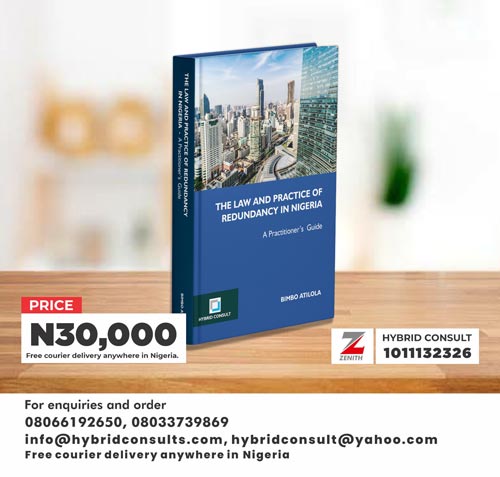 _______________________________________________________________________
[A MUST HAVE] Evidence Act Demystified With Recent And Contemporary Cases And Materials
_______________________________________________________________________
[A MUST HAVE] Evidence Act Demystified With Recent And Contemporary Cases And Materials