*Say “Nigeria Already Has The Laws; The Problem Is How We Apply Them”

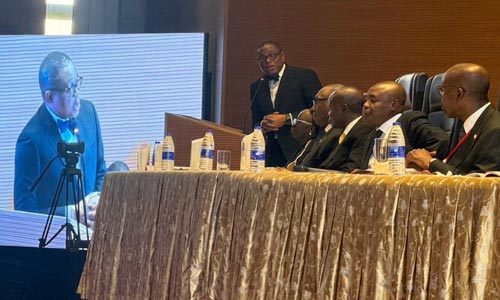
Mazi Afam Osigwe, SAN, the immediate past President of the Nigerian Bar Association, has told a room of justices and judges that Nigeria already has the law it needs to prosecute economic and financial crime, and that the delays everybody complains about are produced by the three sets of people in the courtroom.
Speaking as a discussant at the Economic and Financial Crimes Commission and National Judicial Institute workshop for justices and judges, on the theme “Investigation and Prosecution of Economic and Financial Crimes in a Digital Age”, he addressed the subject of delay tactics and abuse of court processes in high-profile financial crime cases.
He agreed with the position of Hon. Justice James Kolawole Omotosho of the Federal High Court, Abuja Division, whose paper he was responding to, that the legal framework is substantially adequate, and said the principal challenge lies in effective implementation. The failure to apply existing provisions consistently, together with practices that unnecessarily prolong proceedings, continues to undermine the speedy administration of criminal justice.
On bail. He identified an inconsistency in the conduct of the prosecuting agency: the Commission sometimes grants a suspect bail during investigation, and then opposes the same person’s bail application when the matter reaches court. He described such practices as contributing to delay and called for greater consistency in the handling of bail.
On investigation before charge. He urged prosecuting agencies to complete their investigations before filing charges, warning that repeated amendments to charges waste judicial time because an amended charge must be read again to the defendant.
On confessional statements. He supported the proposal that the prosecution should, where applicable, produce video recordings of the process by which a confessional statement was obtained. Effective implementation of the relevant provisions of the Administration of Criminal Justice Act would, he said, help courts determine the circumstances in which a statement was taken, reduce the time consumed by trial within trial, and safeguard the rights of defendants.
On bail conditions. He drew attention to the courts’ own contribution to delay, particularly where excessively stringent bail conditions are imposed. Both the prosecuting agencies and the judiciary, he said, must examine their respective practices to ensure they do not inadvertently frustrate the expeditious determination of cases.
On the Administration of Criminal Justice Act. He lamented that the objectives of the Act of 2015 are often defeated by the failure to give practical effect to its provisions on day-to-day trials and the prevention of unnecessary adjournments, and urged judges to deploy the powers the law already gives them so that criminal proceedings progress without avoidable interruption.
On training. He questioned the practice of taking judges away from their courtrooms for training programmes while pending cases remain unattended. While accepting the importance of continuing judicial education, he encouraged the National Judicial Institute to develop flexible arrangements, including virtual courses, so that judicial officers can acquire specialised knowledge without disrupting court proceedings. He proposed a structured certification system through which judges could acquire specialised competence in financial crimes, criminal procedure, digital evidence and other emerging areas.
On technology. He encouraged judges to adopt available tools to improve courtroom management and accelerate the determination of cases, saying technology properly deployed could reduce procedural bottlenecks.
He called on judges to take a firmer position against the misuse of court processes, including cases where lawyers advance arguments based on obsolete legal provisions or conduct themselves in ways that undermine the orderly conduct of proceedings.
He advocated appropriate professional disciplinary referrals where lawyers engage in misconduct, saying accountability would serve as a deterrent and promote greater professionalism at the Bar.
Asked whether Nigeria requires special courts for high-profile financial crime cases, he aligned himself with Justice Omotosho’s position that specialised judges, rather than entirely new courts, are the more practical solution.
Establishing special courts, he observed, could involve significant bureaucratic and institutional hurdles. Rather than concentrating on new judicial structures, he urged the authorities to strengthen existing courts, improve their efficiency and equip judicial officers to handle complex financial crime cases.
He concluded by urging all stakeholders to move beyond discussions about reform and focus on practical measures that give effect to existing laws, strengthen institutional capacity and promote timely justice. Responsibility for ending delay, he said, does not rest with the judiciary alone.
[A MUST HAVE] Evidence Act Demystified With Recent And Contemporary Cases And Materials

Available now for NGN 40,000 at ASC Publications, 10, Boyle Street, Onikan, Lagos. Beside High Court, TBS. Email publications@ayindesanni.com or WhatsApp +2347056667384. Purchase Link: https://paystack.com/buy/evidence-act-complete-annotation
______________________________________________________________________ “Enhance Legal Practice With Authoritative Reports” — Alexander Payne Offers Comprehensive Law Reports, Spanning Over A Century Of Nigerian Jurisprudence Interested buyers are encouraged to place their orders and enquiries via:
0704 444 4777, 0704 444 4999, 0818 199 9888
Website: www.alexandernigeria.com
Interested buyers are encouraged to place their orders and enquiries via:
0704 444 4777, 0704 444 4999, 0818 199 9888
Website: www.alexandernigeria.com