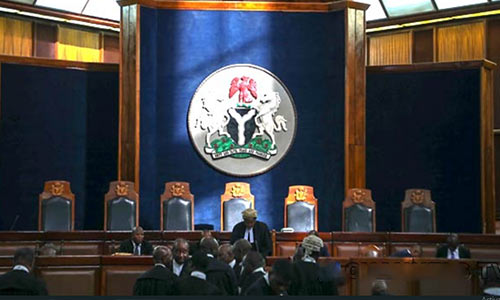
The Supreme Court on Friday set aside the decision of the Court of Appeal disqualifying Chief Wole Olanipekun (SAN) and Dr. Muiz Banire (SAN) from appearing as counsel for Neconde Energy Limited and Nestoil Limited, affirming the companies’ right to appoint their own legal representatives in a dispute challenging the validity of a receivership.

In a unanimous judgment delivered by Justice Mohammed Baba Idris, the apex court held that where the legality of a receiver’s appointment is itself in dispute, such a receiver cannot assume the authority to appoint counsel to represent the company in the same proceedings.
The ruling effectively restores Olanipekun’s appearance for Neconde and Banire’s representation of Nestoil in the high-profile $2 billion debt dispute involving a consortium of lenders led by FBNQuest Merchant Bank Limited and FBN Trustees Limited.
At the heart of the dispute was whether a receiver appointed by lenders could exclusively determine the legal representation of a company, even when the validity of that appointment is being challenged in court.
The Supreme Court answered in the negative.
Justice Idris noted that the questions submitted by the lenders before the trial court sought judicial interpretation on critical issues, including whether the lenders were entitled to enforce security, appoint a receiver, and whether the receiver could lawfully exercise powers under that appointment.
According to the court, these questions strike at the “very foundation” of the receivership, rather than relating to routine management or realization of assets.
“It would occasion a conflict of interest,” the court held, “for a receiver appointed by parties whose rights are being challenged to also determine the legal representation of the company in the same proceedings.”
The apex court emphasized that the receiver’s authority is derived from the very transaction under challenge, making it improper for such a receiver to control the company’s legal defence in a suit questioning that authority.
It further held that proceedings challenging the validity and scope of a receivership do not fall within the general powers granted to a receiver under Section 556(3) of the Companies and Allied Matters Act (CAMA) and its Eleventh Schedule.
In such circumstances, the court ruled, a company cannot be stripped of its residual powers to defend itself through its board of directors and counsel of its choice.
“The defence of the action through its directors and the counsel retained by them cannot be said to be incompetent merely because a receiver has been appointed,” Justice Idris declared.
The Supreme Court specifically faulted the Court of Appeal’s January 13, 2026 decision, which had disqualified Olanipekun, Banire, and their legal teams, while recognising the receiver as the sole authority competent to appoint counsel.
Describing that position as erroneous, the apex court held that the lower court failed to appreciate the conflict inherent in allowing a receiver—whose appointment is under judicial scrutiny—to control the company’s legal representation.
The case, marked SC/CV/48/2026, arises from an alleged $2 billion indebtedness owed by Nestoil and Neconde to a consortium of lenders.
Following an alleged default, the lenders appointed a Receiver/Manager to take control of the companies’ assets and operations.
By affirming that companies can retain independent legal representation in disputes challenging receivership arrangements, the Supreme Court has clarified a critical aspect of corporate governance and creditor enforcement, with implications for future insolvency proceedings.
 The book, titled The Law of Torts in Nigeria: A Functional Approach, authored by Professor Hagler Sunny Okorie Ph.D and Ikeocha, Nathaniel Ngozi Esq, offers law students, practitioners, and academics a comprehensive guide to understanding and applying tort law in Nigerian courts. Interested buyers can place orders via the following contact numbers: 08028636615, 08037667945, 08032253813, or +234 902 196 2209.
______________________________________________________________________
[A MUST HAVE] Evidence Act Demystified With Recent And Contemporary Cases And Materials
The book, titled The Law of Torts in Nigeria: A Functional Approach, authored by Professor Hagler Sunny Okorie Ph.D and Ikeocha, Nathaniel Ngozi Esq, offers law students, practitioners, and academics a comprehensive guide to understanding and applying tort law in Nigerian courts. Interested buyers can place orders via the following contact numbers: 08028636615, 08037667945, 08032253813, or +234 902 196 2209.
______________________________________________________________________
[A MUST HAVE] Evidence Act Demystified With Recent And Contemporary Cases And Materials

 ARTIFICIAL INTELLIGENCE FOR LAWYERS: A COMPREHENSIVE GUIDE
Reimagine your practice with the power of AI “...this is the only Nigerian book I know of on the topic.” — Ohio Books Ltd
Authored by Ben Ijeoma Adigwe, Esq., ACIArb (UK), LL.M, Dip. in Artificial Intelligence, Director, Delta State Ministry of Justice, Asaba, Nigeria.
Bonus:
Get a FREE eBook titled “How to Use the AI in Legalpedia and Law Pavilion” with every purchase.
ARTIFICIAL INTELLIGENCE FOR LAWYERS: A COMPREHENSIVE GUIDE
Reimagine your practice with the power of AI “...this is the only Nigerian book I know of on the topic.” — Ohio Books Ltd
Authored by Ben Ijeoma Adigwe, Esq., ACIArb (UK), LL.M, Dip. in Artificial Intelligence, Director, Delta State Ministry of Justice, Asaba, Nigeria.
Bonus:
Get a FREE eBook titled “How to Use the AI in Legalpedia and Law Pavilion” with every purchase.
How to Order: 📞 Call, Text, or WhatsApp: 08034917063 | 07055285878 📧 Email: benadigwe1@gmail.com 🌐 Website: www.benadigwe.com
Ebook Version: Access directly online at: https://selar.com/prv626
________________________________________________________________________ “Enhance Legal Practice With Authoritative Reports” — Alexander Payne Offers Comprehensive Law Reports, Spanning Over A Century Of Nigerian Jurisprudence Interested buyers are encouraged to place their orders and enquiries via:
0704 444 4777, 0704 444 4999, 0818 199 9888
Website: www.alexandernigeria.com
Interested buyers are encouraged to place their orders and enquiries via:
0704 444 4777, 0704 444 4999, 0818 199 9888
Website: www.alexandernigeria.com