By Kunle Edun

Arrests and detentions are justified only in limited circumstances by the Constitution. Section 35(4) of the Nigerian Constitution requires that a person who is arrested or detained in such circumstances shall be brought before a court of law within a reasonable time, and if he is not tried within a period of “two months from the date of his arrest or detention in the case of a person whois in custody or is not entitled to bail; or three months from the date of his arrest or detention in the case of a person who has been released on bail, he shall (without prejudice to any further proceedings that may be brought against him) be released either unconditionally or upon such conditions as are reasonably necessary to ensure that he appears for trial at a later date. “
Arrest
Arrest and detention constitute frontline issues in the administration of criminal justice system in Nigeria with the attendant problems of over-crowded detention facilities caused by the slow-paced judicial process and indiscriminate arrest by security agencies. It is not every crime that is committed that requires that an arrest must be carried out. Sections 6, 7, 8, 14, 15 & 18 of the Administration of Criminal Justice Act, 2015 (ACJA) made bold attempts at guiding the conduct of security agencies and their personnel including private persons when they are effecting arrests and how they must respect the fundamental rights of suspects, and made sufficient provisions curtailing subjective or arbitrary arrest
without warrant and also subjecting the exercise of the power of arrest to judicial moderation.
The ACJA specifically prohibits proxy arrest of family members and friends of a suspect in order to get a suspect to surrender. By Section 30 (1)&(2) of ACJA suspects must be charged to Court within 24 hours after arrest or granted administrative bail. However, in respect of capital offences like murder, armed robbery, treason and kidnapping (in some States), section 161(1) of ACJArequires that it is only the High Court that can grant bail. In some instances Magistrate Courts have granted bail after going through the facts of the case and there is nothing connecting the suspect.
Section 159(1) of ACJAauthorizes any Court to make an order directing an officer who has custody of a suspect to produce him in court on a specified date.
However, a detained suspect in a charge of capital offence must show exceptional circumstance which may include (a) ill health, (b) extraordinary delay in the investigation, arraignment and prosecution for a period exceeding one year and (c) any other circumstance that the judge may consider exceptional. It would be proper for a Magistrate Court to grant bail for a capital offence if the court considers that there is no link or there is a weak link connecting the suspect with the charge.The practice of holding charge is long gone There also instances of politically-contrived charges against innocent persons by prosecuting agencies. It is therefore the duty of the Court to consider all the facts before it and ensure that the Court is not used as a tool of oppression.
[A MUST HAVE] Evidence Act Demystified With Recent And Contemporary Cases And Materials

Available now for NGN 40,000 at ASC Publications, 10, Boyle Street, Onikan, Lagos. Beside High Court, TBS. Email publications@ayindesanni.com or WhatsApp +2347056667384. Purchase Link: https://paystack.com/buy/evidence-act-complete-annotation
______________________________________________________________________ “Enhance Legal Practice With Authoritative Reports” — Alexander Payne Offers Comprehensive Law Reports, Spanning Over A Century Of Nigerian Jurisprudence Interested buyers are encouraged to place their orders and enquiries via:
0704 444 4777, 0704 444 4999, 0818 199 9888
Website: www.alexandernigeria.com
Interested buyers are encouraged to place their orders and enquiries via:
0704 444 4777, 0704 444 4999, 0818 199 9888
Website: www.alexandernigeria.com
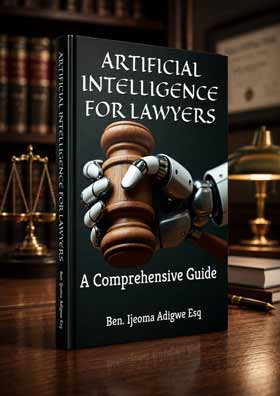 The book also examines Nigeria's legal ecosystem, focusing on the LPELR and NBA AI Guidelines. As a bonus, every purchase comes with a FREE eBook titled: How to Use the AI Features in LegalPedia and LawPavilion.
Ohio Books Ltd praises the publication, stating:
"....this is the only Nigerian book I know of on the topic."
How to Order:
📞 Call, Text, or WhatsApp: 08034917063 | 07055285878
📧 Email: benadigwe1@gmail.com
🌎 Website: www.benadigwe.com
Ebook Version: Access it directly online at https://selar.com/prv626
Authored by Ben Ijeoma Adigwe Esq., ACIarb (UK), LL.M, Dip. in Artificial Intelligence, Director at the Delta State Ministry of Justice, Asaba, Nigeria.
______________________________________________________________________
The book also examines Nigeria's legal ecosystem, focusing on the LPELR and NBA AI Guidelines. As a bonus, every purchase comes with a FREE eBook titled: How to Use the AI Features in LegalPedia and LawPavilion.
Ohio Books Ltd praises the publication, stating:
"....this is the only Nigerian book I know of on the topic."
How to Order:
📞 Call, Text, or WhatsApp: 08034917063 | 07055285878
📧 Email: benadigwe1@gmail.com
🌎 Website: www.benadigwe.com
Ebook Version: Access it directly online at https://selar.com/prv626
Authored by Ben Ijeoma Adigwe Esq., ACIarb (UK), LL.M, Dip. in Artificial Intelligence, Director at the Delta State Ministry of Justice, Asaba, Nigeria.
______________________________________________________________________