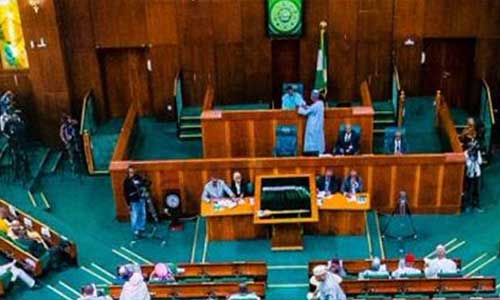
Despite winning the presidential election and producing the majority of Senators in the 10th National Assembly, the All Progressives Congress (APC) is at least 21 seats short of an absolute majority in the House of Representatives.

The governing party needs 181 seats in the 360-member House of Representatives to form the majority and elect a Speaker.
The APC has secured 55 seats in the Senate, giving it a simple majority in the 109-member Red Chamber.
As things stands, opposition parties, who have won a total of 165 seats, are closer to attaining the 181 seats target than the ruling party in the race to determine who nominates the speaker.
Eight political parties were able to win seats in the House of Representatives in the just concluded National Assembly elections held on February 25, 2023.
While the APC won a total of 160 seats, seven other political parties won a total of 165 seats, five more than the ruling party.
For the opposition, winning majority seats in the lower legislative chamber would mean they get to displace the APC of chairmen of important committees.
And in spite of moves by candidates of the ruling party to contest for speaker, the reality is that they still don’t have a majority.
The Independent National Electoral Commission last week announced April 15, 2023 as the date it will conduct supplementary polls in elections across the states that were judged to be inconclusive. They include governorship election in Adamawa and Kebbi States.
Elections will also hold in 33 federal house constituencies, which will likely determine whether the APC or the coalition of seven opposition parties will hold the absolute majority in the House of Representatives.
So far, INEC has presented certificates of return to 98 senators-elect out of the 109 seats in the upper legislative chamber, while 325 House of Representatives-elect have received theirs out of the 360 seats in the lower chamber.
Also, the nation’s electoral body declared elections inconclusive in some of the senatorial districts and federal constituencies due to some factors.
LEADERSHIP Sunday however observed a slight but fundamental change in the pattern of voting which is alien to what was obtainable in the past.
According to the 10th edition of the House Rules book, Standing Order, voting shall be conducted only by electronic voting or by open ballot.
This is different from the rule as contained in the 9th edition House Rules published in March 2016 under the leadership of former speaker Yakubu Dogara.
Section 3 (f) of the 9th edition provides that “(f) When two or more members-elect see nominated and seconded as Speaker and where two or more accept, the election shall be conducted as follows: (i) by electronic voting or voting or (ii)Voting by secret ballot which shall be conducted by the Clerks-at-Table using the list of the members-elect of the House who shall each be given a ballot paper to cast his vote with the proposers and seconders as tellers.”
But in the new 10th edition published in August 2022, the secret ballot pattern was deleted and a provision has been included to mandate an open ballot pattern. The new Rule also specifically provides that only the Clerk or Deputy Clerk to the National Assembly can conduct the election as against the Clerk-at-Table proviso in the 9th edition.
“(f) When two or more members-elect see nominated and seconded as Speaker and where two or more accept, the election shall be conducted as follows. (i) by electronic voting or voting or (ii) Voting shall be conducted by the Clerk to the National Assembly or Deputy Clerk to the National Assembly using the list of the members-elect with the proposers and secondary as tellers (iii) every member voting shall name clearly and in the open the candidate of his choice.”
However, just like what is obtainable with the 9th edition, a Speaker will be elected by simple majority votes; but in the situation that more than two members elect were nominated, seconded and nominations accepted, the member-elect who has received more than one-half of the votes shall be the speaker-elect.
Anyone who is a returning lawmaker is qualified to be elected as the Senate President or speaker. The standing rules of Nigeria do not allow a first-time lawmaker to be elected as Senate President or speaker.
In fact, the standing rules do not give room for any first term lawmaker to be given the office of a principal office nor a presiding officer’s office.
The Senate president is chosen in an indirect election conducted within the senate. The line of succession to the Nigerian presidency goes to the vice president, and then the Senate president, if both the president and vice president are unable to discharge the powers and duties of office.
The opposition parties that have won seats in the House of Representatives are PDP, which has 103 seats, Labour Party with 34 seats, New Nigeria People’s Party with 18 seats and All Progressives Grand Alliance, which won four seats.
The Social Democratic Party and the African Democratic Congress have two seats each, while the Young Progressives Party has a single seat.
On April 15, however, all 11 seats in Sokoto are up for grabs as elections there were declared inconclusive due to ballot snatching and over voting. But the most APC can get in Sokoto is eight seats in its search for a majority in the 10th National Assembly.
The election in House of Representatives elections in three federal constituencies namely, Shagari/Yabo, Gada/Goronyo and Tambuwal/Kebbe seems to be going in the direction of the PDP, with a massive lead prior to the inconclusive logjam.
But, the outcome of the state governorship election could likely have a bandwagon effect on the supplementary elections in affected polling units in the state.
APC is likely to retain Wamakko/Kware, Gudu/Tangaza, Isa/Sabon-Birni, Illela/Gwadabawa, Wurno/Rabah and snatched from the jaws of PDP, Sokoto North/South, Binji/Silame and Bodinga/Dange-Shuni/Tureta federal constituencies.
With the likelihood of three House of Representatives seats or more in the kitty of PDP, Governor Aminu Waziri Tambuwal, himself a former Speaker, will surely have interest in who presides over the 10th House of Representatives.
Supplementary elections will also hold Akwa Ibom where two federal constituencies will be decided, Abak/EtimEkpo/Ika federal constituency and Ikono/Ini federal constituency. In Anambra, the party to represent Obgaru federal constituency will be decided on April 15, while the Southern Ijaw federal constituency in Bayelsa will also be in deduced.
Elections will also hold Edo, Jigawa, Imo, Kano, Kogi, Oyo, Rivers, Taraba and Zamfara on April 15.
[A MUST HAVE] Evidence Act Demystified With Recent And Contemporary Cases And Materials

Available now for NGN 40,000 at ASC Publications, 10, Boyle Street, Onikan, Lagos. Beside High Court, TBS. Email publications@ayindesanni.com or WhatsApp +2347056667384. Purchase Link: https://paystack.com/buy/evidence-act-complete-annotation
______________________________________________________________________ “Enhance Legal Practice With Authoritative Reports” — Alexander Payne Offers Comprehensive Law Reports, Spanning Over A Century Of Nigerian Jurisprudence Interested buyers are encouraged to place their orders and enquiries via:
0704 444 4777, 0704 444 4999, 0818 199 9888
Website: www.alexandernigeria.com
Interested buyers are encouraged to place their orders and enquiries via:
0704 444 4777, 0704 444 4999, 0818 199 9888
Website: www.alexandernigeria.com