“Orders Officers To Wear Name Tags, Display Force Numbers, Declares Anonymous Policing Unlawful”

The Federal High Court sitting in Warri, Delta State, has delivered a landmark judgment affirming the constitutional right of Nigerian citizens to record, photograph, and document police officers performing their duties in public spaces, and declaring anonymous policing — the failure of officers to wear visible identification while on duty — unlawful and unconstitutional.
The judgment, delivered by Justice H. A. Nganjiwa in Suit No. FHC/WR/CS/87/2025, Maxwell Nosakhare Uwaifo v. Inspector-General of Police & 3 Ors., arose from a personal encounter the applicant, a legal practitioner, had with anonymous police officers at a checkpoint, and was brought as a public interest litigation on behalf of himself and in the interest of the Nigerian public.
Court documents reveal that the case was triggered by an incident on May 10, 2025, when Maxwell Nosakhare Uwaifo, a lawyer with Lex Phronesis Solicitors based in Ekpan, Warri, was travelling from Benin to Warri.
In his affidavit sworn at the Federal High Court Registry, Warri, on July 31, 2025, Uwaifo deposed that immediately after the Sapele roundabout, he encountered a group of men who blocked the road with a vehicle and were stopping cars in what appeared to be a police checkpoint.
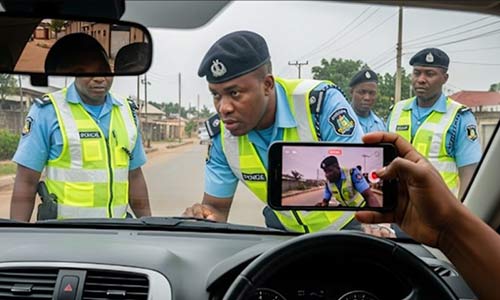
The men flagged him down and began questioning him in a harsh and aggressive manner, without any lawful basis or reasonable suspicion of wrongdoing. Uwaifo attempted to observe and record the exchange with his mobile phone because their tone and conduct gave the impression of extortion or harassment.
However, immediately he brought out his phone, one of the men, dressed in black and appearing to be a police officer, threatened to arrest him and demanded that he put his phone away.
Uwaifo’s affidavit detailed how the officers did not wear any name tags, nor did they introduce themselves or make any effort to disclose their identity or provide a reason for their conduct. The vehicle they used was a Toyota Sienna, painted black, with no police inscription, no plate number, and no markings whatsoever to identify it as a police vehicle.
The lawyer deposed that he was deeply unsettled by the fact that he could not identify any of the officers by name or number, and that they were operating out of an unmarked vehicle with no police insignia, plate number, or department markings.
He stated that the officers carried firearms and issued commands with aggression, making it unsafe and imprudent for him to demand their identification or question their authority. The entire interaction was intimidating, and the men created a hostile atmosphere in which Uwaifo could not confidently ask questions or continue to record for fear of being manhandled or unlawfully detained.
Uwaifo deposed that he had to comply in fear and leave quietly because he did not want to risk being physically assaulted, arrested, or having his phone forcefully taken from him. Due to the fear and the officers’ threatening demeanour, he could not gather any concrete evidence, nor could he record the video or identify them clearly due to the absence of name tags and their use of an unmarked vehicle.
He also disclosed a second similar incident in Warri around the Effurun Roundabout axis in June 2025, where armed police officers conducting checks displayed no name tags, badges, or force numbers on their uniforms.
The suit was brought pursuant to Sections 34, 35, 41, and 46 of the Constitution of the Federal Republic of Nigeria 1999, as amended, Articles 5, 6, 7, 9, and 11 of the African Charter on Human and Peoples’ Rights (Ratification and Enforcement) Act, the Fundamental Rights Enforcement Procedure Rules 2009, and Sections 4 and 7 of the Nigeria Police Act 2020.
In his written address filed in support of the originating summons, Uwaifo raised five issues for the court’s determination:
Whether the refusal of police officers to wear name tags or display force numbers during stop-and-search operations violated the Constitution and the Police Act; whether preventing citizens from filming police officers during official duties violated the constitutional right to freedom of expression; whether the applicant was entitled to public interest redress and damages; whether the applicant had locus standi to institute the action in public interest; and whether the respondents had a constitutional and statutory duty to ensure proper identification of their personnel.
Central to the applicant’s argument was Section 66(1) of the Nigeria Police Act 2020, which provides that a police officer while on uniform duty shall at all times wear a name tag and identification number clearly displayed on his uniform.
Uwaifo argued in his written address that this statutory requirement is not ornamental — it is a safeguard of transparency, accountability, and lawful conduct. He submitted that by deploying officers without names or force numbers, the respondents breach their duty of care to the public, undermine civilian oversight, and render themselves vulnerable to allegations of complicity in unlawful acts.
He further cited Section 8(1)(c) of the Police Act, which provides that one of the core duties of the police is to protect and uphold the rights and freedom of every person in Nigeria as provided in the Constitution, the African Charter, and other applicable laws.
On the right to record, Uwaifo argued that the act of recording police officers in the lawful execution of their public duties falls squarely within Section 39(1) of the 1999 Constitution, which provides that every person shall be entitled to freedom of expression, including freedom to hold opinions and to receive and impart ideas and information without interference.
He submitted that neither the Criminal Code Act, the Penal Code, the Police Act 2020, nor any other Nigerian statute criminalises the act of recording public officials. He argued that any interference with this right must, under Section 45(1) of the Constitution, be by a law of general application and necessary in a democratic society — and no such law exists.
Citing multiple judicial authorities, including the Court of Appeal decisions in Arthur Nwankwo v. The State (1985) and I.G.P. v. Ubah (2014), and the Supreme Court decisions in Fawehinmi v. Abacha (2000) and Centre for Oil Pollution Watch v. NNPC (2019), Uwaifo argued that police officers performing public functions have no reasonable expectation of privacy, that public officials owe a duty to operate transparently, and that recording is a valid exercise of civic responsibility consistent with international best practices.
The Attorney-General of the Federation, the 4th Respondent, represented by Maimuna Lami Shiru (Mrs.), Director of Civil Litigation and Public Law at the Federal Ministry of Justice, filed a written address but did not file a counter-affidavit — meaning the applicant’s affidavit evidence stood unchallenged and was deemed admitted.
In his reply on point of law, Uwaifo argued that the AGF could not contradict facts by written address alone, as written address is not evidence. He also rejected the AGF’s argument that the suit was frivolous, citing the Fundamental Rights Enforcement Procedure Rules 2009, which provide under the Preamble that the court shall encourage public interest litigation in the human rights field and no human rights case may be dismissed for want of locus standi.
The Reliefs Granted
Justice Nganjiwa granted all of the applicant’s claims and made the following orders:
A declaration that the failure of police officers to wear visible name tags and display force numbers while on duty is unlawful and unconstitutional.
A declaration that Nigerian citizens have the constitutional right to record, photograph, and document police officers performing their duties in public spaces.
A declaration that any act of harassment, intimidation, arrest, or seizure of devices from citizens for recording police officers is unlawful and unconstitutional.
An order directing the respondents to ensure that police officers on duty are properly identifiable by wearing name tags, displaying force numbers, or carrying appropriate identification.
A perpetual injunction restraining the respondents from further interfering with or harassing citizens who record police activities in public.
An award of N5 million as damages for the violation of fundamental rights.
An award of N2 million as cost of litigation, bringing the total monetary award to N7 million.
Although the applicant had originally sought N80 million in general and exemplary damages, the court exercised its discretion in awarding N5 million in damages and N2 million in costs.
Justice Nganjiwa held that the right to record police officers performing public duties is protected under Section 39 of the Constitution, and that law enforcement must operate within the bounds of transparency, accountability, and the rule of law. The court further held that anonymous policing and interference with the lawful recording of police activities are inconsistent with constitutional guarantees of dignity, personal liberty, and freedom of expression.
Maxwell v. IGP Any Arrest Or Seizure Of Devices For Recording Police Is UnconstitutionalWhile the judgment now provides definitive judicial authority on the right to record police officers, the Nigeria Police Force had previously acknowledged this right through its spokesperson. The Force Public Relations Officer, DCP Olumuyiwa Adejobi, had earlier clarified that taking videos or pictures of police officers on duty is not an offence, adding that every police officer is aware that no law criminalises citizens from recording them.
Despite this official position, officers on the ground have continued to harass citizens who attempt to film them — a disconnect between policy and practice that the court’s judgment now seeks to address with the force of law.
The ruling is expected to have far-reaching implications for policing standards in Nigeria. The Inspector-General of Police, the Nigeria Police Force, the Police Service Commission, and the Attorney-General of the Federation are now under court orders to ensure officers are identifiable and to cease interference with citizens who record police activities.
The judgment comes at a time of heightened concern about police conduct, particularly following the EndSARS protests of October 2020 and recurring viral incidents of officers harassing citizens for filming them, including a recent incident in Lagos where an officer attempted to forcibly remove smart glasses with camera features from a motorist during a stop-and-search.
The case was brought by Maxwell N. Uwaifo, LLB, BL, LLM, ACIArb, of Lex Phronesis Solicitors, No. 57, NNPC Housing Complex Road, Ekpan/Warri, Uvwie Local Government Area, Delta State.

 ARTIFICIAL INTELLIGENCE FOR LAWYERS: A COMPREHENSIVE GUIDE
Reimagine your practice with the power of AI “...this is the only Nigerian book I know of on the topic.” — Ohio Books Ltd
Authored by Ben Ijeoma Adigwe, Esq., ACIArb (UK), LL.M, Dip. in Artificial Intelligence, Director, Delta State Ministry of Justice, Asaba, Nigeria.
Bonus:
Get a FREE eBook titled “How to Use the AI in Legalpedia and Law Pavilion” with every purchase.
ARTIFICIAL INTELLIGENCE FOR LAWYERS: A COMPREHENSIVE GUIDE
Reimagine your practice with the power of AI “...this is the only Nigerian book I know of on the topic.” — Ohio Books Ltd
Authored by Ben Ijeoma Adigwe, Esq., ACIArb (UK), LL.M, Dip. in Artificial Intelligence, Director, Delta State Ministry of Justice, Asaba, Nigeria.
Bonus:
Get a FREE eBook titled “How to Use the AI in Legalpedia and Law Pavilion” with every purchase.
How to Order: 📞 Call, Text, or WhatsApp: 08034917063 | 07055285878 📧 Email: benadigwe1@gmail.com 🌐 Website: www.benadigwe.com
Ebook Version: Access directly online at: https://selar.com/prv626
________________________________________________________________________ The Law And Practice Of Redundancy In Nigeria: A Practitioner’s Guide, Authored By A Labour & Employment Law Expert Bimbo Atilola _______________________________________________________________________