By Dr David Hoile

The International Criminal Court (ICC) was established by the Rome Statute, adopted by delegates to the United Nations Diplomatic Conference of Plenipotentiaries on the Establishment of an International Criminal Court in Rome on 17 July 1998. The Court opened its doors on 1 July 2002, following ratification by 60 states. Based in The Hague, Netherlands, it is a treaty-based international organisation governed by the Assembly of States Parties (ASP) — its signatories — with a mandate as a court of last resort to prosecute individuals for genocide, crimes against humanity, war crimes, and the crime of aggression.
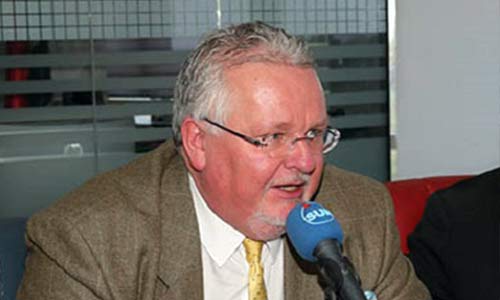
On 17 May 2017, an International Criminal Court Judge, Marc Perrin de Brichambaut, gave a talk at Peking Law School. The presentation was videoed and, unfortunately for him but luckily for observers of the Court, subsequently transcribed and published. The talk provided outsiders with a window into the reality of the Court in the words of a key insider, as opposed to the judicial fantasy that has been projected by its European masters and supporters within national and international human rights industries. De Brichambaut demonstrated the European arrogance and racism at the heart of the Court and candidly described a subprime body delivering subprime “justice”.
Judge de Brichambaut personified virtually everything that is wrong about the ICC. To start with, de Brichambaut is not really a judge as would be understood in Anglo-Saxon jurisprudence or popular culture. Judge Judy would definitely not have approved. As is clear from his curriculum vitae he is a French and European civil servant, diplomat and academic, deemed safe and compliant enough to be elected by the ASP to the ICC bench. In that respect de Brichambaut is typical of the pseudo-judges appointed to serve in The Hague. He worked as a civil servant at the Council of State in France and then from 1983-98 he worked for the French Foreign Ministry, including as Cultural Counsellor at the French embassy in the United States. He headed the French delegation to the Rome Conference and signed the Rome Statute of the ICC on behalf of France. He subsequently served at the French Ministry of the Armed Forces and from 2011 to 2015 was the Secretary General of the Organisation for Security and Co-operation in Europe. Without any hands-on courtroom experience, he was nonetheless elected as an ICC judge, serving from 2015-2024, latterly as the Vice-President of the Court from 2018-2021. It is an open secret that ICC judges have been elected by way of corrupt FIFA-esque vote-trading between States Parties, a process described by Amnesty International as “government lobbying campaigns, which are often based on unseemly secret agreements to trade support for candidates for other political goals.” Not only does vote-trading demonstrate political manipulation of the Court, it also explains the incompetence shown by many ICC judges: Far from securing the best legal minds, vote-trading produces mediocrity. As a result of what the International Justice Monitor describes as “Toxic campaigns and vote trading” many of those elected as ICC judges haven’t even been lawyers, let alone judges before their appointment to the bench (a few real judges do get elected, possibly by accident). This has led to questionable verdicts, appalling procedural errors and miscarriages of justice at the Court. In his talk, de Brichambaut also provides a window into the lackadaisical attitudes at the Court. As presiding judge of Trial Chamber II, de Brichambaut issued a reparations ruling in 2017 against former Congolese militia leader Germain Katanga. He admitted that a key 1,003-page Annex to the Katanga reparations order – which appeared under his name – was written by interns.
Judge de Brichambaut also let the cat out of the bag when he summed up the reality of the structural dynamics of the ICC. In his talk he stated that European countries were “paying the bills for the ICC” (and as we all know “he who pays the piper calls the tunes”), and described African states as “a group of 54 countries who provide the suspects and the accused” for the Court. In so doing he confirmed what many Africans had long believed, that the ICC was a European-funded instrument of European – and especially French – foreign policy in Africa. A year earlier a Gambian minister had described the ICC as “an International Caucasian Court for the persecution and humiliation of people of colour, especially Africans”. The Court had indeed focused very disproportionately on the African continent, having only indicted black Africans in the first twenty years of its existence. Rwanda’s President Paul Kagame summed up African frustration: “[W]ith ICC all the injustices of the past including colonialism, imperialism, keep coming back in different forms. They control you. As long as you are poor, weak there is always some rope to hang you. The ICC is made for Africans and poor countries.”
In addition to revealing that Africa and Africans had been racially profiled by the European-funded ICC, Judge de Brichambaut, who also found time to teach law in France, also confirmed that Africa been targetted by a clearly flawed body in a dubious European legal experiment, admitting “the [Rome] Statute is not a perfect legal object . . . you have in a text like the Rome Statute, many elements which are at a very unequal degree of elaboration . . .” He then went on to state “I tend . . . to be perfectly honest” in telling his students in France to “see [the ICC] as a major experimental organization, do not see it as a final construction. It will take many-many-many years to stabilize the institution and to create all the good practices which are inherent to . . . an international tribunal.” De Brichambaut went on to describe an appalling disconnect in “judging” at the Court. ICC judges sit in several divisions called chambers. He admitted that “you have diverging approaches by different chambers” and that “the procedural rights are basically the initiative of the chambers, which means that there are great variations among chambers.” Simply put, the same case would be dealt with differently within the same court depending on which group of lacklustre judges was on duty at the time: Potluck justice in front of potluck judges. In the meantime Africa would seemingly have to make do with clearly flawed White Man’s justice. The African Union’s former chairman, Jean Ping, had presciently noted in 2010 that “We are not against international justice. It [just] seems that Africa has become a laboratory to test the new international law.” In 2016 President Kenyatta also kicked back: “Africa is not a third-rate territory of second-class peoples, we are not a project, or experiment of outsiders.” African concerns have also been borne out by other ICC Judges, both before and after de Brichambaut’s revelations. Sir Adrian Fulford, one of the few real judges at the Court, had warned in 2011 that “it is dangerous for first-instance judges to use a serious war crimes trial as a laboratory experiment.” And in 2018 ICC Judge Christine Van den Wyngaert also admitted “at this stage in the life of the Court we are still discussing our basic vocabulary.”
Judge de Brichambaut elaborated on how “experimental” the ICC was being – “experimental” being a euphemism to describe a Court that was brazenly making things up as it went along. He cited ICC Prosecutor Luis Ocampo’s invented way of jump-starting African cases before the Court. The cornerstone of the ICC is the principle of complementarity. The Court was designed to be a court of last resort, only acting if a signatory State Party was unable or unwilling to prosecute genocide, crimes against humanity or war crimes. Article 14 of the Rome Statute deals with how case referrals to the Prosecutor were to be made: “[A] State Party may refer to the Prosecutor a situation in which one or more crimes within the jurisdiction of the Court appear to have been committed . . .” The preeminent international legal scholar Professor William Schabas, present at the Rome Conference and author of the definitive 1,600-page The International Criminal Court: A Commentary on the Rome Statute, has clarified that “The drafting history of article 14 of the Rome Statute leaves little doubt that what was considered was a ‘complaint’ by a State party against another State.” The Prosecutor conjured up cases regardless by corrupting the very Statute he had been appointed to uphold. He pressurised the governments of Uganda and Democratic Republic of Congo into referring crimes committed by rebel forces within their own territory — as opposed to the territory of another State Party — to the ICC prosecutor, ignoring the inconvenient fact that both countries had functional legal systems and were willing to prosecute. Professor Schabas was scathing about Ocampo’s trick of “self-referral”: “There was only one problem: it is not in the ICC Statute. Yet, the judicial activism of the Pre-Trial Chamber on this point went unchallenged.“
Judge de Brichambaut was very clearly aware of this political sleight of hand on the part of the International Criminal Court and its Prosecutor, a corruption of Article 14 of the Rome Statute he had himself negotiated, describing it as a “sort of pump priming. There was nothing. No precedent. So, he made a . . . very ambiguous choice . . . quite a radical policy choice”. The Court’s chicanery did not go unnoticed. The Economist noted that “impressions that the judges and prosecutor were making the rules up as they went along were often accurate”. Several equally corrupted Prosecutor-engineered self-referrals would follow in Central African Republic, Mali and the Ivory Coast, often as an adjunct to European military involvement in those countries.
Two years after de Brichambaut’s lecture, four former Presidents of the Assembly of States Parties published an article headlined “The International Criminal Court needs fixing” in which they stated: “We are disappointed by the quality of some of its judicial proceedings, frustrated by some of the results, and exasperated by the management deficiencies that prevent the Court from living up to its full potential.” The ASP subsequently commissioned an Independent Expert Review of the Court which reported back on 30 September 2020 with 384 recommendations to address failings at the Court of which 76 were highlighted as needing to be “prioritised”. African states have been destabilised, its political leaders criminalised and peace processes wrecked by a judicially-incompetent, European-funded body pretending to be a world court. The ICC is an organisation widely acknowledged even by its supporters to be very flawed. To their discredit de Brichambaut and many, many more people like him, have been more than willing to play their part in this dangerous farce.
Dr David Hoile is the author of Justice Denied: The Reality of the International Criminal Court.
 ARTIFICIAL INTELLIGENCE FOR LAWYERS: A COMPREHENSIVE GUIDE
Reimagine your practice with the power of AI “...this is the only Nigerian book I know of on the topic.” — Ohio Books Ltd
Authored by Ben Ijeoma Adigwe, Esq., ACIArb (UK), LL.M, Dip. in Artificial Intelligence, Director, Delta State Ministry of Justice, Asaba, Nigeria.
Bonus:
Get a FREE eBook titled “How to Use the AI in Legalpedia and Law Pavilion” with every purchase.
ARTIFICIAL INTELLIGENCE FOR LAWYERS: A COMPREHENSIVE GUIDE
Reimagine your practice with the power of AI “...this is the only Nigerian book I know of on the topic.” — Ohio Books Ltd
Authored by Ben Ijeoma Adigwe, Esq., ACIArb (UK), LL.M, Dip. in Artificial Intelligence, Director, Delta State Ministry of Justice, Asaba, Nigeria.
Bonus:
Get a FREE eBook titled “How to Use the AI in Legalpedia and Law Pavilion” with every purchase.
How to Order: 📞 Call, Text, or WhatsApp: 08034917063 | 07055285878 📧 Email: benadigwe1@gmail.com 🌐 Website: www.benadigwe.com
Ebook Version: Access directly online at: https://selar.com/prv626
________________________________________________________________________ The Law And Practice Of Redundancy In Nigeria: A Practitioner’s Guide, Authored By A Labour & Employment Law Expert Bimbo Atilola _______________________________________________________________________
[A MUST HAVE] Evidence Act Demystified With Recent And Contemporary Cases And Materials
_______________________________________________________________________
[A MUST HAVE] Evidence Act Demystified With Recent And Contemporary Cases And Materials