The Supreme Court of Nigeria has delivered a judgment on the law of estate agency, holding that an estate agent is not automatically entitled to commission simply because he introduced a buyer to a property, and that he must demonstrate that his introduction was the main and effective reason why the sale eventually took place.

The judgment, delivered by a five-member panel comprising Justices Garba, Jauro, Adumein, Ogbuinya, and Umar, settles a legal dispute that has been winding through Nigerian courts for nearly 19 years since the suit was originally filed in October 2007.
The case involved Philip Kayode Olusegun Ojo, a professional Estate Surveyor and Valuer trading as P. K. Ojo & Co., who claimed he sourced a property known as Plots 9, 10 and 11, Awodiora Industrial Estate, Kirikiri, Lagos, measuring about 20 acres, for purchase by SDV Nigeria Limited through a managerial officer of the company, Mr. Adebola Adejobi.
The property was owned by SCOA Nigeria Limited. Ojo alleged that despite introducing the property to SDV and facilitating negotiations, the company eventually purchased the property from SCOA behind him without paying his professional agency commission.
Ojo claimed the sum of US$1,250,000 (or its naira equivalent of N161,250,000 at the then exchange rate of N129 to one dollar) as agency commission, together with N23,620,000 as special damages and N50,000,000 as cost of the action, plus 21 per cent interest per annum.
The trial court, in a judgment delivered on December 24, 2013, granted the agent’s claim in part. SDV Nigeria Limited appealed to the Court of Appeal, which allowed the appeal and set aside the trial court’s decision. Dissatisfied, the estate agent further appealed to the Supreme Court.
The central issue before the Supreme Court was whether, in the absence of a formal agency relationship between the estate agent and SDV, the agent was entitled to professional fees, and whether the Court of Appeal was right to set aside the monetary award given by the trial court.
Chief A. A. Aribisala SAN, leading Martin Abah Esq. and Mitchel A. Aribisala Esq. for the agent, argued that the facts clearly disclosed an agency relationship. He contended that the agent introduced the property to SDV through Adejobi, who had informed the agent that the company was urgently looking for a property to acquire.
He submitted that SDV’s Managing Director subsequently carried out a confirmatory inspection of the property, which demonstrated acknowledgment of the agent’s role. He argued that Adejobi’s authority was confirmed by the conduct of SDV, that the consent of a principal to an agency relationship need not always be express but may be implied, and that the lower court erred in holding that the introduction was not the effective cause of the purchase.
He further argued that the Court of Appeal was wrong to require an express commission agreement, submitting that since the agreement between the parties was oral, the obligation to pay commission should be implied from the surrounding circumstances.
A. Candide-Johnson SAN, leading Emmanuel Ekpenyong Esq. for SDV, argued that no agency relationship existed. He maintained there was no consensus ad idem capable of creating an agency agreement and that silence does not constitute acceptance in law.
Crucially, he revealed that SDV had commenced negotiations for the property as early as March 2006 — approximately three months before the agent allegedly introduced the property — meaning the agent’s introduction could not have been the effective cause of the transaction.
He also argued that in estate agency transactions, a commission agreement constitutes a necessary precondition for a valid claim, and that the doctrines of agency by estoppel and ratification must be established by clear and unequivocal evidence.
The Supreme Court resolved the issue in favour of SDV, affirming the Court of Appeal’s decision and laying down important principles on estate agency law.
The court held that an estate agent is not automatically entitled to commission simply because he introduced a buyer or tenant to a property. The agent must show that his introduction was the main and effective reason why the sale or lease eventually took place.
The court explained that where an estate agent, without any prior agreement, merely informs someone about a property that may interest them, the agent cannot later demand payment of an agency fee or commission just for providing that information.
The Supreme Court further held that when a person voluntarily gives another person a benefit — such as providing information or doing some work without being asked to do so — the recipient of that benefit is not legally bound to pay for it. The person receiving the benefit is free to use the information or work in any way they choose without owing any obligation to the person who provided it.
Applying these principles, the court held that the agent was unable to establish that his alleged introduction of the property was the real and effective cause that led to SDV’s purchase of the property. For that reason, the agent was not entitled to claim any agency commission.
The ruling has far-reaching implications for estate agency practice in Nigeria. It establishes several important principles.
First, mere introduction of a property to a potential buyer does not, by itself, entitle an agent to commission. The agent must demonstrate that the introduction was the proximate and effective cause of the eventual transaction.
Second, where no prior agreement on commission exists between an agent and a purported principal, the agent bears the burden of proving that an agency relationship was created by conduct or circumstances.
Third, voluntary provision of information or services does not create a legal obligation on the recipient to pay, and the recipient is free to use such information without incurring liability.
Fourth, silence does not constitute acceptance of an offer of agency services, and an agency relationship cannot be implied merely from the fact that a party acted on information provided by the agent.
The judgment serves as an important caution to estate agents and valuers to ensure that agency agreements, including terms of commission, are clearly documented before providing services, rather than relying on implied arrangements or assumptions that introduction alone will guarantee payment.
The case is fully reported at (2026) 3 CLRN in association with ALP NG & Co.
 ARTIFICIAL INTELLIGENCE FOR LAWYERS: A COMPREHENSIVE GUIDE
Reimagine your practice with the power of AI “...this is the only Nigerian book I know of on the topic.” — Ohio Books Ltd
Authored by Ben Ijeoma Adigwe, Esq., ACIArb (UK), LL.M, Dip. in Artificial Intelligence, Director, Delta State Ministry of Justice, Asaba, Nigeria.
Bonus:
Get a FREE eBook titled “How to Use the AI in Legalpedia and Law Pavilion” with every purchase.
ARTIFICIAL INTELLIGENCE FOR LAWYERS: A COMPREHENSIVE GUIDE
Reimagine your practice with the power of AI “...this is the only Nigerian book I know of on the topic.” — Ohio Books Ltd
Authored by Ben Ijeoma Adigwe, Esq., ACIArb (UK), LL.M, Dip. in Artificial Intelligence, Director, Delta State Ministry of Justice, Asaba, Nigeria.
Bonus:
Get a FREE eBook titled “How to Use the AI in Legalpedia and Law Pavilion” with every purchase.
How to Order: 📞 Call, Text, or WhatsApp: 08034917063 | 07055285878 📧 Email: benadigwe1@gmail.com 🌐 Website: www.benadigwe.com
Ebook Version: Access directly online at: https://selar.com/prv626
________________________________________________________________________ The Law And Practice Of Redundancy In Nigeria: A Practitioner’s Guide, Authored By A Labour & Employment Law Expert Bimbo Atilola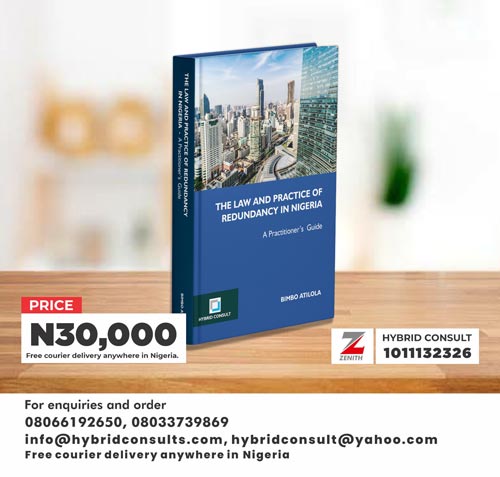 _______________________________________________________________________
[A MUST HAVE] Evidence Act Demystified With Recent And Contemporary Cases And Materials
_______________________________________________________________________
[A MUST HAVE] Evidence Act Demystified With Recent And Contemporary Cases And Materials