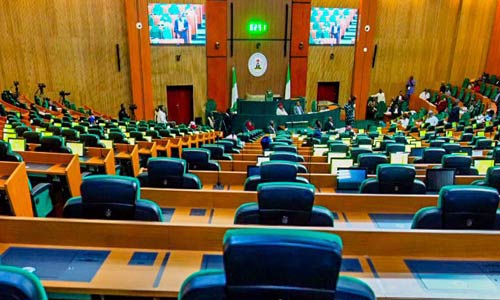
The House of Representatives has been divided over a motion seeking the cancellation of outstanding loans obtained by Nigerian farmers under government-backed agricultural intervention programmes, following allegations that some beneficiaries diverted the funds into real estate and other businesses unrelated to agriculture.

While some lawmakers argued that farmers struggling with insecurity, natural disasters and economic hardship deserved debt relief, others warned that granting a blanket waiver without investigating how the loans were utilised could encourage the mismanagement of public funds.
The disagreement arose during plenary on Wednesday, November 18, 2026, following a motion sponsored by the member representing Yamaltu/Deba Federal Constituency of Gombe State, Inuwa Garba.
Garba urged the House to consider waiving outstanding agricultural loans, arguing that many farmers had been unable to meet their repayment obligations because of circumstances beyond their control.
He explained that insecurity, banditry, insurgency, farmer-herder conflicts, flooding, drought and other natural disasters had disrupted agricultural production, destroyed investments and substantially reduced farmers’ incomes.
According to him, the challenges had been compounded by soil degradation, declining soil fertility, inadequate irrigation infrastructure and insufficient veterinary and disease control services.
“The House is concerned that widespread insecurity, banditry, insurgency, farmer-herder conflicts, flooding, drought, climate change and other natural and human-induced disasters like soil degradation, poor soil fertility, poor irrigation infrastructure and inadequate veterinary and disease control services have severely disrupted agricultural activities, resulting in substantial crop failures, food insufficiency, loss of investments and diminished farm incomes,” Garba stated.
The lawmaker maintained that the inability of many beneficiaries to repay government-backed agricultural loans should not automatically be interpreted as deliberate refusal to meet their financial obligations.
“The House is concerned that many beneficiaries of government-sponsored agricultural loans have been unable to meet their repayment obligations, not necessarily due to unwillingness to repay, but because circumstances beyond their control have substantially undermined their productive capacity and financial stability,” he said.
Garba warned that continued enforcement of outstanding agricultural debts, including principal, interest and penalties, could deepen poverty among affected farmers and expose them to the risk of losing their assets.
“We are worried that the continued accumulation and enforcement of outstanding agricultural debts, including principal, interest and penalties, could push already distressed farmers into deeper poverty, expose them to asset seizures and discourage their participation in future agricultural activities,” he added.
He argued that insisting on repayment under the prevailing economic circumstances could defeat the objectives of the agricultural intervention programmes, which were introduced to support farmers, improve food production and strengthen national food security.
Over the years, the Federal Government, through the Central Bank of Nigeria (CBN) and other financial institutions, introduced agricultural financing initiatives, including the Anchor Borrowers’ Programme, the Commercial Agriculture Credit Scheme and facilities supported by the Nigeria Incentive-Based Risk Sharing System for Agricultural Lending (NIRSAL).
The programmes were intended to provide financing for agricultural activities, support farmers’ productivity and enhance the country’s food security.
However, the proposal to cancel outstanding debts faced strong opposition from some lawmakers who questioned whether all beneficiaries had genuinely invested the funds in agricultural production.
Leading the opposition, the member representing Ede South/Ede North/Ejigbo/Egbedore Federal Constituency of Osun State, Bamidele Salam, argued that the House should first investigate the management and utilisation of the loans before considering any waiver.
Salam, who chairs the House Committee on Public Accounts, said an audit report by the Auditor-General for the Federation before the House had revealed widespread abuse of agricultural intervention funds.
He alleged that beneficiaries of the CBN’s Anchor Borrowers’ Programme had diverted substantial amounts intended for farming into unrelated business ventures, including the purchase of real estate in Nigeria and abroad.
“Over a trillion naira, given up as loans under the Anchor Borrowers Programme, a CBN intervention programme for Nigerian farmers, was largely abused by beneficiaries. People came, approached the CBN or their money deposit banks, and obtained loans for the purpose of farming, but diverted those monies into some other area of business endeavour, buying real estate in Abuja, in Lagos, and some in Dubai,” Salam stated.
He further alleged that the Bank of Agriculture had been severely affected by outstanding loans amounting to ₦795 billion, which he claimed were largely obtained by beneficiaries who diverted the funds to purposes other than agriculture.
“The Bank of Agriculture, which unfortunately was set up as that special purpose vehicle for supporting farmers, has today become virtually immobile as a result of a sum of N795bn borrowed by persons, most of whom diverted that money into other purposes,” he said.
Salam warned that granting debt forgiveness to all beneficiaries without distinguishing genuine farmers from those who allegedly misappropriated the funds would create an incentive for future abuse of government intervention programmes.
According to him, some of the loans were granted at single-digit interest rates or without interest, making it necessary to ensure that beneficiaries accounted for how the funds were spent.
“If we come as a parliament and recommend a holistic waiving of all loans given out to persons who are purportedly to be farmers, we will be setting a very, very dangerous precedent for people to come, access government facilities, some of them interest-free, some of them single-digit interest, only for them to go and use those monies for other things,” he warned.
The lawmaker consequently urged the House to establish an investigative committee to examine the agricultural financing schemes, determine the circumstances surrounding the unpaid loans and identify beneficiaries who genuinely invested their funds in farming.
He maintained that the investigation would help distinguish farmers whose businesses had been affected by insecurity and economic hardship from individuals who allegedly diverted public funds.
Salam also suggested that the House reject the motion if the proposed blanket waiver could not be justified.
Supporting the call for caution, an Ogun State lawmaker, Isiaka Ibrahim, alleged that some beneficiaries of government-backed agricultural loans had spent the money on personal activities unrelated to farming, including marrying additional wives.
He argued that such allegations made it necessary for lawmakers to investigate the utilisation of the intervention funds before recommending wholesale cancellation of debts.
Ibrahim, however, acknowledged that some farmers might have genuinely suffered losses that prevented them from meeting their repayment obligations.
He maintained that a thorough investigation would enable the House to identify such farmers and determine whether they deserved relief.
Similarly, the member representing a federal constituency in Lagos State, Paul Kalejaiye, urged lawmakers to exercise caution in considering the proposed debt cancellation.
Kalejaiye, a member of the All Progressives Congress (APC), argued that the House should establish how beneficiaries utilised loans obtained under the various agricultural intervention programmes before deciding whether to recommend debt forgiveness.
He emphasised the need to protect public funds while ensuring that genuine farmers affected by circumstances beyond their control were not unfairly treated.
The differing positions generated disagreement among lawmakers, preventing the House from reaching a resolution on the motion.
Consequently, further consideration of the proposal was deferred until Tuesday, November 24, 2026.
[A MUST HAVE] Evidence Act Demystified With Recent And Contemporary Cases And Materials

Available now for NGN 40,000 at ASC Publications, 10, Boyle Street, Onikan, Lagos. Beside High Court, TBS. Email publications@ayindesanni.com or WhatsApp +2347056667384. Purchase Link: https://paystack.com/buy/evidence-act-complete-annotation
______________________________________________________________________ “Enhance Legal Practice With Authoritative Reports” — Alexander Payne Offers Comprehensive Law Reports, Spanning Over A Century Of Nigerian Jurisprudence Interested buyers are encouraged to place their orders and enquiries via:
0704 444 4777, 0704 444 4999, 0818 199 9888
Website: www.alexandernigeria.com
“A Comprehensive Guide To Evidence Law” — Releases Second Edition In Three Volumes, Covering 4,051 Cases
For enquiries and orders, contact: 08035526491 Email: jerryamadisilk@gmail.com
 Prof. Jerry Amadi’s Evidence Law, Second Edition (2026), contains 3,314 pages in three volumes, covering the Evidence Act 2011, its 2023 amendment, and 4,051 Nigerian and English cases.