This opinion is more convincing to these persons because the ACJA did not mention or provide for caning/haddi lashing in the provisions in sections 401(1) and 416(1) of the ACJA. For instance, section 401(1) of the ACJA provides thus ‘401(1) Subject to the provisions of a law relating to a specific offence or class of offence and to the jurisdiction conferred on any court or on a person presiding over the court, the provisions in this part shall apply to sentences of death, imprisonment, fine, and non-custodial sentences’. (Underlining is the writer of this paper’s for emphasis). And section 416(1) of the ACJA provides thus ‘(1) On conviction, a court may sentence the convict to a term of imprisonment as prescribed by the law’. However, the writer of this paper strongly opposes the position that the caning/haddi lashing is no more part of our criminal justice system in the FCT just because the ACJA which is applicable to the FCT does not provide for it. This paper is an opposition to the above view that the sentence of caning/haddi lashing has been repealed in the Administration of Criminal Justice Act as applicable in the FCT as a legal debate on the subject matter. First and foremost, it is the submission of the writer of this paper that the sentence of caning/haddi lashing is still part of the Nigerian Criminal Justice System as applicable to the FCT, the non-mention of it specifically in the ACJA notwithstanding. Section 77 of the Penal Code Act, Laws of the Federal Capital Territory-Abuja, 2007-herein after referred to as PC-, provides that ‘A sentence of caning not exceeding twelve strokes may be passed by any court whether trying a case summarily or otherwise on any male offender in lieu of or in addition to any other punishment to which he might be sentenced for any offence not punishable with death’. Under the Islamic Criminal Justice System, this caning is what is known as haddi lashing. Though, under the Islamic law of crimes, the sentence of caning may be more than the twelve prescribed by the PC, depending on the circumstance, however, the Nigerian Criminal Law by the PC, has prescribed the limit of sentence of caning to twelve (12). It has been observed by the writer of this paper that the provisions of the PC on caning is not only in addition to the offences created by sections 387, 388 and 393 of the PC, rather, the Court whether trying a case summarily or otherwise may impose the additional sentence of caning on any male offender in lieu of or in addition to any other punishment to which he might be sentenced for any offence not punishable with death. Furthermore, the fact that the ACJA has been silent on this provision on caning might have been the reason for the erroneous belief that there is no more sentence of caning in the Nigerian Criminal Laws or at best, in the Nigerian Administration of Criminal Justice System, applicable in the FCT. However, at a very close study of the entire provisions of the ACJA, the writer of this paper discovered that what has been asserted as a position that the ACJA has excluded the sentence of caning from the Nigerian Administration of Criminal Justice System, applicable in the FCT, is actually erroneous and untrue. The writer of this paper’s position is clothed with the above underlined part of the provisions of section 401(1) of the ACJA and the provisions of section 492(1) of the ACJA which provides that ‘Nothing in this Act shall affect the use or validity of any forms in respect of a procedure or an offence specified under the provisions of a written law or the validity of any other procedure provided by any other written law’. (Underlining is that of the writer of this paper’s for emphasis). More so that what has been repealed by the ACJA is clearly and expressly provided in section 493 of the ACJA thus ‘The Criminal Procedure Act (CAP. C41 LFN 2004), Criminal Procedure (Northern States) Act Cap C42 LFN 2004, and the Administration of Justice Commission Act (CAP A3 LFN 2004) are repealed’. So, it is submitted by the writer of this paper that the provisions of the PC is excluded from repeal by a literal interpretation of the said section 493 of the ACJA. Also, It is submitted that the provision on caning in section 77 of the PC is one of the procedural provisions on sentencing that the ACJA shall not affect mandatorily as the ACJA in this section 492(1) has used the word ‘shall’ which means compulsory obligation. Therefore, the writer of this paper submits that for those who jubilate that the era of the sentence of caning has passed, then, they should be reminded that it is actually not yet the time for jubilation, as the provisions of caning in section 77 of the PC has been saved by section 492(1) of the ACJA and the above underlined part of the section 401(1) of the ACJA. Finally, it is the submission of the writer of this paper that where it remains a dispute on whether the sentence of caning/haddi lashing has been repealed by the provisions of the ACJA, this dispute can be resolved better by seeking judicial interpretation of the joint provisions in the competent court of record. e-mail: hameed_ajibola@yahoo.com]]>

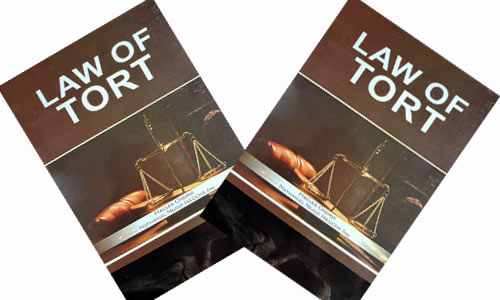 The book, titled The Law of Torts in Nigeria: A Functional Approach, authored by Professor Hagler Sunny Okorie Ph.D and Ikeocha, Nathaniel Ngozi Esq, offers law students, practitioners, and academics a comprehensive guide to understanding and applying tort law in Nigerian courts. Interested buyers can place orders via the following contact numbers: 08028636615, 08037667945, 08032253813, or +234 902 196 2209.
______________________________________________________________________
[A MUST HAVE] Evidence Act Demystified With Recent And Contemporary Cases And Materials
The book, titled The Law of Torts in Nigeria: A Functional Approach, authored by Professor Hagler Sunny Okorie Ph.D and Ikeocha, Nathaniel Ngozi Esq, offers law students, practitioners, and academics a comprehensive guide to understanding and applying tort law in Nigerian courts. Interested buyers can place orders via the following contact numbers: 08028636615, 08037667945, 08032253813, or +234 902 196 2209.
______________________________________________________________________
[A MUST HAVE] Evidence Act Demystified With Recent And Contemporary Cases And Materials

 ARTIFICIAL INTELLIGENCE FOR LAWYERS: A COMPREHENSIVE GUIDE
Reimagine your practice with the power of AI “...this is the only Nigerian book I know of on the topic.” — Ohio Books Ltd
Authored by Ben Ijeoma Adigwe, Esq., ACIArb (UK), LL.M, Dip. in Artificial Intelligence, Director, Delta State Ministry of Justice, Asaba, Nigeria.
Bonus:
Get a FREE eBook titled “How to Use the AI in Legalpedia and Law Pavilion” with every purchase.
ARTIFICIAL INTELLIGENCE FOR LAWYERS: A COMPREHENSIVE GUIDE
Reimagine your practice with the power of AI “...this is the only Nigerian book I know of on the topic.” — Ohio Books Ltd
Authored by Ben Ijeoma Adigwe, Esq., ACIArb (UK), LL.M, Dip. in Artificial Intelligence, Director, Delta State Ministry of Justice, Asaba, Nigeria.
Bonus:
Get a FREE eBook titled “How to Use the AI in Legalpedia and Law Pavilion” with every purchase.
How to Order: 📞 Call, Text, or WhatsApp: 08034917063 | 07055285878 📧 Email: benadigwe1@gmail.com 🌐 Website: www.benadigwe.com
Ebook Version: Access directly online at: https://selar.com/prv626
 _______________________________________________________________________
“Enhance Legal Practice With Authoritative Reports” — Alexander Payne Offers Comprehensive Law Reports, Spanning Over A Century Of Nigerian Jurisprudence
_______________________________________________________________________
“Enhance Legal Practice With Authoritative Reports” — Alexander Payne Offers Comprehensive Law Reports, Spanning Over A Century Of Nigerian Jurisprudence
 Interested buyers are encouraged to place their orders and enquiries via:
0704 444 4777, 0704 444 4999, 0818 199 9888
Website: www.alexandernigeria.com
Interested buyers are encouraged to place their orders and enquiries via:
0704 444 4777, 0704 444 4999, 0818 199 9888
Website: www.alexandernigeria.com