By Farooq Kperogi

THERE is probably no more intensely bitter and fierce political rivalry on the Nigerian political landscape today than that between President Bola Ahmed Tinubu and former Vice President Atiku Abubakar. They are throwing the kitchen sink at each other and working overtime to undermine, subvert, humiliate and politically mutilate each other.
I have, in past columns, shared snippets of Tinubu’s thoughts about Atiku in conversations he secretly had with American diplomats, which were exposed by WikiLeaks, the rogue, secret-spewing website founded by Australian programmer and whistleblower Julian Assange.
In light of the intensifying animosity between the two gladiators, which could conflagrate the country, especially if Atiku is excluded from the presidential contest in 2027, I decided to comb the depths of the website again to understand and reconstruct the contours of their relationship. But why WikiLeaks?
Well, it’s because, as I stated in a September 24, 2011, column titled “What the WikiLeaks Controversy Says about Nigeria’s Leaky-mouthed Elite,” the only time Nigerian elites are truthful, straight-talking and guileless is when they talk to representatives of the American government. Our elites are enervated by a debilitating inferiority complex that causes them to almost literally deify (I prefer “godify” even though it’s archaic) white people.
As I pointed out in the September 2011 column, “the willingness of our elites to divulge unsolicited information about the nation to U.S. officials betrays an infantile thirst for a paternal dictatorship. The United States is seen as that all-knowing, all-sufficient father-figure to whom our elites run when they have troubles. We have learned from the US embassy cables that our Supreme Court judges, Central Bank governors, even vice presidents and governors routinely run to the American embassy like terrified little kids when they have quarrels with each other.”
So, looking at what Tinubu and Atiku confided to U.S. Embassy staff between 1999 and February 2010, a few things became apparent to me. Tinubu genuinely admired and looked up to Atiku initially. He told US diplomats that Atiku encouraged him to go into politics, described Atiku as a cosmopolitan and broadminded Nigerian, supported him against President Olusegun Obasanjo, schemed to be his vice president, but their relationship later ruptured irrecoverably.
Atiku, on the other hand, didn’t directly mention Tinubu to US embassy officers in the cables I could find. Maybe he didn’t consider him important enough to do so, but his confidants, such as Dr. Usman Bugaje, did. I need to be careful here, though.
WikiLeaks didn’t get access to every diplomatic cable sent by US Embassy staff. So, it is entirely possible that the cables where Atiku spoke about Tinubu weren’t part of the cables WikiLeaks had access to.
A confidential cable sent from Abuja on October 22, 2002, already described Tinubu as Atiku’s “longtime friend” and reported speculation that Tinubu could become his running mate if Atiku challenged Obasanjo for the presidency. In other words, the idea of an Atiku-Tinubu presidential ticket didn’t suddenly materialise in 2006 or 2007. It had been percolating for years.
Then came a February 21, 2003, cable based on Tinubu’s February 16 conversation with American officials. Tinubu told them he knew Atiku before he himself entered politics and referred to him as “a detribalised politician who knows where he is going and how to build bridges to get there.” The diplomat added that Tinubu “credited Atiku’s personal encouragement for his entry into politics.”
That’s a remarkable reversal of fortunes. Tinubu, who is today the president of Nigeria, once spoke of Atiku with the deferential admiration of a younger political associate for an older, more accomplished one.
Their friendship, another cable dated September 14, 2005, said, went back to the early 1990s and “defies party lines and perhaps political logic.” These were not overnight friends who suddenly discovered each other in the scramble for power. They have been relationally interlocked for decades.
But affection was never allowed to stand in the way of political self-interest. A September 2005 cable, recounting a meeting on August 27, said Tinubu had become apprehensive that Atiku could no longer secure the PDP presidential nomination. He said it would take “a political miracle” for that to happen. So, while still expressing eagerness to join Atiku in a new party, he was simultaneously exploring the possibility of becoming Muhammadu Buhari’s running mate.
Interestingly, Tinubu did not think a Muslim-Muslim ticket with Atiku was a big problem. He thought one with Buhari was more troublesome because of Buhari’s perceived religious zealotry, as I pointed out in many past columns, including my February 08, 2020, column titled, “Unkind Things US Diplomatic Cables Reported Tinubu to Have Said About Buhari.” This is important because religion would later loom large in the failure of the Atiku-Tinubu presidential arrangement.
Atiku himself did talk to American diplomats. In a February 11, 2006, conversation reported in cable 06LAGOS261, he discussed working with the Alliance for Democracy, Tinubu’s party, and other opposition groups. But he did not name Tinubu in that account.
A June 15, 2006, cable supplies another side of the story.
After conversations with Atiku confidant Usman Bugaje and businessman Saleh Ahmadu, Consul General Brian Browne wrote that “Atiku personally prefers Lagos State Governor Bola Tinubu as his choice for VP.” But the same cable cited opposition to another Yoruba occupying the vice presidency after eight years of Obasanjo and the vulnerability of a Muslim-Muslim ticket.
In other words, the evidence suggests that Atiku did not simply regard Tinubu as a dispensable appendage to his presidential ambition. His own associates represented Tinubu as his preferred running mate.
A June 23, 2006, cable, however, recorded one Babatunde Morakinyo, whom American diplomats curiously and puzzlingly identified as Atiku’s relative, as predicting that Atiku would choose an Igbo running mate and make Tinubu Senate president.
That was Morakinyo’s prediction. It was not a promise by Atiku.
But it shows how Tinubu figured in calculations about an Atiku presidency.
Even as Atiku’s political fortunes dimmed, Tinubu remained privately supportive. In a December 5, 2006, cable recounting Tinubu’s November 18 meeting with Browne, the consul general marvelled that “Tinubu’s loyalty to Atiku is remarkable given the degree of opportunism that usually informs most electoral calculations here.” He speculated that Tinubu still hoped to become the junior partner on an Atiku presidential ticket, although that dream was fading.
In spite of his remarkable loyalty to Atiku, though, Tinubu was also contemplating his own presidential candidacy. Apparently, political loyalty and personal ambition were not mutually exclusive.
Then the plot thickened. On January 29, 2007, Tinubu told Browne he wanted to ask Atiku to abandon his presidential ambition and become a “statesman or guardian of democracy” instead. He contemplated replacing Atiku on the Action Congress ticket with Aminu Masari and Ken Nnamani. The diplomat worried that such a proposal could strain their friendship.
The February 7, 2007, cable does not establish that Tinubu actually made the proposal to Atiku. My suspicion is that he didn’t. But merely contemplating it tells us that Tinubu’s loyalty had its limits. When Atiku’s presidential ambition became an obstacle to what Tinubu considered a more viable political arrangement, friendship was no longer enough.
A careful analysis of the form and nature of their relationship reveals that Atiku repeatedly sought the presidency as a candidate, while Tinubu progressively built power by building coalitions and influencing who could win elections. Through this strategy, he eventually secured the presidency himself in 2023.
It appears that Atiku has a hard time accepting the reversal of the symbolic power asymmetry between them. Tinubu, who used to look up to him, whose loyalty to him even US embassy officials called remarkable, who plotted for him to be president so he would be his vice president, is now president and he is not.
Tinubu must also be unnerved by the increasing virulence with which Atiku attacks and exposes him, given the depth of their friendship and the geniality they shared. The November 5, 2026, court ruling that invalidated Atiku’s presidential nomination, and the appeal that followed, make this feud more than an exchange of political insults.
At stake is whether their rivalry will be settled at the ballot box or aggravated by an exclusion that Atiku and his supporters regard as politically motivated.
What I see in the cables is neither an uncomplicated tale of friendship betrayed nor a relationship that was fraudulent from the beginning. It is the story of two friends who once needed each other, whose ambitions gradually became mutually inconvenient and whose political stations have now been spectacularly reversed.
There may be no greater indignity in politics than watching someone you once encouraged to climb the ladder stand on a rung you have spent your lifetime struggling to reach. Perhaps that is what gives the current Atiku-Tinubu feud its unusually poisonous sting.
[A MUST HAVE] Evidence Act Demystified With Recent And Contemporary Cases And Materials

Available now for NGN 40,000 at ASC Publications, 10, Boyle Street, Onikan, Lagos. Beside High Court, TBS. Email publications@ayindesanni.com or WhatsApp +2347056667384. Purchase Link: https://paystack.com/buy/evidence-act-complete-annotation
______________________________________________________________________ “Enhance Legal Practice With Authoritative Reports” — Alexander Payne Offers Comprehensive Law Reports, Spanning Over A Century Of Nigerian Jurisprudence Interested buyers are encouraged to place their orders and enquiries via:
0704 444 4777, 0704 444 4999, 0818 199 9888
Website: www.alexandernigeria.com
“A Comprehensive Guide To Evidence Law” — Releases Second Edition In Three Volumes, Covering 4,051 Cases
For enquiries and orders, contact: 08035526491 Email: jerryamadisilk@gmail.com
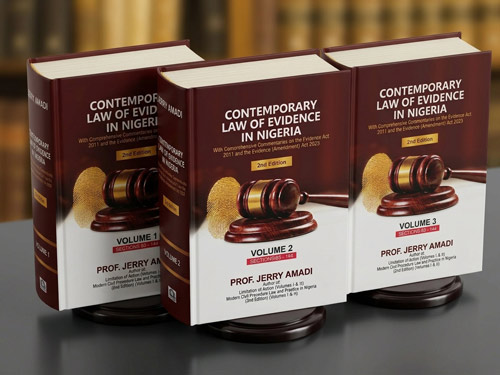 Prof. Jerry Amadi’s Evidence Law, Second Edition (2026), contains 3,314 pages in three volumes, covering the Evidence Act 2011, its 2023 amendment, and 4,051 Nigerian and English cases.