

In the Supreme Court of Nigeria

Holden at Abuja
On Friday, the 27th Day of March, 2026
Before Their Lordships:
John Inyang Okoro
Adamu Jauro
Jummai Hannatu Sankey
Moore Aseimo Abraham Adumein
Abubakar Sadiq Umar
Justices of the Supreme Court
SC/408/2015
Between:
Standard Alliance Insurance PLC — Appellant
And
Sami C. Haidar (Carrying on business under the name and style of Beity Office Mart) — Respondent
(Lead Judgment delivered by Honourable Abubakar Sadiq Umar, JSC)
Facts
The Respondent, who is the proprietor of an office mart known as “Beity Office Mart,” located in Abuja, took out a Burglary and Housebreaking Insurance Policy with the Appellant in Abuja on 10th October, 2003. On 3rd April, 2004, a gang of armed robbers, disguised as customers, robbed the Respondent’s mart of goods valued at about N10 million. The Respondent reported the incident to the Police and thereafter wrote to inform the Appellant of the development and requested necessary action.
The Appellant engaged experts to independently investigate the matter. At the end of the investigation, it was concluded that the insurance policy subscribed to by the Respondent did not cover liabilities incurred through the armed robbery incident because the incident occurred without forcible entry into or exit from the Respondent’s business premises.
Pursuant to the dispute resolution clause in the insurance contract between the parties, they resorted to arbitration before a jointly appointed sole Arbitrator at the Abuja Multi-Door Courthouse. The issue for determination at the arbitration was the interpretation of the insurance policy to determine whether or not the incident was covered by the policy. At the conclusion of the arbitration, the Arbitrator rendered an award dismissing the Respondent’s claim. Dissatisfied, the Respondent filed an Originating Motion at the High Court, seeking an order setting aside the arbitral award. The High Court, however, dismissed the Respondent’s claims.
Consequently, the Respondent appealed to the Court of Appeal. In its judgment, the Court of Appeal set aside the arbitral award and held that the Respondent was entitled to indemnity under the insurance contract. Dissatisfied, the Appellant appealed to the Supreme Court.
Counsel for the Appellant filed the Appellant’s Brief of Argument and raised two issues for determination. Counsel for the Respondent filed the Respondent’s Brief of Argument and also raised a preliminary objection therein.
Issues and Arguments on Preliminary Objection
The grounds of the Respondent’s preliminary objection were that the Appellant’s grounds of appeal were of mixed law and fact, for which the Appellant failed to obtain prior leave of court before raising them, and secondly, that Issue 2, as contained in the Appellant’s Brief, did not relate to Ground 6, from which it was purportedly distilled. Counsel for the Respondent submitted that there were no competent grounds of appeal in the Appellant’s Notice of Appeal on which the Supreme Court could adjudicate.
In response, the Appellant’s Counsel submitted that all the grounds of appeal in the Notice of Appeal were grounds of law for which prior leave of court was unnecessary. Counsel further submitted that Issue 2 did, in fact, arise from Ground 6 of the Notice of Appeal.
Court’s Resolution of Respondent’s Preliminary Objection
The Supreme Court held that an appellant can appeal as of right when the grounds of appeal involve questions of law alone. The Apex Court held that Grounds 1, 4 and 5 in the Appellant’s Notice of Appeal were complaints about the application of law to established facts rather than disputes over the established facts themselves. Hence, they were competently raised without prior leave of court.
However, the Court found that Grounds 2, 3 and 6 complained of the findings of the lower Court that the trial Court did not properly evaluate the documentary evidence before it. The evaluation of evidence is fundamentally regarded as an issue of fact, for which leave must be sought before appealing. The Apex Court found that the Appellant’s failure to seek leave to raise these grounds rendered them incompetent.
On the second leg of the Respondent’s preliminary objection, the Court held that the Appellant’s Issue 2 was indeed tied to Ground 6. However, considering that Ground 6 had been established as an issue of fact for which prior leave was not obtained, it was incompetent, alongside Issue 2, which was distilled from it. Consequently, the Apex Court struck out Grounds 2, 3 and 6, and Issue 2.
The Court then proceeded to determine the sole surviving Issue 1, which it held to have been validly distilled from the competent Grounds 1, 4 and 5.
Issue for Determination
Whether the Court below was right in setting aside the decision of the trial Court, which affirmed the arbitral award rendered by the Abuja Multi-Door Courthouse.
Arguments
Counsel for the Appellant submitted that the lower Court erred when it found that the trial Court failed to evaluate the evidence before it because the trial Court was not expected to sit on appeal over the decision of the Arbitral Tribunal.
Counsel argued further that the case before the Arbitrator concerned the construction of a clause in the Burglary and Housebreaking Insurance Policy, and that mere entry into the Respondent’s business premises without force was excluded under the insurance policy. The insurance contract also did not contemplate armed robbery. Counsel contended that the lower Court erred when it held that the Arbitrator wrongly applied the Criminal Code Act instead of Section 346(d) and (e) of the Penal Code in defining “housebreaking,” because there was nowhere in the insurance contract where the applicable law was expressly stated to be the Penal Code.
In response, Counsel for the Respondent submitted that the Court of Appeal rightly set aside the arbitral award. Counsel argued that the Court of Appeal rightly found that the incident of armed robbery was covered by the insurance policy. Although the applicable law was not stated in the insurance contract, the word “theft” was used in the insurance policy document, which was executed in the Federal Capital Territory, where the applicable law is the Penal Code and not the Criminal Code.
Court’s Judgment and Rationale
The Court held that, in construing the terms of a contract, the meaning to be placed on them is the plain, clear and obvious meaning of the terms used. Thus, where the words of a contract or document are clear, the operative words should be given their simple and ordinary grammatical meaning. The Apex Court referred to its decision in DANGOTE CEMENT PLC v. AGER & ANOR. (2024) LPELR-61800 (SC). The Court held further that, in the interpretation of insurance agreements, the Court must interpret the operative words used in the contract in a manner that reflects the highest standard of honesty expected from both the insured and the insurer.
The Court held that it could be extrapolated from the express words of the operative clause in the insurance contract executed between the parties that the Appellant became liable when there was theft of goods contained within the Respondent’s insured business premises, particularly if the theft was accompanied by actual and violent breaking into the premises, actual forcible and violent breaking out of the premises, or any attempt to do so.
The Apex Court held that, from the Police investigation report on the incident at the Respondent’s premises, although there was no forcible or violent breaking in, as the armed robbers had entered the premises quietly, disguised as customers, their exit from the premises, after violently assaulting the salesgirl and another member of staff and keeping them in a state of fear and imminent danger until their departure, fell within the definition of “housebreaking” under the Penal Code, which is the applicable statute in Abuja, where the insurance contract was executed and where the armed robbery took place.
The Court held that, under Section 346(e) of the Penal Code, a person is said to commit housebreaking if he effects his entrance into, or departure from, a house he enters by trespass for the purpose of committing an offence by using criminal force, committing an assault or threatening any person with assault. The Court held that the armed robbers in this case, as is typical in most cases of armed robbery, also committed the offence of housebreaking in the course of committing the offence of armed robbery.
The Court found that there was, therefore, no doubt that the insurance policy covered the robbery incident that occurred at the Respondent’s insured business premises. The arbitral award was erroneously rendered because the Arbitrator and the trial Court failed to properly consider the operative clause contained in the insurance contract in its legal context.
The Apex Court held further that, undoubtedly, courts do not interfere with arbitral awards in recognition of the principles of party autonomy and the finality of arbitration. However, a court can interfere where it is shown that (i) the arbitration or award was improperly procured; (ii) the arbitrator misconducted himself; (iii) the arbitral award contains decisions on matters beyond the scope of the reference; or (iv) there is an error of law on the face of the award.
The Court relied on BPE & ANOR. v. MESSRS U. MADUKA ENTERPRISES (NIG.) LTD & ANOR. (2025) LPELR-80698 (SC). The Supreme Court held that the Court of Appeal properly identified an error of law on the face of the award, namely, the misapplication of the applicable substantive law in interpreting the insurance contract, and rightly set aside the decision of the trial Court upholding the arbitral award.
Appeal Dismissed.
Nasiru Tijjani for the Appellant.
Abdul Nasser Salau for the Respondent.
Reported by Optimum Publishers Limited, Publishers of the Nigerian Monthly Law Reports (NMLR) (an affiliate of Babalakin & Co.).
[A MUST HAVE] Evidence Act Demystified With Recent And Contemporary Cases And Materials
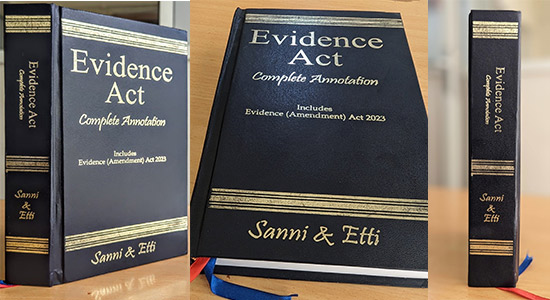
Available now for NGN 40,000 at ASC Publications, 10, Boyle Street, Onikan, Lagos. Beside High Court, TBS. Email publications@ayindesanni.com or WhatsApp +2347056667384. Purchase Link: https://paystack.com/buy/evidence-act-complete-annotation
______________________________________________________________________ “Enhance Legal Practice With Authoritative Reports” — Alexander Payne Offers Comprehensive Law Reports, Spanning Over A Century Of Nigerian Jurisprudence Interested buyers are encouraged to place their orders and enquiries via:
0704 444 4777, 0704 444 4999, 0818 199 9888
Website: www.alexandernigeria.com
“A Comprehensive Guide To Evidence Law” — Releases Second Edition In Three Volumes, Covering 4,051 Cases
For enquiries and orders, contact: 08035526491 Email: jerryamadisilk@gmail.com
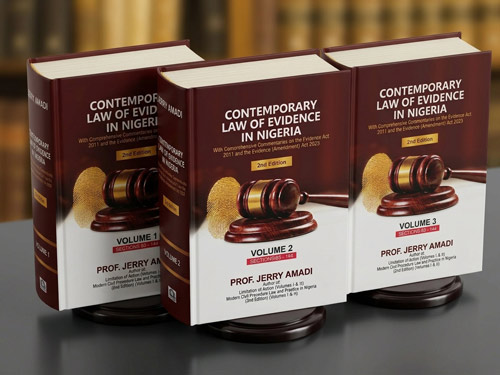 Prof. Jerry Amadi’s Evidence Law, Second Edition (2026), contains 3,314 pages in three volumes, covering the Evidence Act 2011, its 2023 amendment, and 4,051 Nigerian and English cases.