By Oluwaleye Adedoyin Grace

INTRODUCTION
In February 2026, the Nigeria Correctional Service reported that 51,955 of the 80,812 persons in custodial centers which is about 64 per cent were awaiting trial[1]. Behind that figure are people who have not been convicted of any offence, yet whose lives, families, jobs, and reputations remain suspended while they wait for justice. Their situation captures a larger question: what does “public interest” mean when the law promises rights but many citizens cannot easily enforce them?
Public interest should not be treated as a slogan reserved for government speeches or legal conferences. In practical terms, it means a society in which justice is accessible, Justice, democracy and development are interconnected. Without accessible justice, democracy loses public trust; without accountability, public power becomes a tool for impunity; and without inclusive development, the needs of the vulnerable remain unmet.
This essay argues that Nigeria must move beyond constitutional promises to practical reforms that guarantee timely justice, accountable institutions and development that leaves no one behind.
- JUSTICE MUST BE PRACTICAL, NOT THEORETICAL
Nigeria does not lack laws proclaiming rights. The Constitution guarantees fair hearing, personal liberty, and equality before the law; statutes also establish institutions to protect suspects, defendants, and indigent litigants. Yet the daily experience of many Nigerians suggests that justice is often available in principle but difficult to obtain in practice. A right that a citizen cannot afford, understand, or enforce within a reasonable time risks becoming little more than words in a legal document.
The first obstacle is cost. Beyond lawyers’ fees, litigation involves filing fees, transportation, documentation, and repeated appearances in court. For a low-income worker, trader, farmer, or student, these costs can quickly exceed the value of the claim. Many people therefore abandon valid disputes, accept unfair settlements, or simply endure injustice because the formal system feels more punishing than protective. The Legal Aid Council of Nigeria was established to provide free legal assistance to eligible citizens, but inadequate funding, limited personnel, bureaucratic delays, and weak public awareness restrict its reach[2], especially outside major cities.
Delay is equally damaging. Court congestion, frequent adjournments, and slow investigation prolong disputes and increase expenses.[3] In criminal cases, the consequences are more severe: persons presumed innocent may spend years in custody before their trials conclude. The fact that about 64 per cent of inmates in Nigerian custodial centers were awaiting trial in early 2026 shows that pre-trial detention is not an isolated problem but a structural failure of justice delivery.
Justice must therefore be made practical. Courts should adopt firm case-management systems to reduce needless adjournments; police, prosecutors, and defence counsel should be held to statutory timelines; and legal aid should be expanded through duty solicitors, law clinics, and pro bono schemes. Technology can also help through e-filing and digital case tracking, provided it does not exclude citizens with limited internet access or digital literacy. Public interest demands a justice system that is not only independent and learned, but also affordable, timely, and reachable by the ordinary Nigerian.
- DEMOCRACY SURVIVES ON ACCOUNTABILITY
Justice is not only a service delivered in courtrooms; it is also the foundation on which democratic government stands. Elections may bring leaders into office, but democracy is sustained by the willingness of those leaders to obey the Constitution, respect human rights, and submit to judicial scrutiny. Where public officials can ignore court orders, silence critics, or act without consequence, democracy becomes reduced to periodic voting rather than accountable governance.
Judicial independence is central to this balance. A judiciary that lacks financial autonomy, faces political pressure, or depends on the executive for basic operational needs may struggle to check abuses of power[4]. Concerns about interference in judicial administration, inadequate funding, and non-compliance with constitutional provisions on judicial finances continue to test public confidence in Nigerian courts. An independent court does not mean an unaccountable court; rather, it means a court strong enough to decide disputes according to law, even when the outcome is inconvenient to powerful persons.
The disobedience of court orders is particularly dangerous. When government institutions treat judgments as optional, they send the message that the law binds ordinary citizens but not those who hold power[5]. This weakens the authority of the judiciary, encourages arbitrary action, and erodes citizens’ belief that constitutional rights offer real protection. Democracy cannot flourish where compliance with judicial decisions depends on the status or political influence of the parties involved.
Accountability must also extend to law enforcement. Citizens should be able to protest peacefully, express opinions, and seek redress without fear of unlawful arrest, intimidation, or excessive force. Protecting civic space is not a threat to public order; it is a necessary condition for public participation, transparency, and democratic renewal.
Nigeria therefore needs stronger enforcement mechanisms for court orders, transparent judicial funding, merit-based appointments, and effective disciplinary processes for misconduct. Public officials who disregard lawful judgments should face meaningful consequences. A democracy becomes credible not when it merely proclaims the rule of law, but when those who govern are visibly governed by it.
- DEVELOPMENT NEEDS FAIR RULES
Development is often discussed in terms of infrastructure, foreign investment, or economic growth. Yet none of these can endure where people cannot rely on fair rules. A trader needs confidence that a contract will be enforced; a farmer needs protection from unlawful dispossession; a worker needs a safe workplace and a remedy when rights are violated; and an investor needs certainty that agreements and court decisions will be respected. In this sense, development is not separate from justice; it depends on it.
Weak contract enforcement and prolonged commercial disputes discourage productive activity. Businesses that cannot resolve disputes quickly may avoid expansion, raise prices to cover risk, or withdraw from markets altogether. Concerns about court delays, inconsistent enforcement, and policy uncertainty have been identified as obstacles to long-term investment in Nigeria.[6] Small and medium-sized enterprises are especially exposed because they often lack the resources to pursue lengthy litigation. Affordable alternatives such as mediation, small-claims courts, and arbitration can therefore help businesses resolve disputes without exhausting their capital or abandoning legitimate claims.
Corruption and insecurity also undermine development by distorting public decisions and making every day economic life unsafe. Corruption diverts resources meant for schools, hospitals, roads, and social services, while insecurity disrupts farming, trade, and investment. These problems are not merely economic inconveniences; they are failures of public accountability. When public office is used for private gain, the cost is borne by citizens who already have the least capacity to absorb it.
A public-interest approach to development must therefore place people at the center. Government should strengthen transparent procurement, protect whistleblowers, publish budgets and contracts, and ensure that anti-corruption institutions act independently. It should also invest in rural infrastructure, digital access, quality education, and healthcare, so that growth does not remain concentrated among a privileged few. Development becomes meaningful only when it expands opportunity, protects dignity, and gives citizens a fair chance to improve their lives.
Concerns about contract enforcement, court delays, and regulatory uncertainty as barriers to long-term investment in Nigeria, as discussed in 2026 reports and commentary on Nigeria’s investment climate.
- CONCLUSION
Behind every statistic is a person waiting. The trader whose case never ends. The suspect held without trial. The citizen who wins in court but cannot enforce the judgment. These are not small failures; they are warnings that public interest is slipping away.
Nigeria does not need more beautiful speeches about justice, democracy, and development. It needs working courts, obeyed court orders, honest public officials, and growth that reaches the poor. When justice is fast and fair, democracy becomes credible. When power is accountable, development becomes possible.
The real test of national progress is simple: can the ordinary Nigerian obtain justice without losing everything? Until the answer is yes, our democracy remains incomplete; and our development remains uncertain.
A nation truly advances when justice is not a privilege for the few, but a working promise to all.
Oluwaleye Adedoyin Grace, LLB. (Hons.) Oluwaleyeadedoyingrace2001@gmail.com or 08106289069
[1] Awaiting Trial Inmates Account for 64% of Prison Population in Nigeria – NCoS CG’ (Premium Times, 11 February 2026) https://www.premiumtimesng.com/news/more-news/856034-awaiting-trial-inmates-account-for-64-of-prison-population-in-nigeria-ncos-cg.html accessed 1 November 2026.
[2] Legal Aid Act 2011, s 1.
[3] Court Delays Make Justice Costly, Inaccessible — Adekunle, SAN (Punch, 16 October 2026) https://punchng.com/court-delays-make-justice-costly-inaccessible-adekunle-san/ accessed 1 November 2026.
[4] Bertelsmann Transformation Index, Nigeria Country Report 2026’ (Bertelsmann Stiftung 2026) https://bti-project.org/fileadmin/api/content/en/downloads/reports/country_report_2026_NGA.pdf accessed 1 November 2026.
[5] Disobedience of Court Orders Threatens Nigeria’s Democracy — Augie (The Guardian Nigeria, 17 October 2026) https://guardian.ng/features/media/disobedience-of-court-orders-threatens-nigerias-democracy-augie/ accessed 1 November 2026.
[6] US Department of State, ‘2026 Investment Climate Statements: Nigeria’ (29 September 2026) https://www.state.gov/reports/2026-investment-climate-statements/nigeria accessed 1 November 2026.
[A MUST HAVE] Evidence Act Demystified With Recent And Contemporary Cases And Materials

Available now for NGN 40,000 at ASC Publications, 10, Boyle Street, Onikan, Lagos. Beside High Court, TBS. Email publications@ayindesanni.com or WhatsApp +2347056667384. Purchase Link: https://paystack.com/buy/evidence-act-complete-annotation
______________________________________________________________________ “Enhance Legal Practice With Authoritative Reports” — Alexander Payne Offers Comprehensive Law Reports, Spanning Over A Century Of Nigerian Jurisprudence Interested buyers are encouraged to place their orders and enquiries via:
0704 444 4777, 0704 444 4999, 0818 199 9888
Website: www.alexandernigeria.com
“A Comprehensive Guide To Evidence Law” — Releases Second Edition In Three Volumes, Covering 4,051 Cases
For enquiries and orders, contact: 08035526491 Email: jerryamadisilk@gmail.com
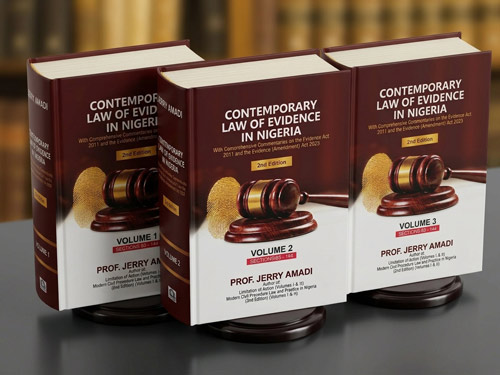 Prof. Jerry Amadi’s Evidence Law, Second Edition (2026), contains 3,314 pages in three volumes, covering the Evidence Act 2011, its 2023 amendment, and 4,051 Nigerian and English cases.