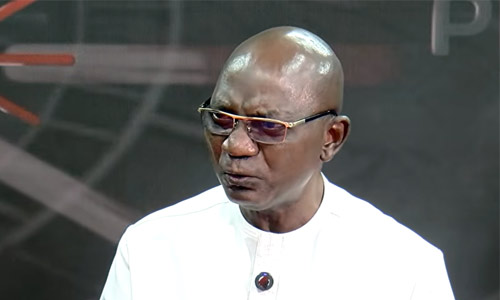
A retired Major General and former Director of Defence Information, John Enenche, has criticised the spending of huge sums of money on political campaigns while Nigeria continues to grapple with insecurity, describing such expenditure as a “total misplacement of priority” if public resources are being diverted from the protection of citizens.

Enenche, a military strategist, argued that the government should prioritise securing lives and property before committing substantial resources to election campaigns, warning that insecurity could persist for several decades unless Nigeria adopts more effective strategies backed by adequate funding and political commitment.
Speaking during an interview on ARISE Television’s Prime Time, the retired general maintained that Nigeria’s security challenges could be substantially addressed through greater investment in surveillance technology, improved intelligence gathering, local equipment production and stronger support for the armed forces.
He estimated that no more than $60 million would be required for the technological security initiative he proposed, insisting that the amount was relatively small compared with the resources available to the country and the expenditure associated with political activities.
The discussion followed questions about the country’s security situation and the apparent expenditure on election campaigns despite continuing insurgency, banditry, kidnappings and mass abductions across different parts of Nigeria.
The presenter drew attention to reports of hundreds of vehicles costing more than ₦100 million each and the distribution of thousands of vehicles in connection with political campaigns.
Asked how he felt about the expenditure, Enenche first sought clarification on whether the money was coming directly from the government or from individuals supporting the political party involved.
The presenter explained that he could not establish the source of the money with certainty but observed that many individuals contributing such funds reportedly had substantial government contracts.
Responding, Enenche suggested that such circumstances could raise questions about whether public resources were indirectly involved, although he did not present evidence establishing that government funds had financed the expenditure.
“That is indirectly we are saying that money was recycled from somehow,” he said.
He maintained that if the money could be traced to government resources, prioritising political campaigns over national security would be difficult to justify.
“Good. So if that is the case, with maybe me and you agreeing that the money somehow came from government, then it’s a total misplacement of priority,” he stated.
Enenche questioned the rationale for spending heavily on elections when citizens remained exposed to attacks and other security threats.
“So that means, if we now say government is doing that, it is a total misplacement of priority, because who are you doing election for? If you have not secured the people who you want to secure, is it animals, is it cows, is it goats?” he asked.
He consequently called for resources and attention to be redirected towards addressing the security challenges.
“So it’s better to readdress, to channel the energy, channel the resources towards securing the country,” he added.
The retired general returned to the issue later in the interview, questioning the priority given to political campaigns when the country had yet to establish a sufficiently secure environment for its citizens.
“If you don’t have a secure environment, then what are you campaigning for? What election are you going to do?” he asked.
Enenche emphasised the importance of making Nigeria a safe and comfortable place for its citizens, including those living abroad who wished to return home.
“There is no place as good as home,” he said.
Drawing from his experiences travelling outside Nigeria, he maintained that living abroad could not replace the sense of belonging associated with one’s country.
He said his relatives living overseas also expressed a desire to return home, stressing that improved security would encourage more Nigerians to live and invest in their country.
“So let us secure Nigeria. Let us make Nigeria a place to be, and they want to come,” he stated.
Turning to the performance of Nigeria’s security agencies, Enenche acknowledged that the country continued to face insurgency in the North-East, banditry and mass abductions in the North-West, and kidnapping across the North-Central region.
The presenter noted that the 2026 budget provided more than ₦3 trillion for the Ministry of Defence, while the broader allocation for defence and security stood at approximately ₦5.44 trillion.
He also referred to independent analyses suggesting that personnel costs accounted for roughly three-quarters of the defence budget.
Asked to assess the performance of the service chiefs after their first year in office, Enenche said any assessment must consider the resources actually made available to them and the limitations affecting their operations.
“The crop of service chiefs that we have now… I would say that they have done well in the sense of the resources available to them,” he stated.
He explained that although military authorities had recorded achievements, their operations had not produced the level of improvement Nigerians expected.
Describing developments in the North-East and North-West, he said the security situation remained characterised by gains followed by setbacks.
According to him, the situation was comparable to “one step forward, some steps backward”.
Enenche acknowledged improvements in some aspects of military welfare but maintained that financial constraints continued to prevent the armed forces from implementing the strategies and technological solutions required to address the threats more effectively.
He recalled making a presentation at Army Headquarters concerning measures he believed could improve Nigeria’s security situation.
According to him, the officials he met immediately raised questions about the source of funding required to implement his proposal.
“The first thing the team I interfaced with asked me was: sir, where is the money going to come from?” he recalled.
Enenche said he was informed that the necessary resources were unavailable.
He also questioned the extent to which approved defence budgets translated into actual funding for military operations.
According to him, discussions about budget implementation revealed a performance level of about 30 per cent.
“That was one of the things that was made open and it didn’t go down well with them, that it was 30% performance. So if you look at 30% of the trillions we are talking about, what does it amount to?” he asked.
The retired general explained that his proposal involved establishing a comprehensive surveillance system capable of locating armed groups, tracking their movements and supporting operations against them.
He described the proposed approach as forming “a blanket of surveillance” to locate and neutralise security threats.
Summarising the strategy, he used the expression “dictate, dominate and delete”.
Enenche said the proposal would combine advanced technology with physical security operations but that military officials had expressed concerns about the cost of implementation.
According to him, the service chiefs possessed considerable professional knowledge and were making efforts within the limits of their available resources.
However, he maintained that their achievements were not translating into sufficient improvements in public safety.
Asked why military announcements concerning arrests, neutralised terrorists and recovered weapons had not resulted in a corresponding reduction in attacks and abductions, Enenche acknowledged the gap between operational achievements and citizens’ experiences.
He explained that while he could commend the service chiefs for their efforts, the public expected measurable improvements in security.
“What I’m supposed to see, a reduction in abductions and all that, is not real. It does not match with what we expect,” he stated.
Enenche said he personally knew some of the officers involved, including individuals he had taught, and believed that they were making genuine efforts.
However, he acknowledged that members of the public would assess their performance differently because insecurity continued to affect communities.
He disclosed that he and others had submitted security proposals to some service chiefs and relevant authorities but had received limited responses.
“I’m even lucky that the Chief of Army [Staff] has responded. The rest will not even respond,” he said.
According to him, he was informed that some of the proposals required decisions beyond the authority of Army Headquarters.
When asked whether inadequate funding was the principal difficulty, Enenche identified both financial constraints and political will as major obstacles.
“Lack of funding, and then I think I’ll have some liberty to say lack of a will, a particular political will,” he stated.
He maintained that although the President and Commander-in-Chief had issued emergency security directives, their effective implementation depended on the relevant institutions.
Enenche specifically identified the Office of the National Security Adviser as an important institution in coordinating the country’s security response.
He argued that the failure to implement necessary measures quickly enough had contributed to the continued inability of security agencies to deliver the results Nigerians expected.
According to him, the existing security strategy was not necessarily unsuitable but required substantial improvement through innovation and technology.
He said security officials understood the need for such measures but repeatedly identified funding as a major obstacle.
“What we are looking at is no more than $60 million to cover the whole country,” Enenche disclosed.
He argued that the amount should not represent an insurmountable financial challenge for Nigeria.
“The service chief cannot manufacture $60 million. He cannot. The army does not trade, does not do business,” he stated.
Enenche stressed that responsibility for making the necessary resources available rested with the relevant political and administrative authorities.
He said the service chiefs were operating within limitations that prevented them from producing the security outcomes Nigerians demanded.
“So Nigerians will not be able to get what they expect. They have limitations. I’m talking for them now. They didn’t send me to talk for them. They have limitations, and that is why we are not seeing what we are supposed to see,” he explained.
He warned that the country’s security challenges required urgent attention rather than prolonged delays.
“Three months, six months is too long, is too far,” he said.
On the operational readiness of the armed forces, Enenche stated that his assessment was informed partly by research he conducted during his doctoral studies.
He said his PhD research examined the Nigerian Army as a case study for the armed forces and led him to conclude that the state of readiness was below 35 per cent.
The retired general also discussed the quality of equipment available to Nigerian troops, acknowledging that the military was acquiring equipment but not necessarily the most effective technology for confronting the country’s security threats.
“They are getting the right equipment but not the best because of cost,” he stated.
He clarified that the proposed $60 million investment was not intended primarily for the purchase of rifles or military aircraft.
“We are talking about high-grade technology which they don’t have the money for,” he explained.
According to him, the military was making the best use of the equipment presently available but required more advanced technological capabilities to improve surveillance, intelligence gathering and operational effectiveness.
Enenche also addressed the welfare and morale of military personnel engaged in operations against armed groups.
He maintained that effective leadership, encouragement and personal example were essential to motivating soldiers deployed to dangerous areas.
According to him, senior military officers, including general officers commanding and brigade commanders, were increasingly participating directly in operations to encourage troops and strengthen confidence.
He acknowledged that some commanders had lost their lives during operations in the North-East.
On soldiers’ welfare, Enenche said he understood that the daily ration cash allowance had been increased to approximately ₦3,000.
He explained that the allowance was intended to support feeding arrangements organised by commanders in operational areas.
When the presenter questioned whether ₦3,000 was sufficient for a soldier risking his life, Enenche clarified that bulk or centralised feeding arrangements could help manage the amount.
However, he agreed that ₦3,000 would be inadequate if individual soldiers were expected to purchase their own meals.
He maintained that his understanding of the allowance was based on the information available to him.
Returning to the wider security situation, Enenche called for increased investment in technology and a combination of military and non-military approaches.
“We think what they have, they are procuring and purchasing what they can purchase, but we need to up the game, going more technological, we now combine kinetic and non-kinetic,” he said.
He warned that failure to adopt improved measures could leave Nigeria confronting insecurity for several more decades.
“I’m sorry to say this, it is a public statement I’m making: if nothing is done in that regard of what I’ve said, we are not seeing the end of this, let me call it a war now. It’s war. Let’s not deceive ourselves any longer. We will not see the end even for three or four decades,” he warned.
Enenche also criticised Nigeria’s continued dependence on imported military equipment and advocated the development of domestic production capabilities.
He disclosed that representatives from two foreign countries had approached him with proposals for partnerships that could enable Nigerians to manufacture security equipment locally.
According to him, the proposed arrangements would involve training Nigerians over approximately one year to produce equipment, including drones and communication systems.
He mentioned Ukraine and Turkey while discussing the offers, describing Ukrainian surveillance and drone technology as particularly advanced.
Enenche maintained that such partnerships could help Nigeria acquire technological knowledge, strengthen local manufacturing capacity and improve its ability to monitor security threats.
He said the proposed arrangements could also make Nigeria safer for foreign nationals and businesses operating in the country.
The retired general expressed confidence that implementing the proposed technological measures could produce noticeable improvements within six months.
“Once that is done, I tell you, in a jiffy, within six months, we will see the evidence all over the place,” he stated.
However, he complained that inadequate political support remained an obstacle to implementing the proposals.
According to him, some authorities failed to acknowledge the proposals submitted to them, while others requested presentations without taking further action.
Enenche said his background as an engineering officer had strengthened his belief that Nigeria possessed the capacity to develop surveillance drones capable of identifying improvised explosive devices.
He maintained that with appropriate support, Nigerian engineers could develop such technologies within a relatively short period.
He also expressed frustration over the lack of follow-up from some security authorities he had contacted about the proposals.
Despite his criticisms, Enenche reiterated his commitment to the military and to improving Nigeria’s security situation.
“What am I saying? I love the military. I love Nigerians. I am for Nigerians, and we will get it right if we adjust our plan and our strategy,” he concluded.
[A MUST HAVE] Evidence Act Demystified With Recent And Contemporary Cases And Materials

Available now for NGN 40,000 at ASC Publications, 10, Boyle Street, Onikan, Lagos. Beside High Court, TBS. Email publications@ayindesanni.com or WhatsApp +2347056667384. Purchase Link: https://paystack.com/buy/evidence-act-complete-annotation
______________________________________________________________________ “Enhance Legal Practice With Authoritative Reports” — Alexander Payne Offers Comprehensive Law Reports, Spanning Over A Century Of Nigerian Jurisprudence Interested buyers are encouraged to place their orders and enquiries via:
0704 444 4777, 0704 444 4999, 0818 199 9888
Website: www.alexandernigeria.com
“A Comprehensive Guide To Evidence Law” — Releases Second Edition In Three Volumes, Covering 4,051 Cases
For enquiries and orders, contact: 08035526491 Email: jerryamadisilk@gmail.com
 Prof. Jerry Amadi’s Evidence Law, Second Edition (2026), contains 3,314 pages in three volumes, covering the Evidence Act 2011, its 2023 amendment, and 4,051 Nigerian and English cases.