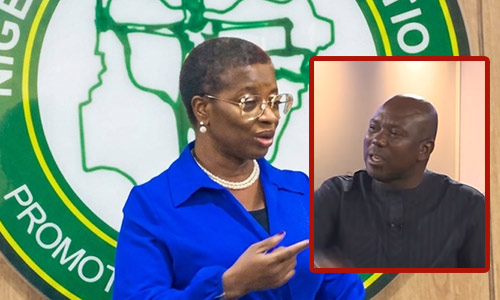
The President of the Nigerian Bar Association (NBA), Oyinkansola Badejo-Okusanya, SAN, FCIArb, has forwarded a formal petition against lawyer and African Democratic Congress (ADC) member, Kalu Kalu, Esq., to the Legal Practitioners Disciplinary Committee (LPDC) over what she described as insulting remarks directed at a judicial officer during an appearance on Channels Television’s Politics Today.

The NBA President condemned the language allegedly used by Kalu while discussing a Federal High Court judgment delivered by Justice Peter O. Lifu concerning the leadership of the ADC and its implications for the presidential candidacy of former Vice President Atiku Abubakar in the 2027 general elections.
In a statement dated November 13, 2026, Badejo-Okusanya disclosed that her attention was drawn on Thursday, November 12, to remarks made by Kalu during the November 11 edition of Politics Today, hosted by Seun Okinbaloye.
She explained that she subsequently obtained and personally watched a recording of the programme before deciding to take disciplinary action.
“I have since obtained and watched a recording of the programme,” the NBA President stated.
“On behalf of the Nigerian Bar Association, I condemn the use of such language unequivocally.”
Badejo-Okusanya maintained that although legal practitioners have the right to criticise court judgments, challenge judicial reasoning and identify errors in decisions, such criticism must not degenerate into personal attacks against the judges who delivered them.
According to her, neither political disagreements nor the intensity of public controversy can justify abandoning the professional standards expected of lawyers.
“A lawyer’s disagreement with a judicial decision, however strongly held, cannot excuse personal abuse of the judge who delivered it. Neither the intensity of a political controversy nor the platform on which a lawyer speaks relieves that lawyer of professional responsibility,” she declared.
The NBA President stressed that lawyers were not prohibited from questioning judicial decisions or demanding accountability from members of the Bench.
Rather, she explained that informed criticism of judgments remains an essential part of legal practice and contributes to the development of the law.
She stated that legal practitioners have “every right to examine judgments, challenge their reasoning and expose errors. Indeed, rigorous criticism contributes to the development of the law and the administration of justice.”
Badejo-Okusanya further acknowledged that judges must remain accountable for the exercise of judicial power and assured that the NBA would continue to insist on such accountability.
However, she distinguished legitimate criticism of judicial reasoning from personal insults against judicial officers.
“But personal insults do nothing to establish that a judgment is wrong. They offer the public no legal analysis and provide no remedy for an aggrieved litigant. Instead, they diminish the quality of public debate and bring our profession into disrepute,” she stated.
The NBA President also drew attention to the Rules of Professional Conduct for Legal Practitioners, 2023, which require lawyers to maintain high standards of professional conduct and treat courts with respect, dignity and honour.
She explained that the rules also provide appropriate procedures for submitting complaints against judicial officers to the relevant authorities.
According to her, lawyers remain bound by these professional obligations even when participating in public discussions or appearing on television programmes.
“These obligations cannot be put aside when a lawyer steps into a television studio,” she maintained.
Badejo-Okusanya observed that the professional standing of lawyers gives their public statements particular influence, especially when discussing politically sensitive court decisions.
She said members of the public are entitled to expect legal practitioners to provide informed explanations of judicial decisions, the reasoning behind them and the legal remedies available to dissatisfied litigants.
“Our professional standing gives our words particular weight. Members of the public are entitled to expect that a lawyer discussing a judgment will help them understand the issues, the reasoning and the available remedies,” she stated.
“That standing carries a responsibility to exercise judgment and restraint, especially when passions are high.”
Following her assessment of the broadcast, the NBA President disclosed that she had formally referred Kalu’s conduct to the LPDC for consideration.
“Accordingly, I have forwarded a formal petition, together with the relevant broadcast material (which is also attached to this statement), to the Legal Practitioners Disciplinary Committee for consideration in accordance with the applicable procedure,” she announced.
She emphasised that the petition did not amount to a final determination that Kalu had committed professional misconduct.
Badejo-Okusanya explained that the lawyer would be entitled to respond to the allegations and that the responsibility for determining whether any disciplinary offence had occurred rested with the LPDC.
She further clarified that any sanction, if considered appropriate, would be a matter for the disciplinary committee to determine.
“Respect for due process does not, however, require the NBA to remain silent about language that falls below the standards we expect of our members,” she stated.
The controversy arose from Kalu’s appearance on Politics Today on November 11, 2026, during which he discussed the Federal High Court judgment delivered by Justice Peter O. Lifu on November 5, 2026, in Gombe v. ADC & 4 Ors.
The discussion centred on the legal implications of the judgment for the leadership of the ADC and whether it affected the eligibility of Atiku Abubakar and other candidates of the party to participate in the January 16, 2027 presidential election.
During the interview, Kalu argued that the judgment did not nullify Atiku’s presidential candidacy or the nominations of other ADC candidates.
According to him, the judgment only declared the actions and activities undertaken by the leadership headed by David Mark from July 29, 2025, null and void.
He maintained that interpreting the ruling as automatically invalidating the party’s candidates would amount to importing conclusions that were not expressly contained in the judgment.
“There is no portion of that judgment that voids the candidacy of Atiku Abubakar and other candidates of the party. There is none. And we are placing it on record. Let the whole world go and read the judgment,” Kalu stated.
He argued that the relevant declaration concerned actions taken by David Mark and others in the party leadership since July 29, 2025.
Kalu maintained that the conclusion that Atiku’s nomination was consequently invalid was not supported by the judgment.
“That is not the law,” he insisted.
In support of his position, Kalu relied on the Supreme Court’s decision in Jegede v. INEC, reported in (2021) 14 NWLR (Pt. 1797) 409.
He explained that the case concerned a challenge to the nomination of a candidate based on the alleged disqualification of a political party official who participated in the nomination process.
According to Kalu’s interpretation of the decision, where the Constitution expressly provides for the qualification and disqualification of electoral candidates, the wrongful act of a political party’s national officers does not automatically invalidate a nomination made by party members.
“The members of ADC nominated Atiku Abubakar and other candidates of the party,” he maintained.
When asked whether Justice Lifu had expressly nullified Atiku’s nomination, Kalu responded that no such order existed in the judgment.
“None at all. It’s just people on the social media we have in Nigeria just importing what is not expressly stated in that judgment,” he said.
The presenter subsequently questioned whether nullifying the leadership of David Mark could nevertheless affect the nominations of Atiku and more than 1,400 other ADC candidates.
Kalu maintained that the legal issue had already been resolved by the Supreme Court in Jegede v. INEC.
He also argued that the Independent National Electoral Commission (INEC) had monitored the processes leading to David Mark’s emergence as the ADC National Chairman and had not identified breaches of the Constitution, Electoral Act or the party’s constitution.
According to him, INEC submitted documents supporting the emergence of Mark and the party’s National Working Committee, but the Federal High Court nevertheless nullified the relevant processes.
Kalu further referred to an earlier proceeding before Justice Liman, which he said had upheld the validity of the communication made to INEC concerning Mark’s emergence and directed the electoral commission to recognise him.
On whether the ADC had challenged Justice Lifu’s judgment, Kalu confirmed that an appeal and an application for a stay of execution had been filed.
“We didn’t just file an appeal. We also filed stay of execution,” he stated.
However, his confirmation related to the filing of those processes and did not establish that a stay of execution had already been granted.
Kalu also questioned the treatment of the tenure of Nafiu Bala Gombe, whom he said was elected into the ADC National Working Committee on October 12, 2022.
He argued that Gombe’s four-year tenure expired on October 11, 2026, before the Federal High Court delivered its judgment on November 5, 2026.
According to him, the court nevertheless held that the tenure was still subsisting.
“When they are scheming to remove some people from the ballot, God has a way of protecting the people whom he wants to include,” he stated.
Asked what assurance he could give voters concerned that supporting Atiku might amount to wasting their votes, Kalu maintained that the constitutional provisions governing the qualification and disqualification of presidential candidates were clear.
He insisted that Justice Lifu’s judgment did not fall within the constitutional grounds for disqualifying a candidate.
The exchange that subsequently attracted the NBA President’s attention occurred when Okinbaloye questioned Kalu about the possible implications of the nullification of David Mark’s leadership for the nomination of Atiku.
During his response, Kalu made remarks about the judge which the presenter considered inappropriate and personally disparaging.
Okinbaloye immediately interrupted him and objected to the language used against the judicial officer.
“I would not allow you to use this platform to disparage a sitting judge… calling him personal names and attacking his personality. I’m sorry, I wouldn’t allow you to do that. Please, I will appreciate if you withdraw that statement,” the presenter told him.
Kalu appeared to explain that he was referring to what the Court of Appeal had said in an earlier case.
However, Okinbaloye maintained that the television station had professional and legal obligations concerning the language permitted during its broadcasts.
“I am regulated by law… I’m just living by the tenets of my profession and my practice… there are some things we are not allowed to be able to say right on this television,” he explained.
The presenter repeatedly requested that Kalu withdraw the statement.
“Can we withdraw that statement?” he asked.
Kalu subsequently complied with the request.
“Because of time, I do withdraw it,” he said.
The interview thereafter returned to the discussion of the Federal High Court judgment and its possible implications for ADC candidates.
Despite Kalu’s withdrawal of the statement during the broadcast, the NBA President subsequently reviewed the recording and referred the matter to the LPDC.
Her decision is consistent with concerns she expressed during the NBA Section on Public Interest and Development Law (NBA-SPIDEL) conference in Umuahia on November 10, 2026.
During her address at the conference, Badejo-Okusanya challenged legal practitioners to ensure that their public criticism of judicial decisions was informed by an examination of the relevant judgments and court orders.
“Have we read the judgment we criticise? Examined the order said to have been disobeyed? Verified the account we circulate?” she asked.
She also maintained that an unpopular judicial decision was not, by itself, evidence of misconduct by the judge who delivered it.
In her November 13 statement, the NBA President reiterated the need for lawyers to combine their responsibility to demand accountability from the judiciary with a commitment to maintaining discipline within the legal profession.
“The Bar must be able to demand accountability from the Bench and insist on discipline within its own ranks. Our credibility depends on our willingness to do both,” she declared.
She consequently urged legal practitioners to remain mindful of the effect their public statements have on confidence in the justice system and the reputation of the profession.
“We can speak firmly, disagree profoundly and challenge judicial decisions with all the force that the law permits. But we must also remember that the manner in which we do so teaches the public something about the profession we represent,” she stated.
[A MUST HAVE] Evidence Act Demystified With Recent And Contemporary Cases And Materials

Available now for NGN 40,000 at ASC Publications, 10, Boyle Street, Onikan, Lagos. Beside High Court, TBS. Email publications@ayindesanni.com or WhatsApp +2347056667384. Purchase Link: https://paystack.com/buy/evidence-act-complete-annotation
______________________________________________________________________ “Enhance Legal Practice With Authoritative Reports” — Alexander Payne Offers Comprehensive Law Reports, Spanning Over A Century Of Nigerian Jurisprudence Interested buyers are encouraged to place their orders and enquiries via:
0704 444 4777, 0704 444 4999, 0818 199 9888
Website: www.alexandernigeria.com
“A Comprehensive Guide To Evidence Law” — Releases Second Edition In Three Volumes, Covering 4,051 Cases
For enquiries and orders, contact: 08035526491 Email: jerryamadisilk@gmail.com
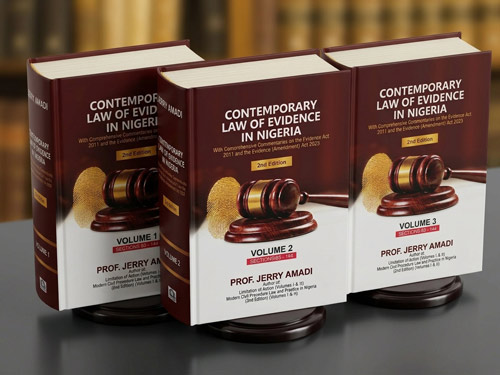 Prof. Jerry Amadi’s Evidence Law, Second Edition (2026), contains 3,314 pages in three volumes, covering the Evidence Act 2011, its 2023 amendment, and 4,051 Nigerian and English cases.