The United States has expressed concern over Nigeria’s failure to make sufficient progress in addressing attacks on Christian communities, warning that the country’s security measures have yet to produce the desired results despite ongoing diplomatic engagements and cooperation between both governments.

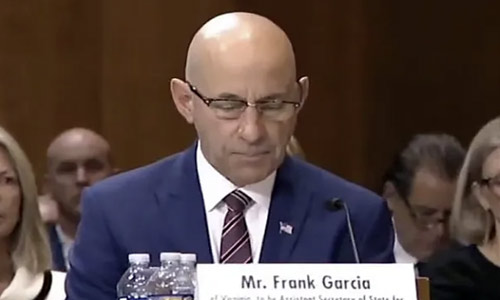
The US Assistant Secretary of State for African Affairs, Frank Garcia, acknowledged that Nigeria had taken steps to address the violence but maintained that the measures were not being implemented quickly or effectively enough to protect vulnerable communities, particularly in the Middle Belt.
Garcia made the remarks on Thursday during a congressional hearing on violence in Nigeria, where US Congressman Riley Moore questioned the Nigerian government’s response to attacks, the deployment of security personnel and the continued designation of Nigeria as a Country of Particular Concern (CPC).
Moore insisted that Nigeria should remain on the CPC list, arguing that the Federal Government had not demonstrated sufficient commitment or achieved the necessary results in addressing attacks on Christian communities.
“Before you answer that, we cannot take this CPC designation off of this country. They have not done enough,” Moore declared.
The congressman specifically questioned what military and security operations Nigeria had undertaken to dismantle militia strongholds and kidnapping camps in the Middle Belt, particularly in Benue and Plateau states.
He recalled that the US Under Secretary of State for Political Affairs, Allison Hooker, had raised concerns in August about the slow pace of Nigeria’s response to the security situation.
Moore demanded to know what concrete steps the Nigerian authorities had taken since those concerns were raised.
He also questioned why Benue and Plateau states, which have continued to experience attacks, were excluded from the 10 states covered by Nigeria’s newly introduced forest guard initiative.
The congressman further expressed concern that 1,000 forest guards approved by the President for Plateau State had yet to be deployed.
Responding to the questions, Garcia agreed that Nigeria had not achieved sufficient progress but cautioned against interpreting the lack of results as evidence that the Nigerian government was completely ignoring the security concerns.
“I think we would agree, as Under Secretary Hooker stated, after our CPC meeting that progress has not been there, but that doesn’t mean that Nigeria is dismissing concerns, and it doesn’t mean that they’re not taking actions, but it does mean that it hasn’t had an impact to this point,” Garcia stated.
He explained that although the Nigerian government had demonstrated some seriousness in addressing the situation, its efforts had not translated into the level of security improvement expected by Washington.
According to him, Nigeria was still developing the capacity required to tackle the security challenges, but the deployment of that capacity remained inadequate.
“I would have to characterise the Nigerians’ placement at this point as in building capacity. And that capacity is not deployed, is not being effective yet, and is not moving fast enough, as far as I’m concerned. But we do see a seriousness, and a deployment underway with the Nigerian government,” Garcia said.
The US official identified the establishment of the US-Nigeria Joint Working Group as an important step towards strengthening accountability and ensuring that commitments made by the Nigerian government were translated into measurable results.
He explained that the arrangement would provide a framework for monitoring Nigeria’s response to the violence and assessing the effectiveness of its security measures.
Garcia also acknowledged counterterrorism operations supported by the United States in the Lake Chad Basin.
However, he observed that such operations had not necessarily addressed the activities of Fulani militants operating across the Middle Belt.
His remarks highlighted concerns over the geographical focus of Nigeria’s security operations and whether existing counterterrorism measures were sufficiently addressing attacks in vulnerable communities.
In his prepared testimony, Garcia explained that the administration of US President Donald Trump had made the persecution of Christians in Nigeria a priority following the country’s redesignation as a Country of Particular Concern on October 31, 2025.
He maintained that the security situation remained troubling despite diplomatic engagements and efforts to strengthen cooperation with the Nigerian government.
“Unfortunately, the violence has not stopped,” Garcia declared.
He described the continuing attacks as an ongoing atrocity, citing a July 27 attack on a Christian community in Kaduna State and killings recorded in Plateau State during August and September.
The Assistant Secretary explained that Washington had continued engaging Nigerian officials to demand more effective protection for communities exposed to violence.
According to him, the US-Nigeria Joint Working Group held its first meeting in Abuja in January and subsequently convened another meeting in Washington in August.
During the engagements, the United States pressed Nigeria to increase security deployments in vulnerable Middle Belt communities, improve responses to early warnings and ensure accountability for perpetrators of attacks.
Garcia said the discussions also focused on strengthening military cooperation between both countries to improve the effectiveness of security operations.
He disclosed that the United States had provided training and equipment to Nigerian police units responsible for protecting vulnerable communities.
According to him, the assistance was delivered through the US Bureau of International Narcotics and Law Enforcement Affairs.
The official further revealed that Washington had expanded biometric information-sharing arrangements with Nigeria to support efforts to identify and prosecute individuals responsible for attacks.
He explained that the cooperation was intended to strengthen investigations and improve the ability of security agencies to hold perpetrators accountable.
Garcia also disclosed that the United States had worked with Nigerian financial institutions to develop an action plan aimed at disrupting terrorist financing networks suspected of funding attacks on churches.
He maintained that identifying and restricting financial support for violent groups formed part of the broader strategy to address the security situation.
The Assistant Secretary further disclosed that Hooker had raised additional concerns during the second meeting of the Joint Working Group in Washington.
According to him, the discussions addressed civilian casualties, the safe and voluntary return of internally displaced persons and the need for greater transparency in the expenditure and delivery of humanitarian assistance.
He said the United States had urged Nigeria to ensure that displaced persons could return safely to their communities while maintaining accountability in the management of humanitarian resources.
Despite the various initiatives, Garcia acknowledged that Nigeria continued to face considerable challenges in implementing its security commitments.
He observed that the country’s security architecture remained overstretched, limiting its ability to respond effectively to threats across different regions.
He also identified restricted access to judicial institutions in parts of the Middle Belt as a challenge affecting efforts to ensure accountability for attacks.
The US official maintained that the combination of limited security capacity, delayed deployments and difficulties accessing justice had contributed to the lack of measurable progress.
However, he reiterated that the United States recognised the steps Nigeria was taking, even though those efforts had not yet produced the expected impact.
Garcia said Washington would continue to employ diplomatic engagements, the CPC designation and targeted security cooperation to press the Nigerian government to protect vulnerable Christian communities and ensure that those responsible for violence were held accountable.
His position came as Congressman Moore insisted that Nigeria’s CPC designation should not be withdrawn while attacks continued and the government’s response remained inadequate.
The hearing highlighted continued differences between US concerns about the protection of Christian communities and the Nigerian government’s explanation of the country’s wider security challenges.
The Federal Government has consistently rejected allegations of a “Christian genocide” or systematic religious persecution.
Instead, Nigerian authorities have maintained that the violence across the country is driven by broader security problems, including terrorism, banditry and conflicts over resources.
The government has also argued that the insecurity affects Nigerians of different religious backgrounds rather than Christians alone.
Nevertheless, Garcia’s testimony indicated that Washington remained dissatisfied with the impact of Nigeria’s security response, particularly in communities experiencing repeated attacks.
While acknowledging efforts to build security capacity and deepen bilateral cooperation, the US official maintained that the measures had not yet delivered sufficient protection or accountability.
The United States consequently signalled its intention to maintain pressure through diplomatic engagement, the CPC framework and security cooperation while monitoring Nigeria’s implementation of its commitments to address the violence.
[A MUST HAVE] Evidence Act Demystified With Recent And Contemporary Cases And Materials

Available now for NGN 40,000 at ASC Publications, 10, Boyle Street, Onikan, Lagos. Beside High Court, TBS. Email publications@ayindesanni.com or WhatsApp +2347056667384. Purchase Link: https://paystack.com/buy/evidence-act-complete-annotation
______________________________________________________________________ “Enhance Legal Practice With Authoritative Reports” — Alexander Payne Offers Comprehensive Law Reports, Spanning Over A Century Of Nigerian Jurisprudence Interested buyers are encouraged to place their orders and enquiries via:
0704 444 4777, 0704 444 4999, 0818 199 9888
Website: www.alexandernigeria.com
“A Comprehensive Guide To Evidence Law” — Releases Second Edition In Three Volumes, Covering 4,051 Cases
For enquiries and orders, contact: 08035526491 Email: jerryamadisilk@gmail.com
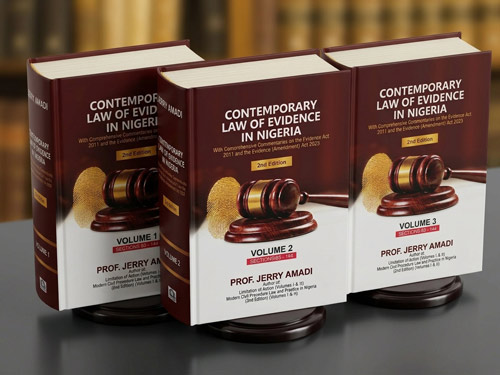 Prof. Jerry Amadi’s Evidence Law, Second Edition (2026), contains 3,314 pages in three volumes, covering the Evidence Act 2011, its 2023 amendment, and 4,051 Nigerian and English cases.