*Warns AI Could Displace Legal Jobs, Urges Overhaul Of Law School Training

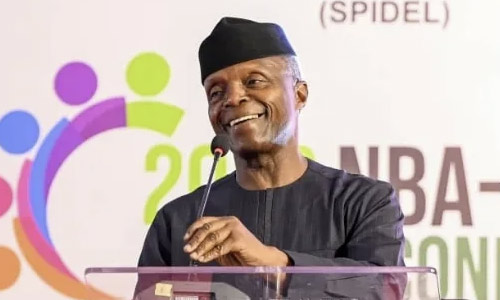
Former Vice President of Nigeria, Professor Yemi Osinbajo, SAN, has challenged Nigerian lawyers to move beyond courtroom victories, constitutional processes and electoral disputes to address poverty, unemployment, corruption, judicial delays and the growing threats posed by artificial intelligence to the legal profession and society.
Osinbajo maintained that democracy should not be judged merely by the conduct of elections or the existence of constitutional institutions but by its ability to improve the welfare, security and living conditions of ordinary citizens.
The former Vice President made the remarks while delivering the keynote address at the 2026 Annual Conference of the Nigerian Bar Association Section on Public Interest and Development Law (NBA-SPIDEL), held in Umuahia, Abia State, on Tuesday, November 10, 2026.
The conference had as its theme, “In Public Interest: Advancing Justice, Democracy and Development.”
Addressing lawyers, judges and other participants, Osinbajo argued that the legal profession must reconsider its traditional responsibilities in the face of economic hardship, declining public confidence in government institutions and technological developments capable of transforming employment and access to justice.
“Democracy must connect more firmly to human welfare: jobs, food, healthcare, justice and the security of lives and livelihoods,” he declared.
He explained that although elections confer legitimacy on governments, democratic institutions must ultimately be assessed by the benefits they deliver to citizens.
According to him, the existence of courts, elected representatives and constitutional safeguards does not automatically guarantee improved living standards or effective governance.
Osinbajo thanked NBA-SPIDEL and its Chair, Uju Agomoh, for the invitation and commended the Section for keeping public interest and development at the centre of the legal profession’s responsibilities.
He described SPIDEL’s mandate as particularly important at a time when traditional assumptions about democracy, justice and the role of lawyers were being challenged across the world.
The former Vice President urged legal practitioners to recognise that their professional obligations extend beyond identifying applicable laws, preparing court processes and representing clients in litigation.
He said lawyers must increasingly see themselves as social engineers whose work influences public policy, economic opportunities, institutional accountability and the protection of vulnerable people.
Osinbajo raised questions about whether democracy was delivering a better life for the majority, what access to justice meant to people who could not afford transportation to court, and how the law should respond to job losses caused by artificial intelligence.
He also questioned how lawyers would remain relevant when machines could perform many traditional legal tasks more quickly and how society should protect children from technologies designed to encourage excessive use.
“Lawyers cannot afford to treat these developments as someone else’s business,” he said.
“They affect the society in which our laws operate and the people whose interests we are supposed to protect.”
He described these challenges as questions concerning power, opportunity and protection, requiring deliberate engagement by the legal profession.
Osinbajo consequently advocated a people-centred approach to public interest law, insisting that legal reforms and government policies must be evaluated against their practical effects on ordinary citizens.
He observed that a government could celebrate increased revenue while families experienced the same policy as rising food prices.
Similarly, he said, authorities could invest in modern court buildings and technological infrastructure while ordinary people continued to face unresolved disputes and barriers to justice.
The former Vice President maintained that laws and institutions should be judged by whether they enable citizens to obtain education and healthcare, earn a livelihood, enjoy security, exercise their freedoms and challenge decisions affecting their rights.
He warned that formal equality before the law did not necessarily translate into equal opportunities to obtain justice.
“The wealthy litigant and the indigent widow have the same entitlement to approach a court. Their practical opportunities are hardly comparable,” he observed.
According to him, a major responsibility of public interest lawyers is to narrow the gap between constitutional promises and the everyday experiences of citizens.
Turning to the state of democracy in Africa, Osinbajo cited Afrobarometer surveys indicating declining public confidence in democratic institutions.
According to the figures he presented, surveys conducted across 39 African countries showed that only 46 per cent of respondents trusted their presidents, 37 per cent trusted their parliaments, 47 per cent trusted the courts and 46 per cent trusted the police.
He described the findings as troubling because the institutions concerned were established to represent citizens, hold governments accountable, administer justice and protect lives and property.
“When confidence in them weakens, obviously democracy suffers legitimacy,” he warned.
Osinbajo argued that much of the dissatisfaction with democratic governance was connected to economic hardship and the inability of citizens to meet basic needs.
Citing Afrobarometer surveys conducted between 2021 and 2025 across 38 African countries, including Nigeria, he said 59 per cent of respondents considered their national economies bad, while 51 per cent believed economic conditions had deteriorated.
He added that 48 per cent described their personal living conditions as fairly bad or very bad.
On government performance, the former Vice President stated that 76 per cent of respondents gave negative assessments of efforts to create jobs, 73 per cent criticised governments’ performance in improving the living standards of the poor, while 79 per cent expressed dissatisfaction with efforts to reduce inequality.
He further disclosed that 79 per cent of respondents reported that they or their families had gone without cash income at least once during the preceding year.
According to the figures, 65 per cent said they had been unable to obtain necessary medicine or medical care, while 58 per cent reported going without sufficient food for extended periods.
Osinbajo maintained that such experiences undermined citizens’ confidence in the value of democratic government.
“The major result of persistent hardship is that people begin to wonder naturally whether democracy is making a difference in their lives,” he said.
He also identified perceived official corruption as a major factor responsible for declining confidence in democratic institutions.
“But few things corrode the trust of people more deeply than the perception that official corruption is rampant,” he stated.
Referring to Afrobarometer surveys conducted between 2021 and 2023 across 39 countries, Osinbajo said 59 per cent of respondents believed corruption had increased during the preceding year.
He added that 67 per cent considered their governments’ efforts against corruption inadequate.
The former Vice President explained that whether every individual allegation of corruption was justified was different from the broader problem of declining public trust.
Those perceptions, he argued, reflected a crisis of confidence in government and the belief among many Africans that political freedom had not translated into economic security or improved living conditions.
He expressed particular concern about the declining participation of young people in electoral politics.
According to him, Afrobarometer surveys across 38 African countries indicated that only about half of young adults between 18 and 25 years reported voting in their countries’ most recent national elections.
He drew attention to Nigeria’s declining voter turnout across three successive general elections.
Osinbajo stated that voter turnout fell from 43.65 per cent in 2015 to 34.75 per cent in 2019 and further to 26.7 per cent in 2023.
He noted that young Nigerians were not necessarily indifferent to politics, as many continued to express dissatisfaction with government policies through protests and other forms of political engagement.
However, he warned that persistent disillusionment could weaken their belief in democratic governance itself.
“But the danger is that a generation which should be shaping Africa’s democratic future may increasingly cease to believe even in that democracy itself,” he said.
Despite the weaknesses of democratic institutions, Osinbajo rejected suggestions that military government or authoritarian rule offered a better alternative.
He cited a 2023 United Nations Development Programme survey which, according to him, found that only 11 per cent of respondents in countries that had experienced unconstitutional changes of government preferred a non-democratic system.
The former Vice President maintained that the appropriate response to democratic failures was to improve institutions, accountability and public service delivery rather than abandon constitutional government.
“Elections confer authority to govern but they do not establish the capacity to govern effectively,” he said.
“That requires competent institutions, accountable leadership, sound policies and capable public administration.”
Osinbajo therefore urged public interest lawyers to go beyond defending electoral processes, separation of powers and fundamental rights by examining whether government institutions were delivering meaningful benefits to citizens.
He said lawyers should scrutinise public budgets, monitor government expenditure, challenge administrative failures and work with communities to improve essential public services.
“Our responsibility cannot end with defending the machinery of government while ignoring what that machinery produces,” he stated.
“We must go beyond litigation: scrutinising budgets and expenditure, challenging administrative failures, and working with communities to improve public services.”
The former Vice President also criticised weaknesses within Nigeria’s justice administration system, particularly prolonged trials, corruption, impunity and the inability of poor citizens to obtain legal remedies.
He recounted an account given by a Justice of the Supreme Court of Nigeria who testified in proceedings in England concerning the time required for cases to progress through Nigeria’s judicial hierarchy.
According to Osinbajo, the Justice indicated that a case could ordinarily take approximately 30 years to move from the High Court to the Supreme Court in Nigeria.
“If cases can go on for disastrously long periods like that, there is no way that anyone can have confidence in the system, whether they are ordinary people or corporate organisations,” Osinbajo warned.
He maintained that a justice system burdened by excessive delays could not effectively protect rights, resolve disputes or support economic development.
The former Vice President argued that lawyers must confront the weaknesses of their own institutions rather than concentrate exclusively on the shortcomings of elected governments.
He said the legal profession’s responsibility was not complete merely because the country maintained a constitutional democracy governed by law.
According to him, lawyers must help build a system in which law makes justice, development and decent living conditions possible for everyone.
Explaining how access to justice could be made more responsive to citizens’ needs, Osinbajo revisited the reforms introduced in Lagos State between 1999 and 2007, during the administration of Bola Ahmed Tinubu as Governor.
He recalled serving as Attorney-General and Commissioner for Justice of Lagos State for two terms during the administration.
According to him, the government inherited a justice system shaped by years of military rule, where the Ministry of Justice largely operated as an institution concerned with protecting government authority and maintaining law and order.
He observed that such an approach sometimes placed greater emphasis on preventing disruptions to government than protecting the rights of vulnerable citizens.
Osinbajo maintained that although law and order remained essential, an orderly society was not necessarily a just society.
An effective justice system, he argued, must protect innocent people, defend vulnerable citizens, ensure fair treatment of accused persons and provide remedies where government itself violates individual rights.
He explained that the Lagos reforms were designed to make justice people-centred rather than institution-centred.
As part of the reforms, the administration established the Directorate for Citizens’ Rights to address the complaints and legal concerns of ordinary citizens.
It also created the Office of the Public Defender to provide free legal representation in both civil and criminal matters.
Osinbajo recalled that public defence arrangements had traditionally concentrated on criminal cases, leaving many poor citizens without effective legal assistance in civil disputes.
Under the Lagos arrangement, the government recruited and paid lawyers to represent indigent persons, just as it employed prosecutors to handle criminal cases.
“Just as we hired and paid prosecutors, we hired and paid lawyers to represent the poor in both civil and criminal cases,” he explained.
The administration also established Citizens’ Mediation Centres to resolve disputes involving family relationships, inheritance, tenancy, employment and commercial transactions.
The former Vice President explained that the centres were initially staffed by lawyers from the Ministry of Justice who received training in mediation.
He said the objective was to provide affordable, timely and accessible dispute resolution without the costs and delays often associated with conventional litigation.
According to him, the centres resolved more than 8,000 disputes during their first year of operation, compared with fewer than 2,000 cases resolved by the Magistrates’ Courts during the same period.
He added that the centres now handled approximately 20,000 disputes annually.
Osinbajo maintained that the success of the initiative lay not merely in the number of disputes resolved but in the opportunity it gave ordinary people to continue their lives without prolonged legal battles.
“The question we must always ask ourselves is how can the poor get justice?” he said.
He questioned how a primary school teacher whose land had been unlawfully encroached upon could afford legal fees and what alternatives the legal system should provide where private representation was beyond such a person’s means.
The former Vice President called on lawyers to approach justice as a practical means of obtaining redress, protection and enforcement of rights, particularly for disadvantaged citizens.
Turning to technological developments, Osinbajo warned that artificial intelligence could fundamentally alter the legal profession and eliminate many traditional employment opportunities.
He said AI systems were becoming increasingly capable of conducting legal research, analysing documents, drafting legal processes and performing other tasks for which lawyers traditionally received professional fees.
“AI tools can research, analyse and draft at extraordinary speed. These are the skills that we as lawyers are trained in,” he observed.
Osinbajo referred to a warning attributed to Anthropic co-founder Dario Amodei that artificial intelligence could eliminate as many as 50 per cent of entry-level white-collar jobs within five years.
He also referred to a reported September 2026 development involving an OpenAI system and the Navier-Stokes mathematical problem, using it to illustrate his concern about AI systems’ increasing capacity to undertake complex intellectual work.
The former Vice President maintained that the implications extended beyond lawyers to accountants, engineers, bankers, software developers, researchers and other professionals.
He warned that advances in robotics could eventually disrupt manual occupations as well.
According to him, the growing accessibility of artificial intelligence meant that clients would increasingly have access to tools capable of carrying out work previously reserved for professionals.
He therefore questioned what distinctive value lawyers would continue to offer when clients could independently obtain legal information, draft documents and analyse possible legal arguments.
“A lawyer must now become a person of affairs: someone who understands institutions, economics, technology and human behaviour, and can explain whose interests a rule serves and what consequences it produces,” he stated.
Osinbajo argued that the profession could no longer depend primarily on the ability to identify legal rules or prepare court processes.
He urged lawyers to develop stronger negotiation, conflict-resolution and analytical skills, predicting that conventional adversarial litigation could become less central to legal practice.
The former Vice President also stressed that lawyers must independently verify AI-generated legal work because they would remain professionally accountable for the advice provided to clients.
He encouraged practitioners to use artificial intelligence to make legal services more affordable and accessible while participating in the development of regulations that protect citizens without unnecessarily restricting beneficial innovation.
Osinbajo described the challenge as particularly serious for younger lawyers.
He questioned how newly qualified practitioners would acquire professional judgment, advocacy skills and practical experience if artificial intelligence substantially reduced entry-level legal work.
To illustrate the scale of the change, he explained that AI tools such as ChatGPT and Claude could already be used to prepare draft statements of claim, defences and legal opinions within minutes.
He said lawyers could provide the facts of a land dispute to such systems and receive draft processes or suggestions on whether proceedings should commence by writ of summons or originating summons.
According to him, an AI system connected to a law firm’s database could also prepare legal documents and briefs from existing materials.
He further observed that a judge could ask an AI system to draft a reasoned judgment from the parties’ final written addresses.
Osinbajo noted that clients could similarly use the technology to obtain preliminary legal opinions about investments, commercial transactions and regulatory requirements.
“This was what we made money from not too long ago,” he remarked.
He warned that lawyers who assumed the profession would remain fundamentally unchanged following the emergence of generative AI tools were failing to appreciate the scale of the technological transformation.
The former Vice President consequently called on law faculties, the Nigerian Law School, the Nigerian Bar Association and law firms to collaborate in redesigning legal education and professional training.
He argued that young lawyers must learn how to interrogate AI-generated results, understand clients’ needs, negotiate effectively and defend their legal reasoning against competing arguments.
Osinbajo also called for broader legal protections for workers whose employment could be displaced by technology.
He referred to approaches being considered by international labour organisations and European jurisdictions, including measures requiring employers to provide advance notice of substantial technology-related redundancies.
According to him, such safeguards should include meaningful consultation with affected employees, reasonable retraining and redeployment opportunities, and minimum benefits to support workers transitioning into other forms of employment.
He maintained that the protections should extend beyond traditional industrial workers to professional and technical employees, including lawyers, accountants, engineers and software developers.
Osinbajo stressed that the profession had a responsibility to protect younger generations from the economic consequences of technological change.
“We owe them more than reassurance,” he said.
The former Vice President also raised concerns about the impact of technology on children, particularly the design of social media platforms and digital products intended to retain users’ attention for extended periods.
He observed that children were especially vulnerable to technologies designed to encourage repeated engagement and potentially addictive behaviour.
According to him, legal practitioners must become more involved in discussions about technology governance, children’s rights and the regulation of harmful digital products.
He urged the profession to examine whether existing Nigerian laws provided adequate protection against technological practices that could exploit children or undermine their welfare.
Osinbajo maintained that emerging technological challenges would increasingly require lawyers to address issues beyond conventional human rights litigation.
He identified labour rights, children’s protection, economic security, access to public services and protection against exploitation by technology as areas demanding greater professional attention.
The former Vice President warned that some of these questions had yet to be adequately addressed by courts or legislation, making proactive legal and policy engagement necessary.
He therefore urged NBA-SPIDEL to take a leading role in developing public interest responses to the emerging challenges.
According to him, the Section’s combined commitment to public interest litigation and development placed it in a position to influence how Nigerian law responds to inequality, technological disruption and institutional failures.
Osinbajo concluded that the most important challenge facing lawyers was to demonstrate the relevance of democracy and justice to the daily lives of citizens.
He maintained that Nigerians were increasingly questioning the value of constitutional government and legal institutions when poverty, insecurity, unemployment and unequal access to justice persisted.
“But most importantly, we are going to have to answer to a skeptical populace that is saying, ‘What is the purpose of justice, what is the purpose of democracy, if it does not represent the vast majority of people, and the needs of the vast majority of people?’” he said.
He urged lawyers to recognise that their responsibility was not limited to technical legal practice but included shaping institutions, protecting vulnerable people and ensuring that government policies produced meaningful improvements in society.
The former Vice President maintained that the ultimate measure of democratic government should be how leaders acquire power, how they exercise it and whose lives improve as a result.
He consequently called on Nigerian lawyers to use public interest advocacy, institutional reforms and emerging technologies to build a justice system capable of addressing the needs of ordinary citizens.
Osinbajo said achieving that objective would require the profession to remain committed not only to defending democracy and the rule of law but also to ensuring that both deliver justice, development and a decent life for everyone.
[A MUST HAVE] Evidence Act Demystified With Recent And Contemporary Cases And Materials

Available now for NGN 40,000 at ASC Publications, 10, Boyle Street, Onikan, Lagos. Beside High Court, TBS. Email publications@ayindesanni.com or WhatsApp +2347056667384. Purchase Link: https://paystack.com/buy/evidence-act-complete-annotation
______________________________________________________________________ “Enhance Legal Practice With Authoritative Reports” — Alexander Payne Offers Comprehensive Law Reports, Spanning Over A Century Of Nigerian Jurisprudence Interested buyers are encouraged to place their orders and enquiries via:
0704 444 4777, 0704 444 4999, 0818 199 9888
Website: www.alexandernigeria.com
“A Comprehensive Guide To Evidence Law” — Releases Second Edition In Three Volumes, Covering 4,051 Cases
For enquiries and orders, contact: 08035526491 Email: jerryamadisilk@gmail.com
 Prof. Jerry Amadi’s Evidence Law, Second Edition (2026), contains 3,314 pages in three volumes, covering the Evidence Act 2011, its 2023 amendment, and 4,051 Nigerian and English cases.