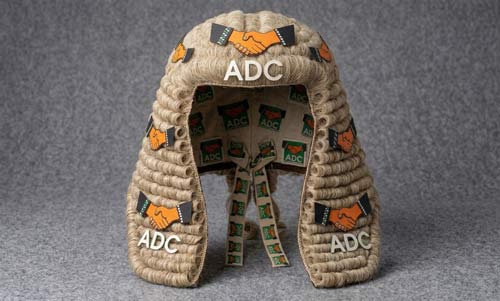
The African Democratic Congress Presidential Campaign Council has asked the National Judicial Council to investigate the circumstances surrounding the transfer of the party’s leadership dispute from Justice Emeka Nwite to Justice Peter Lifu of the Federal High Court in Abuja.

The campaign council also wants the NJC to examine the conduct of the Chief Judge of the Federal High Court, Justice John Tsoho, in relation to the reassignment, as well as Justice Lifu’s handling of the case.
In a statement issued on Tuesday, the Director of Strategic Communications of the ADC Presidential Campaign Council, Phrank Shaibu, said the circumstances surrounding the transfer raised questions which, in the party’s view, required independent examination.
According to Shaibu, the plaintiff in the leadership dispute had requested that the case be transferred from Justice Nwite on grounds of delay and alleged lack of confidence in obtaining a timely hearing.
He said ADC lawyers responded to the request on May 11, 2026, disputing the plaintiff’s account of the previous adjournments and describing the transfer request as forum shopping.
Shaibu said the party’s National Secretary, Rauf Aregbesola, subsequently wrote to Justice Tsoho on June 2, formally objecting to the reassignment and asking that it be reversed on the ground that the party lacked confidence in Justice Lifu’s impartiality.
According to him, the matter was nevertheless assigned to Justice Lifu the following day.
“The sequence and timing of this transfer raise grave concerns about bias and create an appearance that the process was not handled with the impartiality this matter demanded,” Shaibu said.
“Justice Tsoho must answer those concerns openly. The public is entitled to know why our formal protest was set aside and why the case was reassigned the very next day.”
Shaibu argued that the concerns were heightened because Justice Nwite had already begun hearing the matter and had not recused himself before the case was transferred.
The ADC stressed that its allegations remained matters it wanted the NJC to examine, while the substantive legal questions arising from Justice Lifu’s judgment had already been taken before the Court of Appeal.
The party said it would respect the eventual decision of the appellate court.
Justice Lifu had on November 5 nullified the David Mark-led leadership of the ADC and invalidated decisions taken under it, including the presidential primary that produced former Vice-President Atiku Abubakar as the party’s candidate for the 2027 election.
The ADC has since appealed the judgment and applied for a stay of execution, while also asking the Independent National Electoral Commission not to take consequential action until the appellate process is determined.
Shaibu also demanded the immediate release of the full judgment delivered by Justice Lifu, arguing that the party required the official copy and reasons for the decision to effectively pursue its appeal.
“The ADC must be given the official copy and the reasons for the decision so that we can proceed with the appropriate legal action. Withholding the judgment obstructs our right to challenge it and denies the appellate court the benefit of a complete record,” he said.
The party had earlier said its lawyers applied for the certified true copy of the judgment and paid the required fees but had yet to receive it.
Beyond the transfer of the leadership dispute, Shaibu also questioned Justice Lifu’s handling of a separate suit in which the judge ordered INEC to deregister the ADC and four other political parties.
According to him, the Court of Appeal had stayed proceedings in that matter, but Justice Lifu proceeded to deliver judgment, which was subsequently nullified by the appellate court.
Shaibu further relied on an earlier judgment delivered by Justice Musa Liman of the Federal High Court in Abuja in another challenge to the ADC leadership.
He said Justice Liman dismissed that challenge for lack of merit and locus standi, held that the dispute concerned the internal affairs of the party and affirmed the leadership arrangement being challenged.
The ADC maintains that the earlier judgment remains relevant to the present controversy and argues that Justice Lifu, as a judge of the same Federal High Court, could not disregard a subsisting decision of a court of coordinate jurisdiction.
The party has included the alleged conflict between the two decisions among the issues it wants the Court of Appeal to determine. Justice Liman’s July judgment dismissed a separate challenge to the Mark-led leadership on jurisdictional grounds.
Shaibu maintained that the ADC’s presidential candidate remained Atiku and said the party would defend that position through the appellate process.
“The law is on his side, not sentiment. We will defend that position before the Court of Appeal and keep the record before Nigerians,” he said..
[A MUST HAVE] Evidence Act Demystified With Recent And Contemporary Cases And Materials

Available now for NGN 40,000 at ASC Publications, 10, Boyle Street, Onikan, Lagos. Beside High Court, TBS. Email publications@ayindesanni.com or WhatsApp +2347056667384. Purchase Link: https://paystack.com/buy/evidence-act-complete-annotation
______________________________________________________________________ “Enhance Legal Practice With Authoritative Reports” — Alexander Payne Offers Comprehensive Law Reports, Spanning Over A Century Of Nigerian Jurisprudence Interested buyers are encouraged to place their orders and enquiries via:
0704 444 4777, 0704 444 4999, 0818 199 9888
Website: www.alexandernigeria.com
“A Comprehensive Guide To Evidence Law” — Releases Second Edition In Three Volumes, Covering 4,051 Cases
For enquiries and orders, contact: 08035526491 Email: jerryamadisilk@gmail.com
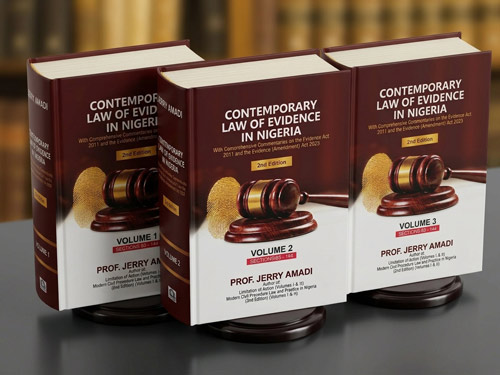 Prof. Jerry Amadi’s Evidence Law, Second Edition (2026), contains 3,314 pages in three volumes, covering the Evidence Act 2011, its 2023 amendment, and 4,051 Nigerian and English cases.