As Troops Deployed Against Supreme Court

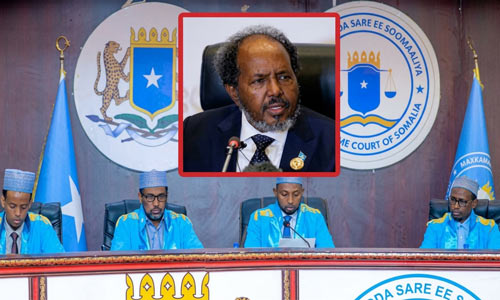
Somalia has been plunged into a constitutional crisis after its Supreme Court declared President Hassan Sheikh Mohamud’s extension of his tenure unlawful, nullified his decision to dismiss the country’s Chief Justice and ordered fresh elections within 90 days.
The confrontation intensified following allegations by opposition leaders that the President deployed security forces to the Supreme Court in Mogadishu and attempted to arrest Chief Justice Baashe Yusuf Ahmed and other judicial officers after the court ruled against his continued stay in office.
The developments have raised concerns about judicial independence, separation of powers and the future of constitutional government in Somalia, which is also battling a prolonged insurgency and growing political divisions.
In its judgment delivered on Thursday, November 5, 2026, the Supreme Court held that constitutional amendments extending presidential and parliamentary terms from four to five years could not automatically apply to officials already holding office.
The court ruled that President Mohamud’s constitutional tenure expired on May 15, 2026, while the mandates of both houses of the Federal Parliament ended on April 14, 2026.
It consequently rejected the government’s position that the amendments approved by Parliament in March 2026 entitled the President to remain in office until May 2027.
The ruling followed a constitutional challenge instituted by former Somali President Sharif Sheikh Ahmed, who questioned the validity of the tenure extension and the legal consequences of the constitutional amendments.
The Supreme Court’s five-member Constitutional Division examined the procedures governing constitutional amendments and their application to existing political officeholders.
The court held that where constitutional amendments introduce new terms of office, they must clearly specify whether those changes apply to incumbent officials or only to those elected after the amendments take effect.
It explained that where such provisions are absent, the new tenure cannot automatically be applied retrospectively to extend the mandates of existing officeholders.
Applying that principle, the court held that the original four-year constitutional terms remained applicable to President Mohamud and the Federal Parliament.
Although the court rejected part of the challenge concerning the constitutional amendment process on the ground of standing, it upheld the challenge to the application of the amendments to the existing administration.
The court also held that the Federal Government’s constitutional mandate had expired alongside that of Parliament, which exercises legislative oversight and grants confidence to the executive.
It declared that the affected institutions could not continue exercising their full constitutional and statutory powers after the expiration of their mandates.
The court further held that official actions taken beyond those expired mandates were unconstitutional and legally invalid, while recognising a limited caretaker role for the Federal Government.
According to the judgment, the caretaker administration may continue performing routine governmental functions but cannot exercise powers extending beyond ordinary day-to-day administration.
The Supreme Court directed Somalia’s political leaders and other relevant stakeholders to reach an agreement on an acceptable electoral framework within 30 days.
It also ordered that elections be conducted within 90 days, effectively rejecting the government’s existing timetable for parliamentary and presidential elections scheduled for April and May 2027.
However, the court did not name an alternative President or specify what should happen if political leaders failed to agree on electoral arrangements within the prescribed period.
The absence of a clearly defined succession arrangement has raised questions about the implementation of the judgment and the status of Somalia’s political leadership pending elections.
The dispute arose after President Mohamud’s administration introduced constitutional reforms designed to replace Somalia’s longstanding indirect electoral system with nationwide direct elections.
Under the existing arrangement, clan representatives participate in selecting lawmakers, who subsequently elect the President.
Mohamud has maintained that direct elections would strengthen democratic participation and allow citizens to exercise greater control over the choice of their political leaders.
His administration argued that additional time was necessary to implement the reforms and prepare the country for elections under the proposed system.
However, opposition politicians and regional administrations, including Puntland and Jubaland, challenged the changes, accusing the government of seeking to extend its stay in power without obtaining a fresh electoral mandate.
The constitutional amendments were approved in March 2026 amid opposition boycotts and allegations that some political groups had been excluded from the process.
The President subsequently declared a transitional period intended to extend his administration’s tenure until 2027.
Opposition leaders maintained that the decision violated the constitutional limits on presidential and parliamentary tenure.
The disagreement eventually reached the Supreme Court, culminating in Thursday’s judgment rejecting the application of the amendments to the incumbent administration.
Mohamud previously served as Somalia’s President from 2012 to 2017 before returning to office following an election held on May 15, 2022.
The latest dispute therefore concerns the attempted extension of his current presidential mandate by one year, rather than a judicial determination expressly prohibiting him from contesting a possible third presidential term.
The constitutional confrontation had already intensified before the Supreme Court delivered its judgment.
On Wednesday, November 4, 2026, the Presidency announced the dismissal of Chief Justice Baashe Yusuf Ahmed and appointed former Chief Justice Ibrahim Idle Suleiman as his replacement.
The government attributed the decision to concerns about the administration of justice and the need to ensure a more efficient, transparent and impartial judiciary.
The Presidency did not expressly connect the dismissal to the pending constitutional challenge concerning the President’s tenure.
However, the Supreme Court rejected the removal, declaring that the President lacked the constitutional authority to unilaterally dismiss the head of the judiciary without following the prescribed procedures.
“The dismissal announced in the statement published on the Presidency’s Facebook page is null and void,” the court declared.
The apex court also accused the Presidency of attempting “to obstruct the administration of justice in the constitutional case filed before the Supreme Court.”
The court maintained that Chief Justice Ahmed remained the lawful holder of the office and that his dismissal violated constitutional requirements governing judicial independence.
The ruling reinforced the principle that judicial officers must be protected from unlawful executive interference, particularly when adjudicating disputes involving the powers and tenure of the President.
Following the judgment, allegations emerged that government security forces had been deployed around the Supreme Court premises in Mogadishu.
Former Prime Minister Hassan Ali Khaire accused President Mohamud of using security personnel to intimidate judicial officers and frustrate the implementation of the court’s decision.
Khaire alleged that the President had “launched an assault on the Supreme Court and deployed troops to its premises.”
He further alleged that security personnel were pursuing the Chief Justice and other legal officers for arrest and that some judicial personnel had been subjected to mistreatment.
The former Prime Minister condemned the alleged conduct, warning that interference with the judiciary could undermine constitutional government and deepen political instability.
“Somalia stands at a dangerous juncture,” he warned.
He urged political leaders, civil society organisations and the public to defend the country’s constitutional institutions and ensure that the judiciary could perform its functions without intimidation.
However, the allegations concerning attempted arrests, torture and the deployment of troops against judicial officers have not been independently verified.
Local media reports indicated that security personnel had been stationed around the Supreme Court and that Chief Justice Ahmed had been ordered to leave the premises.
A senior judicial officer was also cited as saying that the Supreme Court’s official Facebook page, previously used to publish judgments and statements, had become inaccessible.
The circumstances surrounding those developments remain unclear.
Neither the alleged attempted arrest of the Chief Justice nor the reported mistreatment of judicial personnel has been independently established.
Former President Sharif Sheikh Ahmed also condemned the attempted removal of the Chief Justice, describing it as an unlawful interference with the judiciary and a violation of the constitutional separation of powers.
Sharif welcomed the Supreme Court’s decision rejecting the retrospective application of the constitutional amendments, maintaining that political leaders must respect the limits imposed on public authority.
He called for negotiations among political stakeholders to resolve the dispute and establish an acceptable electoral framework.
Other opposition figures, including lawmaker Abdirahman Abdishakur Warsame, accused the administration of worsening the country’s political and security challenges through unilateral decisions.
They warned that attempts to undermine the judiciary could further weaken public confidence in Somalia’s democratic institutions.
The Supreme Court’s ruling comes amid longstanding disagreements between the Federal Government and regional administrations over constitutional reforms and the organisation of national elections.
Puntland and Jubaland have challenged aspects of the government’s electoral proposals, while opposition groups have insisted that fundamental changes to the country’s political system must be based on broad consultation and consensus.
The disagreement had already resulted in violent confrontations in Mogadishu in June 2026, when rival political factions clashed over the constitutional amendments and the government’s electoral timetable.
The latest judicial confrontation has therefore added another dimension to the country’s political instability.
Beyond the immediate dispute, Somalia continues to confront security threats from Al-Shabaab, an Al-Qaeda-linked militant organisation responsible for attacks on government institutions, security personnel and civilians.
The armed group maintains a presence in parts of the country and continues to threaten security in Mogadishu and other locations.
The prolonged insurgency has placed pressure on Somalia’s armed forces and international partners supporting counterterrorism and stabilisation operations.
Concerns about political instability have coincided with reductions in international financial and military support.
Uganda, a major contributor to the African Union’s military operations in Somalia, has announced plans to withdraw its remaining troops by the end of 2027.
The planned withdrawal has raised questions about the ability of Somali security forces to protect strategic locations and maintain security in areas currently supported by international troops.
The United States has also reduced funding support for international security arrangements, while some donors have expressed frustration over the pace of progress against armed groups and continuing political uncertainty.
The constitutional dispute has unfolded shortly after the closure of the United Nations political mission that previously supported dialogue among Somalia’s rival political leaders.
The absence of an agreed replacement mediation arrangement has increased concern about how the government, opposition and regional administrations will resolve their differences.
The Supreme Court’s intervention has therefore created a major test of constitutional authority at a time when the country faces serious political, financial and security challenges.
The judgment raises important questions about whether constitutional amendments can lawfully extend an incumbent President’s tenure, the limits of executive authority over the judiciary and the consequences of government institutions continuing to exercise powers after their mandates have expired.
It also highlights the difficulty of enforcing judicial decisions in situations where the ruling directly affects the political authority of the government responsible for implementing it.
Although the court has declared the tenure extension unlawful and directed elections within 90 days, it remains uncertain whether the administration will comply with the judgment or whether political stakeholders can agree on the necessary electoral arrangements.
The Presidency had not publicly responded to the substantive ruling or the allegations concerning the deployment of security forces as of Friday, November 6, 2026.
There is also no independently verified evidence establishing that Chief Justice Ahmed was arrested or that judicial officers were tortured following the judgment.
For now, the confrontation has placed Somalia’s judiciary and executive on opposing sides of a constitutional dispute over political tenure, judicial independence and the lawful exercise of public authority.
The outcome will depend largely on whether Somalia’s political leaders accept the court’s pronouncements, respect constitutional procedures and reach an agreement capable of producing peaceful and credible elections.
The crisis ultimately represents a major test of the rule of law and the principle that political authority, including the powers of a sitting President, remains subject to constitutional limitations and judicial oversight.
[A MUST HAVE] Evidence Act Demystified With Recent And Contemporary Cases And Materials

Available now for NGN 40,000 at ASC Publications, 10, Boyle Street, Onikan, Lagos. Beside High Court, TBS. Email publications@ayindesanni.com or WhatsApp +2347056667384. Purchase Link: https://paystack.com/buy/evidence-act-complete-annotation
______________________________________________________________________ “Enhance Legal Practice With Authoritative Reports” — Alexander Payne Offers Comprehensive Law Reports, Spanning Over A Century Of Nigerian Jurisprudence Interested buyers are encouraged to place their orders and enquiries via:
0704 444 4777, 0704 444 4999, 0818 199 9888
Website: www.alexandernigeria.com