*Says “I Was A Regular Visitor To EFCC Over Allegations I Knew Nothing About”

Retiring Justice of the Supreme Court, Uwani Musa Abba Aji, has disclosed that the United States government imposed a travel restriction on seven justices of Nigeria’s apex court following what she described as the misinterpretation of a judgment delivered by the panel, revealing that the restriction remains in force.
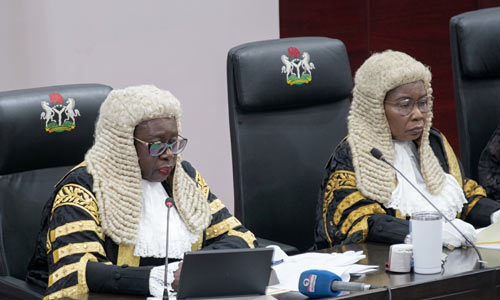
Justice Abba Aji made the disclosure on Friday during a valedictory court session held in her honour at the Supreme Court in Abuja, ahead of her retirement on November 7, 2026, when she will attain the mandatory retirement age of 70 years.
The Yobe State-born jurist described the restriction as one of the challenges she encountered while serving on the Supreme Court bench, maintaining that judicial officers must sometimes endure personal inconveniences and consequences in the discharge of their constitutional responsibilities.
Reflecting on her years in judicial service, she said her career had involved difficult decisions and experiences that strengthened her commitment to the independent administration of justice.
“My time on the Supreme Court bench was filled with challenges, some of which have served as additional opportunities to stand firm on the side of justice, regardless of the consequences,” she stated.
“One such challenging judgment was widely misinterpreted and led to a travel ban to the United States of America being imposed on all members of the panel, a ban which still holds today.”
The retiring justice maintained that such experiences were among the sacrifices judicial officers might be required to make to preserve the integrity and impartiality of the justice system.
Although Justice Abba Aji did not expressly identify the judgment responsible for the restriction in the remarks made available, her disclosure has brought renewed attention to the controversy surrounding the Supreme Court’s January 14, 2020, judgment on the Imo State governorship election.
On that occasion, a seven-member panel of the Supreme Court removed Emeka Ihedioha of the Peoples Democratic Party (PDP) as Governor of Imo State and declared Senator Hope Uzodimma of the All Progressives Congress (APC) the lawful winner of the March 9, 2019, governorship election.
The apex court held that results from 388 polling units had been wrongly excluded during the collation of election results and that the inclusion of those votes gave Uzodimma the highest number of lawful votes.
The court consequently directed the Independent National Electoral Commission (INEC) to withdraw the certificate of return issued to Ihedioha and issue another to Uzodimma.
The lead judgment was delivered by Justice Kudirat Kekere-Ekun, now Chief Justice of Nigeria, while Justice Abba Aji was among the seven justices who constituted the panel.
The judgment generated widespread controversy because Uzodimma had originally been placed fourth in the results announced by INEC before the Supreme Court’s decision changed the outcome.
However, the Supreme Court’s reasoning was that the originally declared results did not reflect all the lawful votes cast, rather than that a candidate could be elevated from fourth position without an examination of the disputed votes.
Ihedioha subsequently approached the Supreme Court seeking a review of its decision.
On March 3, 2020, the court dismissed the application by a majority of six to one, maintaining the finality of the earlier judgment.
Justice Chima Centus Nweze dissented, expressing concern about the disputed results from the 388 polling units and questioning whether the evidence justified the original decision.
His objections included issues concerning the verification of the polling-unit results and the relationship between the revised vote totals and the number of accredited voters.
The majority did not adopt those objections, and the judgment declaring Uzodimma governor remained in force.
Following the controversy, some political and civil society groups called on the United States government to impose visa restrictions on the seven justices involved in the decision.
In January 2020, the Coalition in Defence of Nigerian Democracy and Constitution publicly advocated restrictions against the panel, citing concerns about the implications of the judgment for Nigeria’s electoral process.
Those demands were calls for sanctions and did not, by themselves, establish that the United States had imposed any restriction.
The controversy resurfaced in February 2023 when former Cross River State Governor Donald Duke publicly claimed that the seven justices involved in the Imo governorship decision had been denied visas to attend a judicial conference or retreat in the United States.
According to Duke, the justices’ aides were granted visas while the judicial officers themselves were refused entry documents.
Duke’s account attracted public attention because it suggested that the controversy surrounding the Imo judgment had extended beyond Nigeria.
Justice Abba Aji’s disclosure at her valedictory session now provides an account from a member of the judiciary describing a travel restriction affecting an entire panel of Supreme Court justices.
Nevertheless, her statement did not expressly connect the restriction to the Imo governorship judgment, disclose the individual visa decisions or identify the legal provision relied upon by the United States authorities.
The connection to the Imo case therefore remains contextual rather than conclusively established by her remarks alone.
The United States government had separately announced visa restrictions against certain Nigerians accused of undermining democratic processes.
On January 25, 2023, then US Secretary of State Antony Blinken announced restrictions under Section 212(a)(3)(C) of the United States Immigration and Nationality Act.
The announcement stated that certain individuals were being made ineligible for United States visas because of their alleged involvement in activities undermining democratic processes in Nigeria.
However, the statement did not identify the affected individuals or specifically mention the Imo governorship judgment.
Consequently, the public announcement cannot independently establish that Justice Abba Aji and the other six justices were among those affected or confirm the precise legal basis of the restriction described in her valedictory remarks.
Her assertion that the judgment was misinterpreted also represents her explanation of the circumstances. The specific interpretation considered objectionable, and whether American officials relied on such an interpretation, were not disclosed.
Justice Abba Aji also used the occasion to recount another difficult period in her judicial career, recalling how she became the subject of an investigation by the Economic and Financial Crimes Commission (EFCC) in 2016.
According to her, she was attending a programme in Washington, DC, in the United States when she received a telephone call informing her that the anti-graft agency required her attention over a petition lodged against her in Lagos.
She explained that the development marked the beginning of a distressing period during which she had to visit the EFCC repeatedly to answer questions concerning allegations of corruption.
The retiring justice maintained that she knew nothing about the allegations but cooperated with investigators until the inquiry was concluded.
She disclosed that she was eventually exonerated of the allegations.
However, Justice Abba Aji said the experience was particularly painful because public accusations and damaging commentary continued while she was unable to respond openly.
She explained that the conservative nature of the judiciary and the expectations placed on serving judicial officers prevented her from publicly defending herself against the allegations.
According to her, the situation became chaotic as damaging reports circulated, despite her insistence that she had committed no wrongdoing.
She described the period as one of the most difficult experiences of her judicial career, stressing that the eventual outcome did not erase the emotional and reputational challenges she endured during the investigation.
Nevertheless, she maintained that the experience strengthened her commitment to judicial integrity and the importance of remaining faithful to the law despite personal difficulties.
Reflecting on her career, the retiring justice urged younger judicial officers to uphold integrity, courage and humility in the administration of justice.
She advised them not to allow external pressure, personal interests or fear of consequences to influence their decisions.
Justice Abba Aji reminded serving judges that their responsibility extended beyond determining disputes between litigants to preserving public confidence in the judicial system.
She emphasised that the law should not be regarded merely as a profession but as a public trust requiring diligence, impartiality and moral courage.
She also urged judicial officers to remain steadfast in their commitment to justice, even when their decisions attracted criticism or subjected them to personal inconvenience.
Earlier, the Chief Justice of Nigeria, Justice Kudirat Kekere-Ekun, who presided over the valedictory session, commended Justice Abba Aji for her years of dedicated service to the Nigerian judiciary.
The CJN described the retiring justice as a distinguished jurist whose contributions to the administration of justice had earned her respect within the legal profession.
Justice Kekere-Ekun praised her integrity, intellectual contributions and commitment to judicial responsibilities, noting that she was leaving the Supreme Court with an unblemished record of service.
She also highlighted the importance of Justice Abba Aji’s career to the advancement of women in the Nigerian judiciary.
According to the CJN, her professional journey demonstrated that women could attain the highest levels of judicial responsibility through hard work, discipline and dedication.
Justice Kekere-Ekun recalled that the retiring jurist rose through different levels of the judicial system, serving in the magistracy, High Court and Court of Appeal before her elevation to the Supreme Court.
She particularly acknowledged her historic appointment as the first female judge of the Yobe State High Court, describing the achievement as an important milestone for women in the legal profession.
The CJN also recognised Justice Abba Aji’s contributions to the National Association of Women Judges in Nigeria and her efforts to improve the welfare and professional development of judicial officers.
She maintained that her achievements would continue to inspire younger generations of female lawyers and judges.
Also speaking, the Attorney-General of the Federation and Minister of Justice, Prince Lateef Fagbemi, SAN, commended Justice Abba Aji for her contributions to the development of Nigerian jurisprudence, particularly in cases concerning the powers and constitutional legitimacy of anti-corruption institutions.
Fagbemi specifically acknowledged her role in a Supreme Court judgment concerning the Economic and Financial Crimes Commission (EFCC), the Independent Corrupt Practices and Other Related Offences Commission (ICPC), and the Nigerian Financial Intelligence Unit (NFIU).
The judgment referred to was delivered on November 15, 2024, when the Supreme Court dismissed a suit challenging the constitutionality of the laws establishing the anti-corruption agencies.
In that case, a seven-member panel of the apex court unanimously rejected the action instituted by several state governments questioning the legislative competence of the National Assembly to establish the institutions.
Justice Abba Aji delivered the lead judgment, holding that the relevant legislation was validly enacted and that the agencies were legally empowered to perform their statutory functions.
The decision affirmed the continued legality and powers of the EFCC, ICPC and NFIU. It did not establish the agencies, which had already been created by legislation.
The Attorney-General described the judgment as an important contribution to Nigeria’s legal framework for combating corruption, financial crimes and related offences.
Justice Abba Aji’s retirement brings to an end a judicial career spanning several decades.
Born on November 7, 1956, in Gashua, Yobe State, she obtained a Diploma in Law from Ahmadu Bello University, Zaria, in 1976 and a Bachelor of Laws degree from the same institution in 1980.
She was called to the Nigerian Bar in 1981 and subsequently served in various positions within the judiciary and public legal service.
Her career included appointments as State Counsel, magistrate and Chief Registrar before she was appointed a judge of the Yobe State High Court in December 1991, becoming the first woman to occupy that position in the state.
She was subsequently elevated to the Court of Appeal in 2004 and to the Supreme Court in January 2019.
Her retirement takes effect on Saturday, November 7, 2026, in accordance with the constitutional requirement that justices of the Supreme Court retire upon attaining the age of 70.
The valedictory session provided an opportunity for members of the judiciary and legal profession to recognise her contributions while reflecting on the difficulties judicial officers encounter in carrying out their constitutional responsibilities.
Her disclosure concerning the reported continuing United States travel restriction also raises questions about the circumstances under which foreign governments may impose visa restrictions on judicial officers because of judgments delivered in the exercise of their judicial functions.
While Justice Abba Aji attributed the restriction to a misinterpreted judgment, the precise legal basis and individual terms of the reported American decision have not been independently established.
[A MUST HAVE] Evidence Act Demystified With Recent And Contemporary Cases And Materials

Available now for NGN 40,000 at ASC Publications, 10, Boyle Street, Onikan, Lagos. Beside High Court, TBS. Email publications@ayindesanni.com or WhatsApp +2347056667384. Purchase Link: https://paystack.com/buy/evidence-act-complete-annotation
______________________________________________________________________ “Enhance Legal Practice With Authoritative Reports” — Alexander Payne Offers Comprehensive Law Reports, Spanning Over A Century Of Nigerian Jurisprudence Interested buyers are encouraged to place their orders and enquiries via:
0704 444 4777, 0704 444 4999, 0818 199 9888
Website: www.alexandernigeria.com