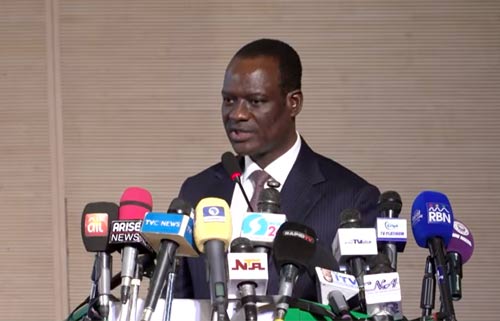
Nigeria will introduce taxes on fuel products only when the economy has stabilised and Nigerians’ income levels have improved sufficiently to absorb the additional cost, the Minister of Finance and Coordinating Minister of the Economy, Taiwo Oyedele, has said.

Oyedele made the disclosure during an interview on the sidelines of the 2026 International Monetary Fund and World Bank Annual Meetings in Bangkok, Thailand.
He said the Federal Government’s immediate priority was to complete ongoing economic reforms, stabilise the economy and restore growth before considering the introduction of fuel taxes.
According to him, imposing new taxes on petroleum products immediately after the removal of fuel subsidy would place additional pressure on Nigerians.
“You remove subsidy, you can’t immediately impose taxes. That would be insensitive. You push the people to the wall,” he said.
Oyedele noted that taxes on petroleum products are common in many countries, including several African nations where multiple levies are imposed on fuel.
“Now, if you look across the world, between 20 to 80% of price is taxes. Many of the countries in Africa have between six to 10 different taxes on fuel products,” he said.
He maintained, however, that Nigeria must first stabilise its economy and improve household incomes before adopting a similar approach.
Oyedele argued that economic policy should focus more on increasing people’s incomes than artificially suppressing prices, saying sustainable prosperity depends on incomes growing faster than the cost of goods and services.
“So, for us, it’s complete the reform, stabilise the economy, bring growth back… I think it happens everywhere in the world; people say, oh, it used to be, in the past, I could go to London with 200 Naira. Oh, I could buy a new car for 2,000 Naira. You see, why were all the people in Nigeria not buying the cars at that time? What is really important is not the price of what you’re buying.
“It is how much income you are earning, right? The objective should be that whatever, instead of trying to suppress prices, which hasn’t worked for us, it hasn’t worked for any country in the world, but not one, instead of trying to suppress prices, think about how to grow income faster than prices rise. Prosperity and grow the middle class, and that’s exactly what we are doing as led by Mr. President himself,” he said.
He said the proposed taxes would only be introduced when economic conditions had improved sufficiently for Nigerians to absorb the additional costs.
“So, at the appropriate time, when the economy has stabilised, and income level would be able to accommodate it, then those taxes will come,” Oyedele said.
The minister explained that revenue generated from the taxes would be channelled towards road infrastructure and the establishment of fuel reserves capable of cushioning the impact of future disruptions in the petroleum market.
“Not because we want to impose taxes, it will be because those amounts of taxes will be dedicated into road infrastructure, they’ll be dedicated into building our fuel reserve, that can help us moderate prices of fuel products, if anything happens,” he said.
Oyedele further explained that fuel taxes could serve as a fiscal buffer during future price shocks, as the government could temporarily waive or reduce them when necessary to moderate the impact on consumers.
“But those things will always happen, right? And then, it will become as a buffer, so that should there be anything next time, you can waive the taxes for that period to bring the stock up. This is what more than 50 countries around the world, they were reducing the taxes, but we had no taxes, there was nothing to reduce,” he said.
He also assured Nigerians that any introduction of fuel taxes would follow the legally prescribed process and could not be implemented secretly.
“The good thing is that the law says that tax cannot come into effect until there’s a gazette. Yeah, there has to be an order published in the gazette by the finance minister, which means we can’t do it in secret.
“Plus, we have no intention of doing stuff in secret, and at the appropriate time, it should be clear to everyone why it needed to be done, and the benefits should be clear also to every Nigerian,” Oyedele added.
[A MUST HAVE] Evidence Act Demystified With Recent And Contemporary Cases And Materials

Available now for NGN 40,000 at ASC Publications, 10, Boyle Street, Onikan, Lagos. Beside High Court, TBS. Email publications@ayindesanni.com or WhatsApp +2347056667384. Purchase Link: https://paystack.com/buy/evidence-act-complete-annotation
______________________________________________________________________ “Enhance Legal Practice With Authoritative Reports” — Alexander Payne Offers Comprehensive Law Reports, Spanning Over A Century Of Nigerian Jurisprudence Interested buyers are encouraged to place their orders and enquiries via:
0704 444 4777, 0704 444 4999, 0818 199 9888
Website: www.alexandernigeria.com