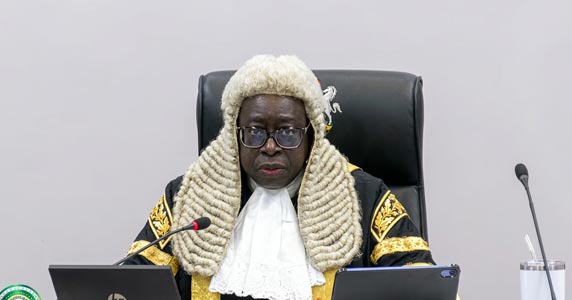
The Supreme Court of Nigeria handled 2,456 matters and delivered 411 judgments during the 2025/2026 legal year, the Chief Justice of Nigeria, Hon. Justice Kudirat Motonmori Olatokunbo Kekere-Ekun, GCON, has said.

She gave the figures in her address at the special session of the Court marking the commencement of the 2026/2027 legal year, at which 68 legal practitioners were conferred with the rank of Senior Advocate of Nigeria.
“The performance of the Court during the legal year under review is encouraging, yet it reminds us that there is still much work to be done.”
The 2,456 matters comprised:
| Category | Number |
|---|---|
| General civil motions | 1,179 |
| Criminal motions | 573 |
| Sheriff motions | 13 |
| Appeals | 676 |
The 676 appeals comprised:
| Type of appeal | Number |
|---|---|
| General civil appeals | 433 |
| Criminal appeals | 212 |
| Political appeals | 19 |
| Sharia appeals | 12 |
| Originating summonses | 10 |
“From these matters, 411 judgments were delivered.”
In the preceding legal year, she said, the Court handled 2,280 matters and delivered 369 judgments and rulings.
“These figures provide a useful measure of institutional activity, but they cannot tell the full story.”
“One area to which I have continued to attach particular importance is the effective management of the Court’s docket.”
“When I addressed this gathering last year, I spoke about the need for deliberate case management strategies to confront delay and the accumulation of pending matters. I am pleased that we can now point to concrete steps taken in furtherance of that objective.”
Between 23 March and 17 December, she said, the e-diary office scheduled 1,385 matters for regular sittings of the Court, comprising 1,021 motions and 364 appeals.
“Significantly, 733 of these were old matters deliberately brought forward for hearing.”
In addition:
- 178 moribund matters were disposed of in chambers.
- 125 matters that had already been concluded were identified and removed from the active pool.
“These measures reflect a more deliberate approach to managing our docket: identifying what is truly pending, bringing older matters forward, dealing appropriately with moribund matters, and removing concluded matters from the active list.”
“The work of the e-diary office is therefore an important part of our continuing effort to make the Court more efficient, responsive, and better able to meet the expectations of litigants.”
“In furtherance of these efforts, we also constituted special panels to focus on designated categories of matters requiring particular attention as part of our backlog decongestion strategy.”
The panels cover Sharia matters, cases involving the Economic and Financial Crimes Commission, the Asset Management Corporation of Nigeria, the Federal Inland Revenue Service (now the Nigerian Revenue Service), and matters arising from proceedings before the Legal Practitioners Disciplinary Committee.
They were assigned 141 matters, comprising 47 motions and 94 appeals:
| Panel | Matters |
|---|---|
| Sharia | 43 |
| EFCC | 52 |
| AMCON | 21 |
| Nigerian Revenue Service | 10 |
| LPDC | 17 |
“This targeted approach is intended to give focused attention to these categories of cases, facilitate their more expeditious consideration, and complement the other measures being undertaken to reduce the Court’s backlog.”
The Chief Justice said the Court’s full complement was restored during the year under review.
“On the 18th day of February 2026, I had the privilege of swearing in 11 newly appointed judges of the Federal High Court.”
“On the 25th day of February 2026, I also had the honour of swearing in Hon. Justice Joseph Olubunmi Kayode Oyewole as a Justice of the Supreme Court of Nigeria, thereby restoring the Court to its full complement following the retirement of my distinguished predecessor, Hon. Justice Olukayode Ariwoola, GCON.”
“The appointment of judicial officers is one of the most consequential responsibilities entrusted to the National Judicial Council and the Federal Judicial Service Commission.”
“A judge does not merely occupy an office. He or she carries the authority of the Constitution and the confidence of the people. For that reason, the processes through which judicial officers are selected must command public confidence.”
She said recent appointments reflected “a deliberate effort to strengthen the evaluation of candidates through structured assessment, professional and peer feedback, background checks, and, in the case of shortlisted candidates, an opportunity for members of the public to comment on their integrity and professional reputation.”
She also noted the retirement of Hon. Justice Ibrahim Mohammed Musa Saulawa, JSC, CFR, after more than four decades on the bench.
“The continuity of the judiciary depends on this process of renewal.”
“Alongside these reforms, we have undertaken a reorganisation of the administrative framework of the Supreme Court with the objective of strengthening the systems that support the work of the Court.”
She said this included:
- the streamlining of functions within the litigation department;
- improvements in records and administrative processes;
- the deployment of strategic planning and performance management tools; and
- expanded training and technological support for staff.
“Attention has also been given to the Court’s physical infrastructure, security, staff welfare, and the working environment of Justices and staff.”
Improvements were made to the Court’s facilities, she said, including:
- the library;
- the mediation centre; and
- an election petition proceedings centre, established with a fully furnished litigation registry, to support the effective handling of election-related proceedings.
She added that investments were also made in health care and other essential support services.
“These measures are intended to provide the institutional conditions necessary for judicial officers and staff to discharge their responsibilities effectively.”
The Chief Justice said the Court commenced implementation of the Nigerian Case Management System on 1 July 2026, together with the Supreme Court of Nigeria (Mandatory Upload of Electronic Copies of Processes, Records of Appeal and Other Matters) Practice Directions 2026.
“This marks a significant step in the digital transformation of the Court, aimed at improving case management, strengthening the security of judicial records, and reducing avoidable administrative delays.”
Implementation is phased, beginning with pending appeals listed for hearing between September and December 2026.
She said the High Courts of Borno, Bayelsa, Delta, Niger and Taraba States have been onboarded on the platform, joined by the High Court of Ebonyi State and the Federal High Court, Lagos Division, and that the Court of Appeal is working towards going live next month.
“Its adoption will be a significant milestone towards the seamless electronic transmission of appeals from connected courts through the Court of Appeal to the Supreme Court.”
“I therefore urge other courts yet to onboard to accelerate the adoption of the system, as broader participation is essential to achieving an integrated, efficient and modern Nigerian judiciary.”
The Chief Justice also set out what the wider court system produced in the fight against corruption and financial crime.
She said the Corruption and Financial Crimes Cases Trial Monitoring Committee (COTRIMCO), chaired by Hon. Justice Suleiman Galadima, CFR, JSC, has continued to play an important role.
“Through its monitoring of corruption, money laundering and other financial crime cases, the committee provides a structured mechanism for identifying challenges affecting the timely and effective trial of such matters, and for promoting greater coordination between the judiciary, the anti-graft agencies and other relevant institutions.”
“Its work is particularly important in cases which are often complex, document intensive, and involve multiple agencies and jurisdictions.”
She linked the judiciary’s work to Nigeria’s exit from the Financial Action Task Force grey list.
“In October 2025, Nigeria was removed by the Financial Action Task Force from the list of jurisdictions under increased monitoring, commonly referred to as the FATF grey list, following the completion of its action plan and the progress made in strengthening the country’s anti-money laundering and combating the financing of terrorism regime.”
“This was an important national achievement with implications for Nigeria’s financial reputation, investor confidence, and participation in the international financial system. The judiciary has played an important role in this national effort.”
The enforcement figures she gave for the period under review were:
| Measure | Figure |
|---|---|
| EFCC convictions | 2,842 |
| ICPC cases filed | 53 |
| ICPC convictions | 33 |
| EFCC recoveries, October 2023 to July 2026 | Over N1.23 trillion and US$684 million, plus £373,905.78 and €9.34 million |
| Of the naira recoveries: for the Federal Government | About N397.26 billion |
| Of the naira recoveries: for states, MDAs, companies and individual victims | N836.34 billion |
“There have also been significant court-ordered forfeitures.”
“These figures are important because they illustrate the wider economic value of an effective justice system. Recovered assets and funds can be returned to their rightful owners, restored to public use, and deployed towards legitimate economic and social purposes.”
“The Federal Government’s approval of allocations from EFCC recoveries to the Nigerian Education Loan Fund and the Nigerian Consumer Credit Corporation demonstrates how effective enforcement can ultimately translate into public benefit.”
She then attached a caution to the whole of it.
“The contribution of the judiciary to the fight against corruption cannot be measured simply by the number of convictions or forfeiture orders obtained. Our constitutional responsibility is to ensure that every case is determined fairly, impartially, and according to law.”
“Equally, the pace or outcome of proceedings must never be dictated by public sentiment or the personality involved. The legitimacy of the judiciary rests upon fidelity to law and due process, even in cases that attract considerable public interest.”
Against those outputs, the Chief Justice set the question of money.
“These achievements also bring into sharp focus the importance of adequately and consistently funding the institutions required to sustain them. There has been improvement in the funding and budgetary provision made for the federal judiciary, and this is commendable. However, appropriation is only the beginning.”
“For a budgetary provision to translate into functioning courts, completed projects, modern technology, adequate facilities and effective judicial administration, the appropriated funds must be released and made available for disbursement in a timely manner.”
“There are instances in which provision has been made in the approved budget and the necessary approvals obtained, but the funds are not thereafter released or disbursed when they are required.”
“Delayed release has practical consequences. Projects are deferred, procurement cycles are disrupted, and the real value of appropriated funds is eroded by inflation and rising costs.”
“There must therefore be a reliable and predictable mechanism for the timely release and disbursement of funds duly appropriated for the judiciary. Financial autonomy must have practical effect.”
“At the state level, the challenge remains even more pronounced. Courts require adequate infrastructure. Judges require proper working conditions. Court staff require appropriate remuneration, training and tools. Technology requires sustained investment. None of these should be regarded as luxuries.”
“Judicial independence must therefore be more than a constitutional expression. It must be supported by the institutional conditions necessary for the judiciary to discharge its constitutional responsibilities effectively, independently, and with integrity. We will continue to advocate for the financial independence of the judiciary in accordance with the Constitution.”
“As we enter this new legal year, our priorities remain clear.”
“We must continue to address case backlog through disciplined case management, effective deployment of judicial resources, and continuous review of our processes.”
“We must expand the use of alternative dispute resolution where the nature of a dispute makes that course appropriate, while ensuring that litigants retain meaningful access to the courts.”
“We must also continue to invest in the professional development, welfare and ethical development of judicial officers and court staff, recognising that the quality of justice is inseparable from the quality of the people and institutions responsible for delivering it.”
She said the National Judicial Institute had undertaken “a deliberate review and modernisation of its continuing judicial education programmes, with greater emphasis on practical and participatory methods, including case studies, structured problem solving, and guided peer engagement.”
The following computations are TheNigeriaLawyer’s, from the figures as delivered. They are set out so that readers can follow the working, and they should be checked against the official text of the address.
Year on year, judgments grew faster than caseload. Matters rose from 2,280 to 2,456, an increase of 176, or about 7.7 per cent. Judgments rose from 369 to 411, an increase of 42, or about 11.4 per cent. One caution attaches to that comparison: the figure for the preceding year is given as “369 judgments and rulings,” while this year’s figure is given as 411 judgments. If the two are not measuring the same thing, the comparison does not hold, and the official text should be checked.
More than half of everything listed was a resurrected case. Of the 1,385 matters the e-diary office scheduled, 733 were old matters brought forward, which is about 52.9 per cent. That single proportion is the clearest evidence in the address that the backlog strategy is operating rather than being described.
Three hundred and three matters left the list without a hearing. The 178 moribund matters disposed of in chambers and the 125 concluded matters removed from the active pool together account for 303 files. Neither figure represents an adjudication. Both represent the Court establishing what is genuinely pending, which is the necessary first step in any decongestion exercise and the one most often skipped.
Political appeals were a small share, and will not remain so. The 19 political appeals represent about 2.8 per cent of the 676 appeals. The year under review was the last full legal year before a general election. The establishment of a dedicated election petition proceedings centre with its own litigation registry, announced in the same address, indicates what the Court expects that proportion to become.
The anti-corruption docket dominates the special panels. The 52 EFCC matters are the largest single category assigned to the special panels, ahead of the 43 Sharia matters.
The recovery figures reconcile. The N397.26 billion said to have been recovered for the Federal Government and the N836.34 billion said to have been recovered for states, agencies, companies and individual victims together come to about N1.2336 trillion, which is consistent with the stated total exceeding N1.23 trillion. It is also worth noting where the larger share went: on those figures, about two naira in every three recovered went to parties other than the Federal Government.
Three totals in the address do not reconcile with their own components, and the official text should be obtained before any of them is published.
The caseload. The four components given for the 2,456 matters (1,179 general civil motions, 573 criminal motions, 13 sheriff motions and 676 appeals) total 2,441, which is 15 short of the stated total.
The appeals. The five components given for the 676 appeals (433 general civil, 212 criminal, 19 political, 12 sharia and 10 originating summonses) total 686, which is 10 more than the stated figure.
The special panels. The five categories given (43 Sharia, 52 EFCC, 21 AMCON, 10 NRS and 17 LPDC) total 143, against a stated total of 141 matters.
Three other sets do reconcile exactly and may be reported as given. The e-diary figures add up: 1,021 motions plus 364 appeals equals 1,385. The special panel split adds up: 47 motions plus 94 appeals equals 141. And the naira recovery components add up, as set out above.
[A MUST HAVE] Evidence Act Demystified With Recent And Contemporary Cases And Materials

Available now for NGN 40,000 at ASC Publications, 10, Boyle Street, Onikan, Lagos. Beside High Court, TBS. Email publications@ayindesanni.com or WhatsApp +2347056667384. Purchase Link: https://paystack.com/buy/evidence-act-complete-annotation
______________________________________________________________________ “Enhance Legal Practice With Authoritative Reports” — Alexander Payne Offers Comprehensive Law Reports, Spanning Over A Century Of Nigerian Jurisprudence Interested buyers are encouraged to place their orders and enquiries via:
0704 444 4777, 0704 444 4999, 0818 199 9888
Website: www.alexandernigeria.com
Interested buyers are encouraged to place their orders and enquiries via:
0704 444 4777, 0704 444 4999, 0818 199 9888
Website: www.alexandernigeria.com