*Condemns Social Media Attacks, Threats And Harassment Against Judges And Lawyer

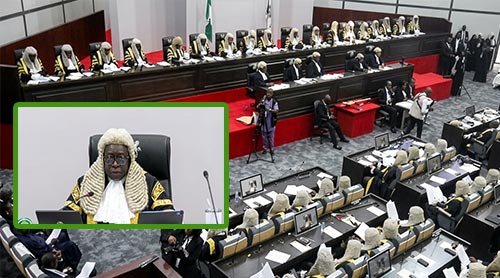
The Chief Justice of Nigeria, Hon. Justice Kudirat Motonmori Olatokunbo Kekere-Ekun, GCON, has formally declared open the 2026/2027 legal year at a special session of the Supreme Court of Nigeria, at which 68 legal practitioners were conferred with the rank of Senior Advocate of Nigeria.
What follows is her address, as delivered.
“It is with profound gratitude to Almighty God that I welcome you all to this special session of the Supreme Court of Nigeria marking the commencement of the 2026/2027 legal year.”
“The opening of a new legal year provides an opportunity to pause from the demands of our daily work and reflect on the institution we serve, the work that lies behind us, and the responsibilities that lie ahead. It is a time to acknowledge what we have achieved, recognise the areas where more remains to be done, remember those who have served before us, and renew our commitment to the administration of justice.”
She acknowledged the former Chief Justices of Nigeria present, Hon. Justice Mahmud Mohammed, GCON, and Hon. Justice Walter Samuel Nkanu Onnoghen, GCON; the President of the Court of Appeal, Hon. Justice Monica Dongban-Mensem, CFR; serving and retired Justices of the Supreme Court and of the Court of Appeal; heads of court and judges; the Executive Governors of Plateau, Kebbi and Kano States; the Attorney-General of the Federation and Minister of Justice, Prince Lateef Olasunkanmi Fagbemi, SAN; members of the National and State Houses of Assembly; members of the Inner and Outer Bar; and the President of the Nigerian Bar Association.
“Sadly, this year’s ceremony is also marked by the memory of those whom we have lost.”
She recorded the death of a former Chief Justice of Nigeria, Hon. Justice Ibrahim Tanko Muhammad, GCON, who died on 16 December 2025 in Saudi Arabia.
“His passing was a great loss to the judiciary and to the nation. He served this country at various levels of the judicial hierarchy and ultimately occupied the highest judicial office in the land.”
She also recorded the death in August 2026 of Hon. Justice Umaru Atu Kalgo, JSC, CON, who served as a Justice of the Supreme Court from 1998 to 2007.
“His judgments and contributions to judicial discourse remain part of the jurisprudential heritage of this Court.”
And the death of Professor Alfred Bandele Kasunmu, SAN, former Attorney-General and Commissioner for Justice of Lagos State.
“Distinguished scholar, advocate and mentor.”
“We also remember the judicial officers, legal practitioners and members of the judiciary’s workforce who passed away during the year. Some occupied prominent positions, others served quietly, often without public recognition. Each in his or her own way contributed to the administration of justice and to the institution we serve today.”
“On behalf of the Supreme Court of Nigeria and the Nigerian judiciary, I extend our deepest condolences to the families, friends, colleagues and associates of all whom we lost during the year.”
She noted the retirement of Hon. Justice Ibrahim Mohammed Musa Saulawa, JSC, CFR, after a judicial career of more than four decades.
“Hon. Justice Saulawa brought to the bench a formidable intellect, a deep knowledge of the law, and a commitment to judicial service.”
“The continuity of the judiciary depends on this process of renewal.”
- On 18 February 2026, she swore in 11 newly appointed judges of the Federal High Court.
- On 25 February 2026, she swore in Hon. Justice Joseph Olubunmi Kayode Oyewole as a Justice of the Supreme Court, “thereby restoring the Court to its full complement following the retirement of my distinguished predecessor, Hon. Justice Olukayode Ariwoola, GCON.”
“The appointment of judicial officers is one of the most consequential responsibilities entrusted to the National Judicial Council and the Federal Judicial Service Commission.”
“A judge does not merely occupy an office. He or she carries the authority of the Constitution and the confidence of the people. For that reason, the processes through which judicial officers are selected must command public confidence.”
“The recent appointments have reflected a deliberate effort to strengthen the evaluation of candidates through structured assessment, professional and peer feedback, background checks, and, in the case of shortlisted candidates, an opportunity for members of the public to comment on their integrity and professional reputation.”
“WE MUST RESIST THIS CULTURE”
“This process must be protected from abuse. It should never become a trial by publicity or an avenue for settling personal disagreements and professional scores.”
“The same restraint is required in the wider public space, where social media is increasingly used to turn professional disagreements into personal attacks, ridicule, threats and harassment. We must resist this culture.”
“There are proper channels for criticising judgments, reporting professional misconduct, and complaining about the conduct of judicial officers or legal practitioners. The administration of justice cannot be left to anger, intimidation or trial by social media.”
“A judge should be able to decide according to law without fear of personal retaliation. A lawyer should be able to make a legitimate submission without being subjected to intimidation. A member of staff should be able to perform his or her duties without harassment. The dignity of the profession is the collective responsibility of the bench and the bar.”
THE ELECTORAL SEASON
“This responsibility assumes even greater importance as we approach another electoral season. Elections inevitably generate heightened political activity and strong emotions. They also bring before the courts disputes that may have significant consequences for individuals, political parties, and the country.”
“The judiciary must approach such matters with the same calmness, detachment, and fidelity to the law that it brings to every other dispute.”
“Judicial officers must remain conscious that every word they speak and every action they take during an electoral period will be subjected to scrutiny. They must therefore exercise restraint, avoid political association or conduct capable of creating an appearance of partiality, and remain firmly within the boundaries imposed by their oath and the Constitution.”
On forum shopping:
“There is also a need for greater professional responsibility by lawyers in the institution of proceedings arising from political and electoral disputes.”
“Forum shopping, whether by the deliberate choice of commencing an action in a court or division perceived to be more favourable to a particular party, or by the institution of multiple proceedings seeking substantially similar reliefs, can result in conflicting orders, undermine orderly judicial process, and expose the judiciary to avoidable embarrassment.”
“It can also create the unfortunate impression that parties are seeking not justice according to law, but a particular outcome from a particular court.”
On the cost to other litigants:
“There is moreover a broader institutional concern. It does not augur well for a judicial system or the administration of justice if the courts become so overwhelmed by political disputes that other cases in their dockets are consequently delayed or denied the timely attention they require.”
“The judiciary must remain available to all litigants, and the urgency or public prominence of political litigation should not come at the expense of other legitimate claims awaiting determination.”
“Counsel must therefore exercise the professional judgment expected of members of the bar before commencing proceedings, particularly where related proceedings are already pending before another court. The duty of counsel to the court requires full candour as to the existence of related proceedings and respect for the jurisdiction and processes of other courts.”
“The responsibility of counsel extends beyond securing an immediate advantage for a client. It includes a duty to protect the integrity and orderly functioning of the judicial process.”
THE NIGERIAN CASE MANAGEMENT SYSTEM
“The Supreme Court itself has continued to evolve.”
On 1 July 2026 the Court commenced implementation of the Nigerian Case Management System (NCMS), together with the Supreme Court of Nigeria (Mandatory Upload of Electronic Copies of Processes, Records of Appeal and Other Matters) Practice Directions 2026.
“This marks a significant step in the digital transformation of the Court, aimed at improving case management, strengthening the security of judicial records, and reducing avoidable administrative delays.”
Implementation is phased, beginning with pending appeals listed for hearing between September and December 2026.
“I am encouraged by the growing adoption of the NCMS across the judiciary.”
She recalled commending the High Courts of Borno, Bayelsa and Delta States in last year’s address, and acknowledging preparations in Niger and Taraba States. Those courts have now been onboarded, and have been joined by the High Court of Ebonyi State and the Federal High Court, Lagos Division.
“I am also pleased that the Court of Appeal is working towards going live on the platform next month. Its adoption will be a significant milestone towards the seamless electronic transmission of appeals from connected courts through the Court of Appeal to the Supreme Court.”
“I therefore urge other courts yet to onboard to accelerate the adoption of the system, as broader participation is essential to achieving an integrated, efficient and modern Nigerian judiciary.”
ADMINISTRATION AND FACILITIES
“Alongside these reforms, we have undertaken a reorganisation of the administrative framework of the Supreme Court with the objective of strengthening the systems that support the work of the Court.”
This included streamlining of functions within the litigation department, improvements in records and administrative processes, the deployment of strategic planning and performance management tools, and expanded training and technological support for staff.
Attention was also given to physical infrastructure, security, staff welfare and the working environment of Justices and staff, with improvements to the Court’s facilities including the library and the mediation centre, and the establishment of an election petition proceedings centre with a fully furnished litigation registry to support the handling of election-related proceedings. Investments were also made in health care and other essential support services.
“These measures are intended to provide the institutional conditions necessary for judicial officers and staff to discharge their responsibilities effectively.”
THE YEAR IN FIGURES
“The performance of the Court during the legal year under review is encouraging, yet it reminds us that there is still much work to be done.”
During the 2025/2026 legal year the Supreme Court handled 2,456 matters, comprising:
- 1,179 general civil motions
- 573 criminal motions
- 13 sheriff motions
- 676 appeals
The appeals comprised:
- 433 general civil appeals
- 212 criminal appeals
- 19 political appeals
- 12 sharia appeals
- 10 originating summonses
“From these matters, 411 judgments were delivered.”
In the preceding legal year the Court handled 2,280 matters and delivered 369 judgments and rulings.
“These figures provide a useful measure of institutional activity, but they cannot tell the full story.”
DOCKET MANAGEMENT AND THE E-DIARY
“One area to which I have continued to attach particular importance is the effective management of the Court’s docket. When I addressed this gathering last year, I spoke about the need for deliberate case management strategies to confront delay and the accumulation of pending matters. I am pleased that we can now point to concrete steps taken in furtherance of that objective.”
Between 23 March and 17 December, the e-diary office scheduled 1,385 matters for regular sittings of the Court, comprising 1,021 motions and 364 appeals.
“Significantly, 733 of these were old matters deliberately brought forward for hearing.”
In addition, 178 moribund matters were disposed of in chambers, while 125 matters that had already been concluded were identified and removed from the active pool.
“These measures reflect a more deliberate approach to managing our docket: identifying what is truly pending, bringing older matters forward, dealing appropriately with moribund matters, and removing concluded matters from the active list.”
“The work of the e-diary office is therefore an important part of our continuing effort to make the Court more efficient, responsive, and better able to meet the expectations of litigants.”
SPECIAL PANELS
“In furtherance of these efforts, we also constituted special panels to focus on designated categories of matters requiring particular attention as part of our backlog decongestion strategy.”
The panels cover Sharia matters, cases involving the Economic and Financial Crimes Commission, the Asset Management Corporation of Nigeria (AMCON), the Federal Inland Revenue Service, now the Nigerian Revenue Service, and matters arising from proceedings before the Legal Practitioners Disciplinary Committee.
The panels were assigned 141 matters, comprising 47 motions and 94 appeals. Of these:
- 43 Sharia matters
- 52 EFCC matters
- 21 AMCON matters
- 10 NRS matters
- 17 LPDC matters
“This targeted approach is intended to give focused attention to these categories of cases, facilitate their more expeditious consideration, and complement the other measures being undertaken to reduce the Court’s backlog.”
CORRUPTION, FINANCIAL CRIME AND THE FATF
“Efforts to improve the administration of justice also extend to the fight against corruption and financial crime.”
She said the Corruption and Financial Crimes Cases Trial Monitoring Committee (COTRIMCO), under the chairmanship of Hon. Justice Suleiman Galadima, CFR, JSC, has continued to play an important role.
“Through its monitoring of corruption, money laundering and other financial crime cases, the committee provides a structured mechanism for identifying challenges affecting the timely and effective trial of such matters and for promoting greater coordination between the judiciary, the anti-graft agencies and other relevant institutions.”
“Its work is particularly important in cases which are often complex, document intensive, and involve multiple agencies and jurisdictions.”
On the FATF:
“In October 2025, Nigeria was removed by the Financial Action Task Force from the list of jurisdictions under increased monitoring, commonly referred to as the FATF grey list, following the completion of its action plan and the progress made in strengthening the country’s anti-money laundering and combating the financing of terrorism regime.”
“This was an important national achievement with implications for Nigeria’s financial reputation, investor confidence, and participation in the international financial system. The judiciary has played an important role in this national effort.”
She commended the judges of the Federal High Court, the National Judicial Institute, the EFCC, the ICPC, the Nigerian Financial Intelligence Unit and other institutions.
The enforcement figures she gave:
- The EFCC reported 2,842 convictions during the period under review.
- The ICPC filed 53 cases and secured 33 convictions.
- EFCC recoveries between October 2023 and July 2026 exceeded N1.23 trillion and US$684 million, in addition to £373,905.78 and €9.34 million.
- Of the naira recoveries, approximately N397.26 billion represented direct recoveries for the Federal Government, while N836.34 billion was recovered on behalf of state governments, ministries, departments and agencies, private companies and individual victims.
“There have also been significant court-ordered forfeitures.”
“These figures are important because they illustrate the wider economic value of an effective justice system. Recovered assets and funds can be returned to their rightful owners, restored to public use, and deployed towards legitimate economic and social purposes.”
“The Federal Government’s approval of allocations from EFCC recoveries to the Nigerian Education Loan Fund and the Nigerian Consumer Credit Corporation demonstrates how effective enforcement can ultimately translate into public benefit.”
“Confidence in the integrity of the financial system is essential to investment, commerce and sustainable economic activity. Where financial crimes are effectively investigated, prosecuted and adjudicated, and the proceeds lawfully traced are recovered, the judiciary contributes to the protection of public resources, property and investments, and to confidence in the rule of law.”
And the caution she attached to all of it:
“The contribution of the judiciary to the fight against corruption cannot be measured simply by the number of convictions or forfeiture orders obtained. Our constitutional responsibility is to ensure that every case is determined fairly, impartially, and according to law.”
“Equally, the pace or outcome of proceedings must never be dictated by public sentiment or the personality involved. The legitimacy of the judiciary rests upon fidelity to law and due process, even in cases that attract considerable public interest.”
“FINANCIAL AUTONOMY MUST HAVE PRACTICAL EFFECT”
“These achievements also bring into sharp focus the importance of adequately and consistently funding the institutions required to sustain them. There has been improvement in the funding and budgetary provision made for the federal judiciary, and this is commendable. However, appropriation is only the beginning.”
“For a budgetary provision to translate into functioning courts, completed projects, modern technology, adequate facilities and effective judicial administration, the appropriated funds must be released and made available for disbursement in a timely manner.”
“There are instances in which provision has been made in the approved budget and the necessary approvals obtained, but the funds are not thereafter released or disbursed when they are required.”
“Delayed release has practical consequences. Projects are deferred, procurement cycles are disrupted, and the real value of appropriated funds is eroded by inflation and rising costs.”
“There must therefore be a reliable and predictable mechanism for the timely release and disbursement of funds duly appropriated for the judiciary. Financial autonomy must have practical effect.“
“At the state level, the challenge remains even more pronounced. Courts require adequate infrastructure. Judges require proper working conditions. Court staff require appropriate remuneration, training and tools. Technology requires sustained investment. None of these should be regarded as luxuries.“
“Judicial independence must therefore be more than a constitutional expression. It must be supported by the institutional conditions necessary for the judiciary to discharge its constitutional responsibilities effectively, independently, and with integrity. We will continue to advocate for the financial independence of the judiciary in accordance with the Constitution.”
“There is also a continuing need to safeguard the integrity of judicial appointments, particularly at the state level. The appointment of judges and heads of court must be guided by the Constitution, applicable regulations, and objective institutional criteria. Merit, competence, integrity and experience must remain central to the process.”
PRIORITIES FOR THE NEW YEAR
“As we enter this new legal year, our priorities remain clear.”
“We must continue to address case backlog through disciplined case management, effective deployment of judicial resources, and continuous review of our processes.”
“We must expand the use of alternative dispute resolution where the nature of a dispute makes that course appropriate, while ensuring that litigants retain meaningful access to the courts.”
“We must also continue to invest in the professional development, welfare and ethical development of judicial officers and court staff, recognising that the quality of justice is inseparable from the quality of the people and institutions responsible for delivering it.”
On the National Judicial Institute:
“The Institute has undertaken a deliberate review and modernisation of its continuing judicial education programmes, with greater emphasis on practical and participatory methods, including case studies, structured problem solving, and guided peer engagement. These efforts strengthen critical judicial reasoning and practical decision making.”
FIRSTS IN THE PROFESSION
“The Nigerian legal profession has also witnessed developments that deserve recognition.”
- In January 2026, Dr. Olugbemisola Titilayo Odusote became the first woman to head the Nigerian Law School since its establishment.
- Mrs. Oyinkansola Badejo-Okusanya, SAN, became the first woman to be elected President of the Nigerian Bar Association and assumed office as its 33rd President.
- Following the passing of Professor Alfred Kasunmu, SAN, Chief Folake Solanke, SAN, became the most senior living Senior Advocate of Nigeria and assumes the position of Vice Chairman of the Body of Senior Advocates of Nigeria.
“These developments are significant because institutions are strengthened when ability is allowed to find expression wherever it may be found.”
“For the young women and girls watching the legal profession today, they provide visible evidence that the highest levels of professional leadership are open to them.”
“We must continue to build a profession in which talent is recognised, merit is rewarded, and no young lawyer is discouraged from aspiring to leadership because of gender, background, or circumstance.”
TO THE 68 NEW SENIOR ADVOCATES
“It is also our tradition at the commencement of each legal year to formally swear in legal practitioners who have distinguished themselves and satisfied the rigorous requirements for the conferment of the rank of Senior Advocate of Nigeria. To the 68 new Senior Advocates of Nigeria who have just been conferred today, I offer my warmest congratulations.”
“The rank you receive today is a distinction of great honour and carries a corresponding responsibility. The Inner Bar is not merely a recognition of professional success. It is a call to leadership.“
“You will now be looked upon not only for the quality of your advocacy, but also for the example you set to younger members of the profession. Carry the rank with dignity, humility and a deep sense of responsibility.”
“You have participated in the induction programme organised by the Body of Senior Advocates of Nigeria. I encourage you to reflect on the guidance and experiences shared during that programme, and to make professional integrity a permanent companion of professional excellence.”
“The fact that a lawyer has attained the rank of Senior Advocate does not place him beyond accountability. The disciplinary action taken against senior members of the profession during the past legal year should remind us all that no professional rank is a substitute for ethical conduct.“
CONCLUSION
“As we commence the 2026/2027 legal year, I am conscious that much remains to be done. The challenges before the Nigerian judiciary remain substantial and the expectations placed upon our courts continue to grow.”
“We must therefore remain candid about the areas that require further attention, whether in the timeliness of justice, the adequacy of resources, case management, or the efficacy of our processes.”
“At the same time, the past year has given us good reason to look forward with confidence. Across the judiciary, important reforms have moved from discussion to implementation. These developments demonstrate that with purpose, cooperation and institutional commitment, the judiciary can respond to changing demands while remaining firmly anchored to its constitutional responsibilities.”
“Our task now is to build on this progress, learn from what has worked, address what remains unfinished, and ensure that each reform ultimately improves the experience of justice for those who come before our courts.”
She thanked the Attorney-General of the Federation, the Vice Chairman of the Body of Senior Advocates of Nigeria, Chief Folake Solanke, SAN, the President of the Nigerian Bar Association, Mrs. Oyinkansola Badejo-Okusanya, SAN, the newly conferred Senior Advocates, her brother Justices of the Supreme Court, judicial officers across the country, and the entire workforce of the judiciary.
“As we commence another legal year, let us proceed with humility, courage and a deep sense of the trust reposed in us. May we have the courage to do what duty requires, the restraint to listen and reflect, and the wisdom to treat every person who comes before us with fairness and dignity. May we remain steadfast in our independence, and faithful to the Constitution and the law.”
“I pray that Almighty God will guide us throughout this legal year, grant us wisdom in our decisions, courage in our difficult moments, and humility in all that we do. May He strengthen our resolve, preserve the rule of law, and grant our nation peace, stability and prosperity.”
“I thank you all for honouring our invitation and for sharing this important occasion with us. May Almighty God bless the Federal Republic of Nigeria.”
[A MUST HAVE] Evidence Act Demystified With Recent And Contemporary Cases And Materials

Available now for NGN 40,000 at ASC Publications, 10, Boyle Street, Onikan, Lagos. Beside High Court, TBS. Email publications@ayindesanni.com or WhatsApp +2347056667384. Purchase Link: https://paystack.com/buy/evidence-act-complete-annotation
______________________________________________________________________ “Enhance Legal Practice With Authoritative Reports” — Alexander Payne Offers Comprehensive Law Reports, Spanning Over A Century Of Nigerian Jurisprudence Interested buyers are encouraged to place their orders and enquiries via:
0704 444 4777, 0704 444 4999, 0818 199 9888
Website: www.alexandernigeria.com
Interested buyers are encouraged to place their orders and enquiries via:
0704 444 4777, 0704 444 4999, 0818 199 9888
Website: www.alexandernigeria.com