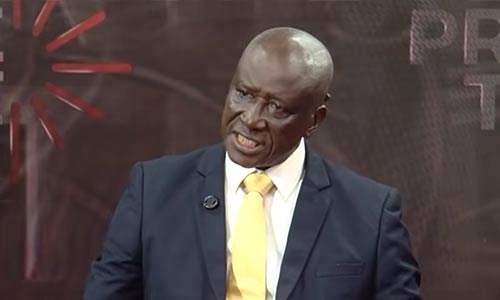
A Senior Advocate of Nigeria, Mr. Oba Maduabuchi, has said the Independent National Electoral Commission has no constitutional or statutory power to disqualify a candidate, and that in omitting names from its final list of governorship candidates for the 2027 general elections the Commission has “overshot its limits”.

The Pantami Movement, the campaign organisation of the former Minister of Communications and Digital Economy, Professor Isa Pantami, called for calm following the omission of his name from the Commission’s final list.
In a statement, Professor Suleiman Mohammed Gombe described the development as a temporary challenge, and said the campaign’s legal and liaison teams were engaging the relevant organs of the party and the Commission to secure a resolution within the period allowed by law. He alleged that some people were working behind the scenes to frustrate good and responsible leadership in Gombe State.
The Commission left out Senator Danjuma Goje of the Nigeria Democratic Congress from the list of governorship candidates for Kaduna State.
The omission matters, the programme reported, because Senator Goje had been announced by the NDC State Executive Committee and local government chairmen as their preferred candidate, while rival claims and conflicting statements from the party’s national leadership have left the identity of the candidate officially entitled to contest under the NDC unclear.
The state executive committee and local government chairmen adopted him as their candidate, but the party’s national leadership later disowned a widely circulated document said to confirm his candidature.
The NDC governorship candidate in Kano State, Alhaji Gwarzo, was also omitted. The Kwankwasiyya Movement’s spokesman, Mr. Habibu Mohammed, joined the programme from Kano.
Asked whether the Commission has power to omit names submitted by parties from its final list particularly where it had itself monitored the primaries at which those candidates emerged Mr. Maduabuchi began with the source of the Commission’s authority.
“Every body like INEC, police, army these are statutory creations. They are created by a law. That law defines the ambit of the powers exercisable by those bodies. So for you to know what a particular body has the capacity to do, you go back to the establishing statute.”
“In INEC, it is the Electoral Act, the Nigerian Constitution. These are the two documents you must look at.”
“There is no provision in the 1999 Nigerian Constitution authorising INEC to disqualify anybody. There is none.”
“There is also no provision in the Electoral Act that gives INEC the power to decide whether somebody is qualified or not to contest an election. There is no such provision.”
“So INEC is simply how do I describe it? I am on air worldwide, so I have to be careful with the words I use. But I think they are ill-advised, to say the least.”
On the Supreme Court judgment
Put to him that the Commission appeared to have drawn its impetus from the recent Supreme Court judgment upholding its guidelines, and particularly sections 77(5) and (6) and section 84 of the Electoral Act — under which a party must make its membership register available 21 days before its primaries, and a person whose name is not on that register may not be voted for — Mr. Maduabuchi did not dispute the provisions. He disputed who applies them.
“Where does that give INEC authority to decide?”
He put the point by analogy:
“If you haven’t been educated up to school cert level, you are not qualified to contest election… Can INEC disqualify you because you didn’t have school cert? How can they do that?”
“Their business is to publish the names of all those who have been submitted. That is all the power INEC has.”
What a complainant must do instead
“If a candidate in a particular political party feels that there has been an infraction of the Electoral Act, the Constitution or guidelines of the party that is under Section 88(4) or so, I’m not sure — then the person will go to court and say, ‘That man’s name is not on our register. He’s not a member of our party.’ That is the only way. Then the man will be called.”
“Remember that Section 36 of the Constitution tells you that before you decide the fate of anybody, his rights, his obligations, you must bring him before a court, give him fair hearing in a court or tribunal constituted in such a way that ensures its impartiality.”
“So INEC under any provisions of our laws does not have the power.”
Publication, then challenge
“The INEC has simply overshot its limits. The only power INEC has is to publish the names of the candidates submitted to it by political parties. The moment it publishes those names, the law allows you I think Section 82 allows you to approach the court to say: ‘That man who you published as the gubernatorial candidate of Enugu State I’m from Enugu State the man is not a member of our party. His name is not on the list of those who are qualified to contest elections.'”
“The man must be given an opportunity to say, ‘Yes, my name is not on the list,’ or ‘No, my name is on the list.'”
He then put the case against administrative determination at its highest:
“Take a scenario. INEC sits in the luxury of its office and disqualifies you because your name is not on the list. The political party picks a register and says, ‘This is the man’s name,’ and shows you that that list was submitted — but a political opponent removed the register. What do you do?”
On the Commission’s own lawyers
Told that the head of the Commission is a professor of law and an electoral expert, Mr. Maduabuchi said:
“It is unfortunate. I know there are at least five senior advocates in the legal department of INEC… So why INEC should say they are omitting somebody’s name — it beats me hollow. They don’t have that power. INEC does not have the power.”
“It is for somebody to say, ‘You are not qualified.’ That is the only thing… I don’t know how anybody can say INEC will wake up in the morning and say somebody is not qualified. That is a judicial decision.”
Mr. Habibu Mohammed said the omission came as a shock.
“It came to us as a shock actually, because we believe that there are no particular reason for that. No reason actually advanced by the INEC itself.”
“To us, we believe it’s just maybe an administrative error or something else, because we do not have any pending judgment, nor do we have any court order. And this is a man that has already served as a deputy governor, so we cannot even think about his own qualification or what have you. And also we believe he is duly registered with NDC within the stipulated period.”
He said the party would use a statutory window:
“There is this provision of the Electoral Act I mean, Section 32, subsection 2 of the Electoral Act that gives political parties a 14-day window within which they are required to make their own submissions where their candidate is missing or omitted or whatever terminology is used, if he’s not on the list of INEC.”
“Kwankwasiyya, being law-abiding and also those that are actually concerned with doing things the right way, we will explore that opportunity, engage INEC, and we are certain things will be worked out.”
Asked what the movement would do if the candidate were not cleared:
“Our concentration right now is in trying to explore that particular angle… We have no reason to think things are not going to work out, because we believe it is an error, administrative or otherwise, and there are also procedures by which those errors will be rectified. So to us, him not being on that list, I believe, is just temporary.”
“If INEC will actually rely on the prohibition of the law or pronouncement of the court, so also other Nigerians have rights to explore all avenues… because we are not caught — my candidate is not caught — within that particular pronouncement of the Supreme Court. He is duly registered before the stipulated period and he has completed all the necessary formalities or requirements by the law.”
Asked whether there is time to correct what the parties are calling an anomaly before an election now less than a hundred days away, Mr. Maduabuchi gave the warning that dominated the rest of the programme.
“This is a pre-election matter. That is the first thing the NDC or whoever is involved must realise, and you must go to court within 14 days of the incident you are complaining about.”
“So if anybody’s name is not on that list as published and you allow 14 days to lapse — my friend, you are out. You are out. You can’t complain.”
“You can’t even complain in a tribunal. It will be difficult, because the only two people who can complain in a tribunal are, one, the person that contested an election, or a political party that sponsored such a person. If a political party did not sponsor a candidate in an election, it has no podium upon which to come and say, ‘I’m going to file an election petition.’ And if you are not a candidate in an election, you cannot go to tribunal and say, ‘I was wrongly excluded’ — because you were excluded a hundred days before the election and you didn’t react.”
“So when my friend says they are exploring other things, they should know that the time set by the Constitution cannot be extended by anybody, by any court, not even the Supreme Court.”
“No. Elections are statutory issues. You must hold election within a given period, from the election to handover date. It is not at the whims and caprices of [the INEC chairman]. He knows he has to act within a given time. So it is for those who are affected.”
“Like we say in law, if you are negotiating settlement with somebody, it doesn’t stop time from running.”
His advice
“What they should do now I’m advising them free, even though they should pay what they should do now is to go to court, then go to INEC and discuss. If they come to court and court says, ‘No, INEC, you don’t have the power. You have to wait. Somebody has to ask you to act. You don’t have any interest. You are not supposed to be partisan, you are supposed to be an onlooker.'”
“It is a candidate in that election that will come and say, ‘This man’s name is not on the list,’ before INEC will act based on the order of the court. It is not administrative. It is not administrative at all.”
[A MUST HAVE] Evidence Act Demystified With Recent And Contemporary Cases And Materials

Available now for NGN 40,000 at ASC Publications, 10, Boyle Street, Onikan, Lagos. Beside High Court, TBS. Email publications@ayindesanni.com or WhatsApp +2347056667384. Purchase Link: https://paystack.com/buy/evidence-act-complete-annotation
______________________________________________________________________ “Enhance Legal Practice With Authoritative Reports” — Alexander Payne Offers Comprehensive Law Reports, Spanning Over A Century Of Nigerian Jurisprudence Interested buyers are encouraged to place their orders and enquiries via:
0704 444 4777, 0704 444 4999, 0818 199 9888
Website: www.alexandernigeria.com
Interested buyers are encouraged to place their orders and enquiries via:
0704 444 4777, 0704 444 4999, 0818 199 9888
Website: www.alexandernigeria.com