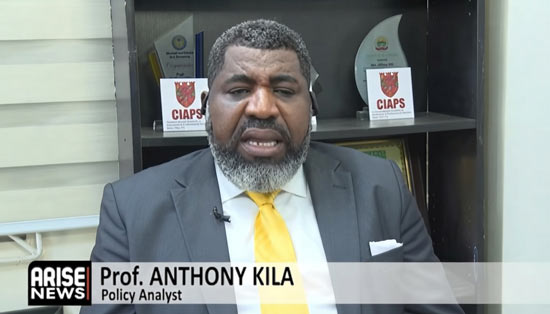
PREMIUM TIMES has reported that Mr. Anthony Kila, the pro-chancellor of Michael and Cecilia Ibru University (MCIU), was never awarded the academic rank of professor, despite having long presented himself publicly as a professor and as a “Jean Monnet Professor of Strategy and Development.”

In an investigation published on Saturday, 3 October 2026, under the byline of Qosim Suleiman and headlined “INVESTIGATION: The fake professor leading a Nigerian university,” the newspaper reported that “no recognised academic institution has ever awarded Mr Kila a professorial title.”
Mr. Kila was appointed pro-chancellor of MCIU in August 2025. The newspaper reported that he “has a long list of academic profiles that present him as a well-educated and widely travelled jurist, professor, scholar, accomplished professional, author, and public commentator of repute.”
“They Are Both Made Up”
The report noted the office Mr. Kila occupies and what it carries.
“A pro-chancellor chairs the governing council of every Nigerian university,” it stated. “The governing council is in turn charged with the general control and supervision of the administration, policy implementation, finance and assets of the university.”
It said Mr. Kila “has given many interviews to Nigerian newspapers and television stations, where he is frequently addressed as ‘professor’.”
“Some publications call him a professor of political science, while others refer to him as the Jean Monnet Professor of Strategy and Development. But they are both made up,” the newspaper wrote.
It added that the investigation “also found that his profile on the MCIU and CIAPS websites contain suspicious academic qualifications and roles used to embellish his academic standing, raising questions about his other academic qualifications.”
The newspaper said that in his profile on the MCIU and CIAPS websites he was identified as “Prof. Anthony Kila,” and that in several television and newspaper interviews it reviewed he was also regularly addressed as a professor. It said Arise TV “regularly invite him for analysis and calls him a professor.”
“The professorial rank is the highest academic rank awarded to top researchers and educators in Nigerian universities and globally,” the report said. “There is no evidence that Mr Kila ever taught at any university in Nigeria and abroad or that he was ever awarded the title.”
The Institution That Could Not Be Found
Asked where the professorship came from, Mr. Kila gave an answer the newspaper said it could not verify.
“In his response to our reporter, Mr Kila said the European Centre for Advanced and Professional Studies (ECAPS) awarded him the professorship. But this newspaper found that the institution is non-existent, present only in Mr Kila’s profile,” the report stated.
It said Mr. Kila told the newspaper that ECAPS, “based in Cambridge in the United Kingdom,” awarded him the professorship in 2016.
“However, this newspaper found that the institution doesn’t exist anywhere, except in Mr Kila’s profiles,” the report said, adding: “A search on the UK Companies House and Nigeria’s Corporate Affairs Commission (CAC), as well as a general online search, didn’t provide any leads, including a website, social media handles, an address, or alumni of the said institution.”
The newspaper said Mr. Kila’s public biographies repeatedly describe him as an international Director of Studies at the same body, which it described as the non-existent “European Centre of Advanced and Professional Studies.”
It identified a real institution of a similar name and reported its reply. “The European Centre for Advanced Studies (ECAS), the institution closest in name to Mr Kila’s so-called ECAPS, was established by the University of Glasgow and Leuphana University. But the institution said it has no connection with Mr Kila.”
Its Academic Director, Mr. James Conroy, told the newspaper by email: “The European Centre for Advanced Studies has no knowledge of this person.”
The Jean Monnet Claim
The newspaper reported that Mr. Kila also attributed the title “Jean Monnet Professor of Strategy and Development” to the same body, and set out what the title actually denotes.
“The title ‘Jean Monnet Professor’ is associated with the European Union’s Jean Monnet Actions, a programme established to promote teaching, research and debate on European Union integration,” the report said.
It said it contacted the European Education and Culture Executive Agency (EACEA), which administers the programme.
“In its response, the Jean Monnet team said Mr Kila does not appear as a Jean Monnet project coordinator for any project, based on information accessible in its directory,” the newspaper reported.
The agency was quoted as saying: “In other words, within the period for which coordinator data are publicly available, Mr Kila has not been listed as holding the role of Jean Monnet project coordinator since 2015.”
The newspaper also reported contacting Mr. Jean-Marc Trouille, a professor and co-chair of the AfriquEurope Jean Monnet Network and Director of the Jean Monnet Centre of Excellence on the EU and Regional Integration in the East African Community.
“First, I think it is highly unlikely that Prof. Kila would hold a Jean Monnet Chair award,” Mr. Trouille wrote to the reporter by email.
The newspaper said Mr. Trouille searched for Jean Monnet activity involving Mr. Kila and found that the only Jean Monnet module in Nigeria of which he was aware was at the University of Lagos, where Mr. Kila did not appear on the team.
Significantly, the report states that Mr. Kila himself accepted the position: “Mr Kila also confirmed to this newspaper that he was not associated with the Jean Monnet actions. He, however, failed to explain how he began to refer to himself as a ‘Jean Monnet professor.'”
What It Takes To Become A Professor
The investigation set out the route to the rank, citing the regulator.
“A professor is the highest academic rank and is attained through promotion within a university,” it said.
According to the National Universities Commission (NUC), as quoted in the report, the minimum standard for attaining the rank “considers a candidate’s academic qualifications, teaching and research experience, publications, postgraduate supervision and contribution to knowledge.”
“The first level qualification is to have a doctorate in the area of specialisation,” the NUC was quoted as saying.
The newspaper reported that the Commission added that a candidate must spend at least three years in teaching, research and community service at each of the ranks of Lecturer II, Lecturer I, Senior Lecturer and Associate Professor, “meaning a candidate would typically have about 12 years of university teaching and research experience before being considered for professorship.”
A former Deputy Vice-Chancellor of the Federal University Gusau, Prof. Ahmad Galadima, explained the internal process to the newspaper, saying candidates are first evaluated at departmental level through the faculty, then by the university promotion committee, on their publications, teaching load, quality of teaching, administrative experience, community service and relationships with colleagues.
“When the requirements are fully satisfied, their CVs are sent for external assessment,” Prof. Galadima said, adding that the curricula vitae go to three high-ranking professors in the candidate’s area of expertise and that “two positive responses are required to promote the staff to the rank.”
He said the procedure in countries such as the United Kingdom is more stringent, with “additional requirements like research grants acquired and quality of journal papers considered” ranking highly.
The newspaper said that against that standard, “there is no evidence that Mr Kila taught at any university or authored any peer-reviewed academic journal.”
The Publication Record
The report examined Mr. Kila’s listed scholarship.
“Mr Kila’s Google Scholar page listed 22 works, including books, journal articles, book chapters and other works, but PREMIUM TIMES found that nine of the 22 records were not authored by Mr Kila,” it stated.
“Of the works actually attributed to Mr Kila, none could be independently established from the review as a peer-reviewed article in a reputable academic journal.”
It added: “Three entries on the Google Scholar profile are listed as published in the Commonwealth Institute of Advanced and Professional Studies (CIAPS) Journal, a publication associated with an organisation he created.”
On another platform, the newspaper reported: “In his ResearchGate profile, where he identified himself as a ‘full professor’, he listed no publications.”
The Qualifications He Listed
The newspaper said Mr. Kila’s profiles did not state which schools he attended, but listed several qualifications including an LLM, MBA, MSc, PhD and PGCE.
It quoted the profile as reading: “Anthony studied in Cambridge, London, Perugia, and Suffolk. He graduated with a first-class degree in political economy and later specialised in political anthropology. He has taught in various colleges and universities in Cambridge, Ipswich, Lecce, London, Perugia, and Siena.”
The reporter sought his full curriculum vitae, which the newspaper said “would have provided details of the institutions he attended, qualifications obtained, his academic career, and where he obtained his professorship.”
“Mr Kila initially told PREMIUM TIMES that he did not have a CV readily available because he was no longer a young professional who needed one regularly,” the report said, quoting him: “I don’t really have a CV handy. I will find time to send you something.”
He subsequently provided a list of qualifications, which the newspaper reproduced: a Bachelor of Arts (Honours) in Classic Studies from Università per Stranieri, Italy, in 1989; a Master of Arts in European Studies from the same institution in 1991; a Postgraduate Diploma in Media and Communication from the University of Essex in 1992; a Master of Science in International Banking and Finance from City University London in 1994; a Doctor of Philosophy in Political Economy from the University of Perugia in 1997; a Master of Business Administration from Aston University, Birmingham, in 2002; a Postgraduate Certificate in Higher Education from Cambridge in 2006; and a Master of Laws from Cambridge in 2009.
The newspaper reported that the list did not sit comfortably with his own published profile.
“But even these claims contradicted his profiles on the website of his Commonwealth Institute of Advanced and Professional Studies (CIAPS), where he portrayed himself as having graduated with a first-class degree in political economy and later specialising in political anthropology. That claim was repeated on the website of the Michael and Cecilia Ibru University,” it said.
“However, in a brief resume he shared with our reporter, he told a different story, saying his first degree was in Classical Studies from Università per Stranieri, Perugia, Italy. We are still investigating that claim.”
The Website Was Edited, Then Taken Offline
The newspaper reported a sequence of changes to the CIAPS website after its reporter put the findings to Mr. Kila.
“The CIAPS website, through which Mr Kila made several suspicious claims about himself and his business, was unreachable in the past few days. That was after our reporter confronted him with our findings,” it said.
“The website was repeatedly edited, with Mr Kila’s misleading profile initially removed, before it was eventually taken offline.”
The newspaper said its work is not finished. “This newspaper is continuing investigations into the academic qualifications claimed by Mr Kila. The verification process has been slow because we are still awaiting responses from some of the institutions he claimed to have attended.”
“However, this newspaper clearly established his fake professorship, while its investigation into his claimed educational qualifications continues.”
The University’s Response
The newspaper reported that it put its findings to Michael and Cecilia Ibru University, and that the institution did not accept them.
“When presented with our findings, a spokesperson for Michael and Cecilia Ibru University said the institution has no evidence that Mr Kila is not a professor as he claimed,” the report stated.
It described how the response was obtained. “PREMIUM TIMES had contacted Thomas Kolo, a former Registrar at MCIU, asking to speak with the university spokesperson. He then passed the phone to someone who identified himself as the spokesperson, but failed to provide his name.”
That person was quoted as saying: “We don’t debate issues. You can go up with whatever you are going up with. If there’s a need to respond, we will respond when we see the article.”
The instinctive question for a legal readership is which offence is committed by a person who calls himself a professor without having been made one. The answer, uncomfortably, is that in Nigeria there is no statute that reserves the word “professor” to those on whom a university has conferred it.
Nigerian law protects professional titles selectively and by express enactment. The Legal Practitioners Act makes it an offence for an unqualified person to practise or to hold himself out as entitled to practise as a barrister and solicitor. The Medical and Dental Practitioners Act, the Council for the Regulation of Engineering in Nigeria Act, the Architects (Registration, etc.) Act and comparable statutes each create an offence of practising or holding oneself out in the regulated field without registration. “Professor” has no such statute behind it. It is an employment rank conferred inside a university, regulated by the National Universities Commission as a matter of academic standards rather than by the criminal law, and the Commission’s own account quoted in the investigation describes a promotion process, not a licence.
The consequence is that a false claim to the rank is ordinarily actionable not as an offence in itself, but through what the claim was used to obtain. That is where the analysis has to go.
Where the legal exposure actually lies
Four routes exist, and each depends on facts beyond the title.
The first is obtaining by false pretence. Under the Advance Fee Fraud and Other Fraud Related Offences Act 2006, and under the false pretence provisions of the Criminal Code, the offence requires a false representation of a present fact, made with intent to defraud, by which property or a benefit is obtained. A representation that one holds a professorship conferred by a named institution is a representation of fact, not of opinion. If an appointment carrying emoluments, allowances or fees was procured by that representation, the elements are capable of being made out. If no material benefit was obtained, they are not.
The second is forgery and uttering. If a certificate, letter of appointment or conferment document exists and was fabricated, the forgery provisions of the Criminal Code and the Penal Code apply directly, and uttering such a document is a separate offence. The investigation does not report the existence of any such document, and that distinction matters: an unsupported oral or online claim is a different thing in law from a fabricated instrument.
The third is the Cybercrimes (Prohibition, Prevention, etc.) Act 2015, which criminalises the fraudulent use of a computer system or network to impersonate another person or body with intent to gain an advantage. A website asserting an institutional affiliation that the institution denies, and a claimed association with a European Union programme that the administering agency says does not exist in its records, are the kind of facts that would be examined under those provisions. Again, intent and advantage would have to be proved.
The fourth is civil rather than criminal. A body whose name is used without authority — whether a real institution, a European Union programme, or a university whose brand carries the claim onward — may sue in passing off and for injurious falsehood, and may obtain injunctive relief requiring the representation to be withdrawn.
“Jurist,” “LLM” and the line the Legal Practitioners Act does draw
One element of the profiles quoted by the newspaper deserves particular attention in a legal publication. Mr. Kila is described in his biographies as a “jurist,” and the qualifications he supplied include a Master of Laws.
Neither of those, by itself, raises a question under the Legal Practitioners Act. “Jurist” is not a protected description, and a postgraduate law degree from a foreign university confers no right of audience in Nigeria. Entitlement to practise here comes only from enrolment at the Supreme Court following call to the Bar by the Body of Benchers, which in turn requires the qualifying law degree and the Nigerian Law School programme. A person holding only a foreign LLM is not a legal practitioner in Nigeria, and the line is crossed — and section 22 of the Act engaged — only where such a person holds himself out as entitled to practise, appears in court, or acts in a manner reserved to enrolled practitioners.
The relevance here is comparative. Parliament has decided that some descriptions are dangerous enough to the public to be made criminal to misuse, and the practice of law is one of them. It has made no equivalent decision about academic rank, with the result that the governance of a university can be chaired on the strength of a title nobody is required to verify.
The office is not decorative, which is why the governance question is the real one
The newspaper is right to foreground what a pro-chancellor does. The governing council exercises general control over the administration, policy, finances and assets of a university. It approves budgets, appoints and disciplines senior staff, and bears the fiduciary duties that attach to the stewardship of institutional funds. Its chairman is not a ceremonial figure; he is the person who signs the council’s decisions.
Two consequences follow if the account published is correct.
The first concerns the appointment itself. An appointment procured by a material misrepresentation is voidable at the instance of the appointing authority — in a private university, the proprietors acting through the council and subject to the institution’s own statutes. It is not void automatically, and it does not unwind itself. Someone has to act, and the first question for the university’s council is therefore not whether the newspaper is right but whether it has satisfied itself one way or the other. On the account published, it has not tried: a spokesman who declines to give his name and says the institution “has no evidence that Mr Kila is not a professor” has inverted the burden. Verification of the credentials of the chairman of a governing council is the council’s own responsibility, not a journalist’s, and it is discharged by writing to the awarding institution, not by waiting for an article.
The second consequence is reassuring and should be stated plainly, because it is the question students and staff will ask first. Decisions taken by a council chaired by a person whose appointment is later set aside do not collapse with it. The de facto officer doctrine, long applied in this jurisdiction, preserves the validity of acts done by a person holding an office under colour of title, precisely so that third parties who dealt with the institution in good faith are not prejudiced. Section 168(1) of the Evidence Act 2011 reinforces the position by presuming the regularity of official acts shown to have been substantially regular. Degrees conferred, appointments made and contracts executed during the period are not nullities, and nothing in the investigation suggests otherwise.
Taking the website down has an evidential cost
The newspaper reports that the CIAPS website was repeatedly edited, the profile removed, and the site then taken offline, all after its reporter put the findings to Mr. Kila.
Whatever the reason, that sequence carries a specific legal disadvantage. Section 167(d) of the Evidence Act 2011 permits a court to presume that evidence which could be produced and is not would, if produced, be unfavourable to the person who withholds it. Where the document in question is the very profile said to contain the disputed claims, and it is withdrawn after enquiries begin, the presumption is available to anyone who later needs it — including the newspaper, if it is sued. Publications of this kind are, in any event, almost always preserved: archive services capture pages automatically, and a page taken down after a reporter’s call is generally still obtainable in the form it had before.
Why the right of reply decides the libel question
The report is a grave imputation against a named individual, and the question any editor will ask is what protects it.
In Nigeria, truth is a complete defence to an action in defamation. Where a publication asserts, as this one does, that a title was never conferred and that the conferring institution does not exist, the defence stands or falls on proof of those two facts, and the newspaper has placed on the record the material by which it says they are proved: the Companies House and Corporate Affairs Commission searches, the email from the Academic Director of the institution closest in name, the response of the European agency administering the Jean Monnet programme, and the opinion of a Jean Monnet network co-chair. It has also recorded the subject’s own concession that he is not associated with the Jean Monnet actions, and his failure to explain the usage. An admission of that kind, published alongside the allegation, is the single most valuable item in a justification defence.
Equally important is what the newspaper did procedurally. It sought the subject’s comment, published his explanation in his own words, sought his curriculum vitae, published his answer when it was not produced, reproduced the qualifications he did supply, approached the university, and published its response verbatim including the refusal to engage. It also drew a careful line between what it says it has established and what it has not, stating expressly that it “clearly established his fake professorship” while its investigation into the claimed educational qualifications “continues.” That distinction is not editorial modesty; it is the thing that keeps the unproven portion out of the imputation.
A point for every other newsroom in the country follows from the same analysis, and the investigation names it directly in reporting that Nigerian newsrooms and a television station addressed him as a professor. Republication is a fresh publication: a broadcaster or newspaper that confers a title on a guest adopts the claim as its own, and cannot rely on the guest having supplied it. The duty of accuracy imposed on broadcasters by the Nigeria Broadcasting Code points the same way. The remedy is procedural and cheap — verify a claimed rank with the institution said to have conferred it before the lower-third graphic is cut.
The wider pattern this sits inside
This is not an isolated curiosity. Nigeria has an established market in unearned academic standing: honorary doctorates worn as earned titles despite repeated warnings by the National Universities Commission that they confer no such entitlement; “professorships” issued by unaccredited bodies, some of them registered as companies rather than as institutions; and, as the Federal Government was obliged to acknowledge when it suspended the evaluation and accreditation of degree certificates from two neighbouring countries following an undercover investigation in 2024, a cross-border trade in certificates themselves.
The structural weakness the present case exposes is verification. Nigeria has no public register against which a claimed professorship can be checked, no requirement that a person appointed to a university governing council produce verified credentials, and no body charged with policing the use of academic titles in public life. The National Universities Commission regulates institutions, not the descriptions individuals attach to themselves. Until a claimed rank must be evidenced to someone before it can be used, the only mechanism that works is the one that worked here a reporter writing to the awarding institution and publishing the reply.
This report is based on the investigation published by PREMIUM TIMES on 3 October 2026. TheNigeriaLawyer has independently sought comment from Mr. Anthony Kila, from Michael and Cecilia Ibru University, and from the National Universities Commission on whether it intends to make any enquiry into the composition of the university’s governing council.
[A MUST HAVE] Evidence Act Demystified With Recent And Contemporary Cases And Materials

Available now for NGN 40,000 at ASC Publications, 10, Boyle Street, Onikan, Lagos. Beside High Court, TBS. Email publications@ayindesanni.com or WhatsApp +2347056667384. Purchase Link: https://paystack.com/buy/evidence-act-complete-annotation
______________________________________________________________________ “Enhance Legal Practice With Authoritative Reports” — Alexander Payne Offers Comprehensive Law Reports, Spanning Over A Century Of Nigerian Jurisprudence Interested buyers are encouraged to place their orders and enquiries via:
0704 444 4777, 0704 444 4999, 0818 199 9888
Website: www.alexandernigeria.com
Interested buyers are encouraged to place their orders and enquiries via:
0704 444 4777, 0704 444 4999, 0818 199 9888
Website: www.alexandernigeria.com