TheNigeriaLawyer Editorial

A succession of threatening and exclusionary remarks by politicians linked to the All Progressives Congress has raised fresh concern over the atmosphere surrounding the 2027 general elections, with Amnesty International Nigeria now questioning whether the security agencies are responding firmly enough to rhetoric capable of intimidating voters and opponents.
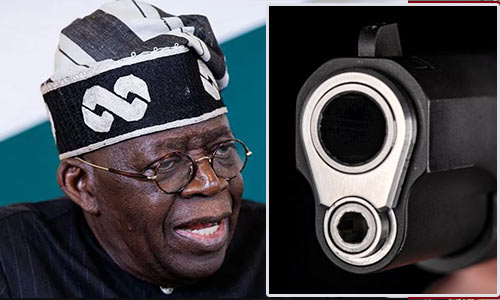
The latest came from the Edo State APC Chairman, Jarrett Tenebe, who, speaking about the party’s plan to deliver 2.5 million votes for President Bola Tinubu, referred to a General Purpose Machine Gun and ended his warning to those he said might stand in the party’s way with the words, “AK-47 fire.”
Amnesty International subsequently accused the Nigeria Police Force and the State Security Service of failing in their responsibilities as politicians publicly threaten violence ahead of the elections.
The Pattern, Not The Incident
Tenebe’s remarks are not isolated. A review of reported incidents over roughly the last six months shows several APC-linked figures accused of using threatening, exclusionary or inflammatory language in connection with elections or political mobilisation.
They include the Osun East Senator, Francis Fadahunsi; the Borno State Commissioner, Sainna Buba; the Ebonyi State Governor, Francis Nwifuru; the Ohaukwu Local Government Chairman, Paul Ituma; and the Kuje Area Council Chairman, Danjuma Shekwolo.
Fadahunsi drew national condemnation in August after telling APC supporters in Osun to “kill” Accord Party members ahead of the governorship election, and saying they should not be allowed to vote even if they came with their voter cards. He later said the words were metaphorical and that he meant APC supporters should defeat Accord politically.
In Borno, Buba told critics at an event organised by the City Boy Movement in support of the President’s second-term bid that if they raised their fingers against the government again, “we will cut them off.” He subsequently said the remark was figurative.
In the Federal Capital Territory, Shekwolo told residents of Kuje that it was either they supported the APC or left the area council. He later said he had no intention of denying anyone their constitutional rights because of political affiliation.
In Ebonyi, Governor Nwifuru warned newly inaugurated council chairmen in September that they could be removed if the APC failed to win their local government areas in 2027. Days later, Ituma warned opposition politicians against coming into Ohaukwu unless they were prepared to align with the APC, and declared that anyone fighting the governor would be treated as an enemy.
Figures Around The Administration
The debate extends to officials who hold no party office but sit close to the Presidency.
The FCT Minister, Nyesom Wike, warned external political actors against interfering in Rivers politics in May, saying, “You put your hand, you get fire,” and telling them that trouble could follow them back to their own states. Wike is not an APC official, but he is a serving minister, and his remarks form part of the wider argument about the tone being set around the administration.
Earlier episodes, outside the six-month window, remain part of the same discussion. In April 2025, the Benue Governor, Rev. Fr. Hyacinth Alia, warned that the safety of high-profile visitors entering the state without his knowledge could not be guaranteed, as Mr Peter Obi prepared to visit internally displaced persons. In July 2025, the Edo Governor, Monday Okpebholo, told Obi not to return to Edo without security clearance, though the state government later maintained the statement concerned security protocol rather than a threat. In March 2025, the Kogi State Government imposed a broad ban on rallies and required prior clearance for security convoys entering the state, citing intelligence and public-order concerns.
What The Law Now Says
The legal position is governed by the Electoral Act 2026, which repealed the 2022 Act.
Section 97 expressly prohibits a party, candidate, aspirant, person or group from directly or indirectly threatening force or violence during a political campaign to compel another person to support or refrain from supporting a political party or candidate. An individual convicted faces a maximum fine of ₦5 million or 12 months’ imprisonment. A political party faces ₦10 million for a first offence and ₦2 million for a subsequent one.
Section 96 prohibits abusive, intemperate or base language and insinuations designed or likely to provoke violent reactions or emotions during political campaigns.
Whether any particular statement amounts to an offence is a matter for investigation, prosecution and judicial determination, turning on the exact words, the context, the intent and the evidence.
What The Agencies Have Actually Done
The record is uneven rather than empty, and the unevenness is the point.
The police summoned Fadahunsi, questioned him and granted him administrative bail, while an Abuja magistrate separately directed the police to investigate a criminal complaint arising from his statement. The police later confirmed that the comments attributed to Fadahunsi, Buba and Shekwolo were under investigation.
In Ebonyi, the command said politicians had been warned against threats, and later convened a meeting of political stakeholders in Ohaukwu at which participants reportedly agreed to tone down hostile rhetoric.
What has not followed, in any of these cases, is a charge. Investigation, invitation, administrative bail and a stakeholders’ meeting are not prosecution, and sections 96 and 97 have so far produced no arraignment of any of the figures named.
As at 3 October, the sources reviewed showed no publicly announced SSS response to Tenebe’s remarks specifically.
The Peace Committee
The National Peace Committee is chaired by the former Head of State, Gen. Abdulsalami Abubakar, with Bishop Matthew Hassan Kukah serving as Convener and The Kukah Centre housing its secretariat.
The committee activated a situation room and an Electoral Offences Tracking System as campaigns began, saying it was documenting both violent and non-violent breaches and transmitting relevant information to the police and INEC, because it has no statutory power to prosecute offenders.
In a statement jointly signed by Abdulsalami and Kukah, the committee said it had recorded 60 election-related incidents between 19 August and 19 September, including political intimidation, threats, violence, attacks and inflammatory statements. It called on the police and other security agencies to carry out prompt, impartial and evidence-driven investigations, and demanded equal protection for all parties and candidates.
The President, represented by the Secretary to the Government of the Federation, George Akume, was among the actors represented when presidential candidates and party leaders signed the National Peace Accord on 18 August, committing themselves to peaceful and issue-based campaigns. The accord was organised by the National Peace Committee in partnership with The Kukah Centre.
Defending The Vote, Lawfully
For voters, protecting the franchise means lawful participation rather than confrontation. Citizens are entitled to cast their ballots without intimidation, and may report threats, violence, voter suppression or other suspected electoral offences to the appropriate authorities and to accredited observers.
Defending a vote does not mean fighting anyone at a polling unit.
INEC’s current election-day guidance is that after casting a ballot, a voter may leave, or may remain at least 300 metres away to peacefully observe open counting and the announcement of results. Voters who choose to observe should keep to that distance, obey lawful instructions, avoid confrontation, and document and report irregularities through lawful channels.
That is the lawful form of vote protection: vote, follow INEC’s rules, stay within any legally permitted observation area, pay attention to the counting and the announcement, and report irregularities properly. Refusing to be intimidated out of participating is the whole of it.
The World Bank has said that while the reforms introduced since 2023 have improved some macroeconomic indicators, household incomes have yet to recover fully and poverty remains high. Rising fuel and transport costs have renewed cost-of-living pressure across the country.
Nigerians who have endured rising living costs and declining purchasing power should not additionally be subjected to threats because of how they intend to vote. The constitutional answer to dissatisfaction with any government is the ballot box.
[A MUST HAVE] Evidence Act Demystified With Recent And Contemporary Cases And Materials

Available now for NGN 40,000 at ASC Publications, 10, Boyle Street, Onikan, Lagos. Beside High Court, TBS. Email publications@ayindesanni.com or WhatsApp +2347056667384. Purchase Link: https://paystack.com/buy/evidence-act-complete-annotation
______________________________________________________________________ “Enhance Legal Practice With Authoritative Reports” — Alexander Payne Offers Comprehensive Law Reports, Spanning Over A Century Of Nigerian Jurisprudence Interested buyers are encouraged to place their orders and enquiries via:
0704 444 4777, 0704 444 4999, 0818 199 9888
Website: www.alexandernigeria.com
Interested buyers are encouraged to place their orders and enquiries via:
0704 444 4777, 0704 444 4999, 0818 199 9888
Website: www.alexandernigeria.com