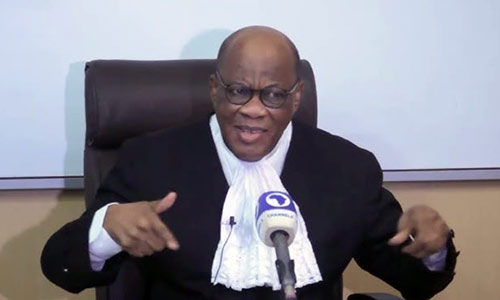
A former President of the Nigerian Bar Association, Dr. Olisa Agbakoba, SAN, has said that public perception of the Nigerian judiciary is of low performance, driven by what the public sees as interference and uncertainty in the decisions of the courts, particularly in election petition cases.

Assessing the judiciary 66 years after independence, he was careful to distinguish his own view from the public’s.
“Generally speaking, I am not giving my personal view. I am giving the view of what I see the public saying,” he said. “It seems to me that the perception of the public is that there is low performance on the part of the judiciary.”
“Not The Place Of The Judiciary”
“The public perception is that it is not the place of the judiciary to determine political office holders, such as the President, governors and senators. It is the duty of the people who elect them,” he said.
“But it seems now that the judiciary has taken over that function, and everybody turns to the judiciary to ask, who will they elect? That is not their function.”
“The judiciary should resist the invitation to be lured into becoming an electoral umpire. That is not its function.”
He added an observation about venue. “There are cases I have seen where a judge would take a case and you would ordinarily wonder: why is this case here? I am sitting in Jigawa, and this matter concerns a party dispute in Onitsha. Why is it here?”
“I think there is a lot that needs to be done to restore public confidence in the judiciary because there are so many fine judges on the bench. There are so many brilliant and distinguished judges serving today. But whether we like it or not, there is a very strong perception by the public that something is wrong.”
Two Reasons For Conflicting Judgments
Asked what accounts for the conflicting judgments, he gave two reasons.
“One is the public perception that judges are no longer following their oath and are influenced by considerations other than judicial considerations. Whether that is so or not, I don’t know. But I have seen evidence of cases that look alike and should be decided alike, yet they receive different decisions.”
“The second problem has to do with competence. To be a judge is not an easy thing. You have to demonstrate competence.”
He contrasted the present with an earlier period. “In the old days, when my father was around, there were competent people who did not apply for the job. In fact, I know that the first Northern lawyer, Alhaji AbdulRazaq, the father of the current governor of Kwara State, declined to become a judge in 1969. They asked him and he said, I just can’t afford to be a judge. How much are you going to pay?”
“That was the quality of the time. It wasn’t a matter of being forced into it. People who wanted to be judges had already made successful careers as lawyers. They didn’t have the temptation to go there to make money. I don’t know if you can speak of that criterion today.”
“I have appeared before judges whom I am shocked by how they became judges,” he said. “If a judge doesn’t understand the rudimentary rules of the law of evidence, how to decide cases or the substantive issues involved, then he will give poor-quality decisions.”
“Put It In The Newspaper”
On appointments, he said the process should be transparent and compared it to the publication of banns before a marriage.
“I sat on the National Judicial Council, and we set up criteria for appointment. Unfortunately, those criteria are not being followed,” he said.
“Put it in the newspaper: the following 10 people have applied to be judges in the Anambra State High Court. Anyone who has any complaint or anything against them, please say so. Put them through public scrutiny so that anything we have against them will be put on the table. I think that is a very important filter.”
“If the NJC criteria for the appointment of High Court judges, Court of Appeal justices and Supreme Court justices are followed, I think it will go a long way towards dealing with the problem we have. But they are not being followed. That is the problem.”
“The Almighty Power”
On the National Judicial Council itself, he said its composition concentrates authority in one office.
“The composition of the NJC makes the Chief Justice of Nigeria the almighty power. When I sat on the NJC, nobody could challenge the CJN. Nobody. Because he appoints virtually everybody.”
He said the only Chief Justice who attempted structural reform was the late Honourable Justice Dahiru Musdapher, who constituted a 29-man panel to examine the issues. “The main thing we said was that if the NJC structure continued to be what it was, then we cannot have a great judicial policy.”
“Unfortunately, the late Dahiru Musdapher was only six months in office. He was the shortest-serving CJN in Nigerian history. Immediately he retired, all the reforms died. He appointed me to create model rules for the speedy administration of justice, but till today, not one person has remembered what the late Justice Musdapher put in place.”
“The NJC continues to be a body that doesn’t have any staff. It is unbelievable. We are all ex-officio members. The law says there are five NBA members and judges from the six geopolitical zones, and they are all appointed by the CJN. But what about the quality of people who work in the NJC? There is nobody. So, they don’t deal with high judicial policy. There is no thinking about the concept of how to speed up justice.”
“Nobody Cares”
He said urgency in the courts is reserved for political cases.
“The only issue where speed of justice has relevance is politics. If it is the National Assembly where politicians have an interest, they have created a very fast timeline. Six months and it must be finished.”
“What about commercial cases? What about people on trial for murder who sit on death row for 30 years? When I was a political prisoner in Enugu under Abacha, I met two or three people on death row. One was an 80-year-old man who had been on death row for about 45 years.”
“Nobody cares. The only interest we see in speed is political cases because politicians have an interest. But the NJC ought to have an interest in saying: if cases don’t go fast, nobody will be interested in going to the courts.”
“All these rule-of-law things you see are just hype. We need to see a very active NJC. You mentioned conflicting decisions. Has the NJC ever made a statement on it? Has it ever said to judges, why do you keep giving conflicting decisions?”
“I Am Not Sure”
He offered his own uncertainty as evidence of the problem.
“Nobody can tell what exactly constitutes a pre-election matter. Even me, at 50 years at the Bar, I am not sure that if a client comes to me and asks, what exactly is a pre-election matter, that I know.”
“There are too many conflicting decisions. In what cases can the courts determine to remove the chairman of a political party? I don’t know. These very basic issues heat up the polity.”
“Still Handwriting”
On the speed of proceedings, he said the architecture of the system has not changed.
“The NJC and the constitutionally mandated organ to deal with judicial policy ought to do more about the speed of justice. You have to look at the rules of court and how the courts work.”
“Why are judges still handwriting and taking things down in longhand in today’s technological, digital age?”
“If Mr Justice Jones, who sat in the High Court of Lagos in 1830, were to come back to life today, he would recognise the system and say there has been no change. The entire architecture that underlies the way the legal profession works needs a complete overhaul.”
Religion And The State
Asked about the operation of Sharia alongside the general legal system, he said the difficulty is the failure to observe section 10 of the Constitution.
“When Sharia law first started in Zamfara, I led a strong team. We lost the case. We argued that the state could not declare that Zamfara was a Sharia state because it conflicted with the doctrine of separation of religion from the state.”
“Nigeria is a secular state. Nigeria is not a secular state for nothing. It does not mean Nigeria ceases to be a religious country. It means that religion is a private matter. It is in the Constitution.”
“But the Constitution is not obeyed. That is the problem. If the Constitution were obeyed, a lot of these conflicts around religion would have been dealt with. That is why I raised the issue that government should not sponsor pilgrimages to Mecca or Jerusalem. There should be nothing like Christian pilgrimage. People criticised me for saying that, but that is what the Constitution says.”
Funding
On insulating the judiciary from executive influence, he returned to the Council.
“I sat on the NJC and raised this point: the Constitution confers on the NJC a funding structure. But the problem is that the funding structure set out in the Constitution is not being obeyed, and the NJC has not really pushed to have it obeyed.”
“I went to court. I went to three courts and I won all three cases. I raised the issue in the NJC that it has the power to determine its budget. Why doesn’t it take that power? At that time, it was Justice Aloma, the first female CJN. I thought, since nobody would do it, I would do it. I won the cases establishing that the judiciary does not depend on the executive to be funded. Unfortunately, the effort I made and the decisions of the courts have not been implemented.”
He said the apex court had not helped. “There was a case before the Supreme Court on the funding mechanism of the Parliament, the executive and the judiciary. By Section 162(9) of the Constitution, the makers of the Constitution set out parameters for funding. The justices of the Supreme Court said that provision was unconstitutional.”
“That was shocking to me. Judges said that the way they should get money was unconstitutional. My predecessor, Alegeh, after he had been NBA president, went back to the Supreme Court and we again raised the issue that the Supreme Court does not have the power to declare the Constitution unconstitutional. It cannot, unless the National Assembly amends it.”
“Is That His Job?”
He explained how the appropriation is in practice routed.
“The NJC sends an estimate to all branches of the judiciary across Nigeria. They gather together what is called an estimate and it is sent to the National Assembly for appropriation, not to the executive.”
“But what is going on now is that the NJC sends it to the executive, and somebody in the Ministry of Finance may then decide that the judiciary’s budget will be, for example, N100 billion. That is not their job. It is the job of the NJC to determine its budgetary allocation. That is the problem.”
“And that is why Wike is building houses for them and they are gratefully accepting them. Is that his job?”
“It is the job of the judiciary to create a budget where it takes care of itself, its salaries, housing and courts. If a judge has collected a house from the executive, the public perception becomes: can this man really do justice in my case?”
“A Judge Was Seen As A God”
Asked what reforms he would prioritise, he named competence first.
“I would focus on the competence of a judge being properly weighed and subjected to public scrutiny. That is the area I would focus on, so that the person who becomes a judge is entitled, not only in law but by public confidence, to be called a judge.”
“Once the quality of a judge goes up, the judge is not interested in who you are. He does his job without fear or favour, then we are good. But if the judge is influenced by what he is going to get or fear of executive condemnation, then we don’t have a judiciary.”
He described the bench of an earlier era. “You know what it was to be a judge in the old days? A judge was seen as a god. My father was Chief Justice, and you couldn’t just come to our house. Who were you to approach our house? Even the Commissioner of Police in Enugu at that time couldn’t just come and see my father. He would come to the gate and sign the visitors’ book, saying, my Lord, I am here to ensure that your safety and security are secured, and he would go away. My father never went to any social function. There was total seclusion. Today, it is strange.”
“Without Fear Or Favour”
His second priority is funding. “Judges must be free from executive control of their funding. They must be totally free. I should not need Wike to build me a house, nor should I need the executive to assign a budget for me to build courts. Once the judiciary controls its budget, that is the second important thing.”
“The words without fear or favour are very heavy words. The reason judges of old could dispense justice without fear or favour was because they were protected. They didn’t have anything to lose.”
He gave an example. “There was a judge in a case in Benin who gave a decision adverse to the interest of the government. He was transferred from Benin to Maiduguri as punishment. Other judges would see what happened to him and become afraid. So, judges must be able to do their work without fear or favour. The Constitution needs to guarantee their tenure of office.”
“Look at how Justice Onnoghen, the CJN of Nigeria, was removed and nothing happened. Yet, the Constitution gives him protection. I was the one who defended him at the NJC trial against the way he was removed.”
“We Should Regulate Ourselves”
On the Bar, he said its regulatory position is weaker than the public assumes.
“I don’t even sit on the body that disciplines lawyers, yet I am their president. It is ridiculous. So, please don’t assume that the NBA is what you think it is. It has a powerful voice, but I think two things should happen.”
“Either the system should free the NBA and allow it to operate like ICAN. ICAN controls its own examination. There is no law school for ICAN; it has its own examination process and nobody controls it.”
“For us, everybody goes to law school. The NBA is too constrained by government bureaucracy and, as a result, it is not anywhere near as influential as people think. That is why, for me, the NBA cannot do much unless to play an advocacy role. But I want the NBA to have the sort of power that its equivalent in London has.”
“If a lawyer misbehaves in the United Kingdom, you complain to the professional body. If it finds that your complaint is justified, it can impose the relevant punishment, including striking the lawyer’s name off the roll. But in Nigeria, by the time you go through the hierarchy and get to the Legal Practitioners Disciplinary Committee and all of that, the whole process is muddled in statutory bureaucracy.”
“We should regulate ourselves. Everything about the law profession should be done by us, not the government. We should determine the curriculum that lawyers require. We should determine the discipline that is required. We should determine the excellence that we will bestow on those found worthy of it. That is when you will have a strong NBA.”
“When there is misconduct, the decision should be taken at the local bar. If a lawyer in Lagos misbehaves, the Nigerian Bar Association, Lagos Branch, should be able to deal with it.”
[A MUST HAVE] Evidence Act Demystified With Recent And Contemporary Cases And Materials

Available now for NGN 40,000 at ASC Publications, 10, Boyle Street, Onikan, Lagos. Beside High Court, TBS. Email publications@ayindesanni.com or WhatsApp +2347056667384. Purchase Link: https://paystack.com/buy/evidence-act-complete-annotation
______________________________________________________________________ “Enhance Legal Practice With Authoritative Reports” — Alexander Payne Offers Comprehensive Law Reports, Spanning Over A Century Of Nigerian Jurisprudence Interested buyers are encouraged to place their orders and enquiries via:
0704 444 4777, 0704 444 4999, 0818 199 9888
Website: www.alexandernigeria.com
Interested buyers are encouraged to place their orders and enquiries via:
0704 444 4777, 0704 444 4999, 0818 199 9888
Website: www.alexandernigeria.com