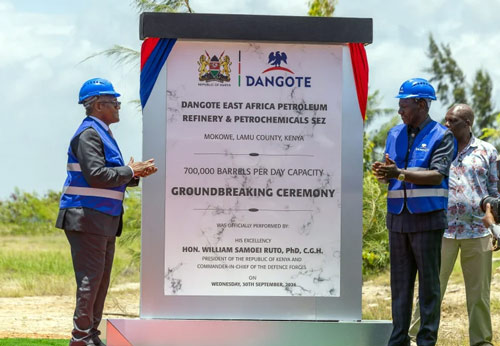
Africa’s push to refine more of its own crude oil received a major boost on Wednesday as Kenyan President William Ruto, Nigerian industrialist Aliko Dangote and other African leaders broke ground on the $16 billion Dangote East Africa Petroleum Refinery and Petrochemicals complex in Lamu County, Kenya.

The huge industrial project, designed to process 700,000 barrels of crude oil per day, is expected to serve not only Kenya but a broad East African market stretching across Uganda, Rwanda, Tanzania, Ethiopia, South Sudan, the Democratic Republic of Congo and other neighbouring economies. Dangote has promised that the refinery will be completed within 40 months, putting its targeted commissioning around early 2030.
Standing at the project site during the groundbreaking ceremony, Dangote gave an unusually firm timeline.
“Mr President and our other respected presidents, my brother Prime Minister Abiy, I want to assure you we will come back here and commission this refinery in 40 months from today,” he said.
The ceremony brought together President Ruto, Uganda’s President Yoweri Museveni, Ethiopian Prime Minister Abiy Ahmed, leaders and delegations from other African countries, as well as former Nigerian President Olusegun Obasanjo. Their presence gave the launch a regional character beyond what would ordinarily be a private-sector investment in Kenya.
For Dangote, the project is deliberately being presented as more than another oil refinery.
“This refinery is therefore not simply about one country. It is about a region,” he said.
Dangote said his company had already begun mobilising machinery, personnel and technical resources to Lamu, while drawing heavily on lessons from the development of the Dangote Petroleum Refinery in Lagos.
Kenya’s Ministry of Roads and Transport said more than 110 pieces of equipment were already at the site, with another 400 expected within 60 days as mobilisation gathers pace.
The refinery will sit at the heart of a wider integrated industrial complex. Apart from producing petrol, diesel, aviation fuel and other refined products, plans for the development include a 1,000-megawatt power plant, polypropylene production, base oils and related petrochemical industries.
Ruto described the roughly KSh2.2 trillion investment as a generational project that could fundamentally reshape Kenya’s energy and industrial landscape.
The Kenyan government expects the development to help turn Lamu into a major energy and manufacturing hub while reducing East Africa’s dependence on imported refined petroleum products.
But ownership is also central to Dangote’s plan.
He has reserved as much as 30 per cent equity in the refinery for East African countries, saying regional governments should have the opportunity to become owners of an asset that will supply their economies rather than simply remain customers.
Kenya and Rwanda have moved to take advantage of the offer, with Rwanda seeking a possible 10 per cent stake, while Ethiopia has also previously expressed interest. Dangote has said participating governments would be allowed to spread payment for their stakes over four years.
“I want to particularly commend both Kenya and Rwanda for moving very quickly to grab that opportunity. The rest will come,” Dangote said.
Museveni welcomed the regional shareholding arrangement, describing it as a sensible way of ensuring that neighbouring countries benefit financially even though the refinery is physically located in Kenya.
He, however, maintained that Uganda would continue pursuing its own refinery plans, arguing that the region is large enough to support multiple refineries and that processing African crude should also create jobs in countries where the resources originate.
Employment and skills development featured prominently at the groundbreaking.
Current projections put the number of direct and indirect jobs that could be linked to the project at about 60,000, while Dangote said the company intended to ensure that people from Lamu and other parts of Kenya were not reduced to spectators as billions of dollars flowed into the project.
More than 1,000 young people from host communities are expected to receive technical and vocational training, while an engineering training school is planned in Lamu to prepare young people for jobs connected to the refinery and its surrounding industries.
“We want young Kenyans and East Africans with skills here. We want local businesses to become suppliers. We want entrepreneurs around this project,” Dangote said.
For him, the real test of the project would not simply be the size of the refinery or how many barrels it processes.
“Industrialisation must have a human face. It must create dignity. It must create jobs. It must create opportunities. It must create hope,” he said.
That message ran through much of Wednesday’s ceremony.
Dangote argued that Africa could no longer continue the familiar cycle of exporting crude oil, minerals and agricultural commodities cheaply, only to import the finished products at a much higher cost.
“We must retain more value here at home in Africa,” he said.
Former President Obasanjo similarly used the occasion to recall Dangote’s transition from trading and importation into large-scale manufacturing, arguing that African governments must create conditions in which indigenous businesses can invest, manufacture and compete on a global scale.
Museveni also returned to one of his longstanding themes that exporting raw materials amounts to exporting the jobs and wealth that come with processing them.
Abiy, for his part, said the Lamu refinery could strengthen East Africa’s energy security at a time when dependence on petroleum products refined outside the continent leaves countries vulnerable to international supply disruptions and price shocks.
“East Africa is not only a market. It is a place to produce, to build and to create value,” the Ethiopian leader said.
For Ruto, the project is particularly significant because it anchors a large industrial investment around the Lamu Port-South Sudan-Ethiopia Transport Corridor, commonly known as LAPSSET.
Lamu’s deep-water port and its potential links to regional oil producers were among the reasons the Kenyan coastal location was ultimately preferred for the project.
The groundbreaking, however, took place against the backdrop of an unresolved legal battle over part of the land earmarked for the development.
A group of 133 residents has approached the Environment and Land Court in Malindi, claiming interests in land identified as LR No. 13061 in the Hindi/Manda Magogoni area. They have raised allegations involving ancestral land rights, occupation, compensation and the treatment of residents affected by the proposed development.
Justice Jane Onyango declined to stop Wednesday’s groundbreaking ceremony but ordered that the status quo on the disputed parcel be maintained until October 14, when the application is scheduled for inter partes hearing. The respondents were also directed to file their responses.
The distinction is important: the court did not prohibit the ceremonial groundbreaking of the entire refinery project, but its status-quo order may restrict activity on the specific land under dispute until the parties return to court.
The dispute has also brought environmental and community concerns into the spotlight. Some residents and conservation advocates have questioned the potential impact of a project of this size on Lamu’s coastline, marine ecosystem and local livelihoods. Lamu Old Town is also a UNESCO World Heritage Site.
Lamu Governor Issa Timamy, while insisting that the refinery should proceed, acknowledged that development could not come at the expense of the county’s mangroves, fishing grounds, coastline and cultural heritage.
Dangote, however, has made clear that the court challenge has not altered his commitment to the project.
Speaking during an earlier engagement at the Nairobi Securities Exchange, he said legal disputes around major African investments were not unfamiliar to his group and expressed confidence that the refinery would proceed.
Commercially, the Lamu development is already attracting major engineering partners. U.S.-based Honeywell is expected to provide technology, engineering services, licensing and equipment, while Engineers India Limited is involved in project execution. Both have experience working with Dangote on large-scale refinery operations.
[A MUST HAVE] Evidence Act Demystified With Recent And Contemporary Cases And Materials

Available now for NGN 40,000 at ASC Publications, 10, Boyle Street, Onikan, Lagos. Beside High Court, TBS. Email publications@ayindesanni.com or WhatsApp +2347056667384. Purchase Link: https://paystack.com/buy/evidence-act-complete-annotation
______________________________________________________________________ “Enhance Legal Practice With Authoritative Reports” — Alexander Payne Offers Comprehensive Law Reports, Spanning Over A Century Of Nigerian Jurisprudence Interested buyers are encouraged to place their orders and enquiries via:
0704 444 4777, 0704 444 4999, 0818 199 9888
Website: www.alexandernigeria.com
Interested buyers are encouraged to place their orders and enquiries via:
0704 444 4777, 0704 444 4999, 0818 199 9888
Website: www.alexandernigeria.com