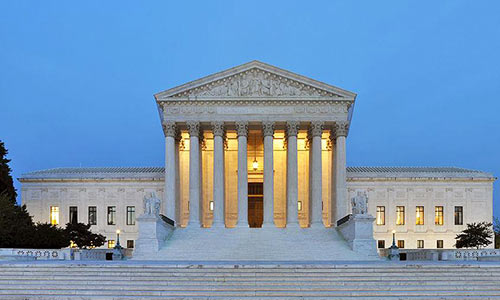
The United States Supreme Court has removed, for now, legal obstacles preventing the Trump administration from deporting certain immigrants to third countries with which they have no prior connection, while agreeing to hear the underlying legal dispute in December 2026.

In a brief unsigned order issued on Tuesday, September 29, the Supreme Court granted an emergency application filed by the Department of Homeland Security and other federal officials seeking a stay of a lower court judgment that had found the administration’s current third-country removal procedures unlawful. The Court also agreed to hear the case on the merits during its December argument session.
The Supreme Court’s official docket in Department of Homeland Security, et al. v. D.V.D., et al., No. 26A406, confirms that the justices stayed the February 25, 2026 judgment of the United States District Court for the District of Massachusetts, treated the government’s emergency application as a petition for certiorari and granted review. The Court directed the parties to brief questions concerning jurisdiction, the scope of classwide relief and whether the government’s third-country removal guidance violates federal immigration law, the Due Process Clause or protections relating to torture.
The decision means that, pending the Supreme Court’s final determination, the administration may continue implementing the disputed policy under which immigrants subject to removal may be sent to countries other than their countries of origin.
The latest order was issued over the dissent of the Court’s three liberal justices, according to the report.
The dispute centres on whether immigrants facing deportation to countries with which they have no connection must first be provided a meaningful opportunity to argue that they could face persecution, torture or other serious dangers if removed there.
Four unnamed immigrants challenged the policy, contending that they should have such an opportunity before being transferred to a third country.
U.S. District Judge Brian Murphy of Massachusetts agreed with the challengers.
The Boston-based 1st U.S. Circuit Court of Appeals subsequently upheld the relevant portion of Murphy’s ruling, concluding that the government’s existing process did not sufficiently protect people who claimed they would face serious safety risks if removed to third countries.
The appeals court relied in part on federal law restricting deportation to countries where an individual is likely to face persecution. Its ruling went into effect on September 23 after initially being stayed, prompting the Trump administration to seek emergency relief from the Supreme Court.
The Supreme Court’s intervention marks the second major occasion on which the justices have rejected lower-court restrictions requiring additional procedures before the administration can carry out third-country deportations.
In 2025, the Supreme Court allowed the policy to proceed after lower courts had blocked it at an earlier stage of the same litigation. The Court later clarified, following a request from the administration, that its ruling covered eight men whom the government intended to deport to South Sudan.
Since President Donald Trump began his second term in January 2025, thousands of people have been deported from the United States to third countries, including South Sudan, Eswatini and Rwanda.
According to figures cited in the report from the Migration Policy Institute, about 15,000 people were deported to third countries in 2025, with Mexico receiving the largest number.
The Trump administration welcomed Tuesday’s order.
James Percival, general counsel of the Department of Homeland Security, described the ruling as favourable to the administration’s immigration enforcement efforts and again promoted the government’s offer of financial assistance and a flight home for immigrants who choose to leave voluntarily.
Lawyers representing the immigrants, however, warned that the decision could expose people to removal before they have a sufficient opportunity to raise fears concerning persecution or torture.
Trina Realmuto, a lawyer with the National Immigration Litigation Alliance representing the plaintiffs, said the Supreme Court action places people facing third-country removal at immediate risk of being sent to places where they may not have a meaningful opportunity to seek protection.
She said the consequences could be significant for people whose safety and lives may be at stake.
The Trump administration, through Solicitor General D. John Sauer, had argued that leaving the lower court restrictions in place was disrupting ongoing deportation operations.
In its filing before the Supreme Court, the government said the restrictions had created substantial logistical difficulties, increased costs, generated potential diplomatic problems and prevented authorities from removing some immigrants with criminal convictions.
Sauer told the Court that one planned flight carrying 70 people with criminal convictions to three different countries had to be cancelled immediately because of the lower court order.
The administration has maintained that separate individual determinations are unnecessary where countries that have entered arrangements with the United States have given assurances that deportees will not be subjected to torture or persecution.
The government has also said it would not immediately remove people to a third country where it had not obtained assurances that they would not be tortured or persecuted there.
Lawyers for the plaintiffs dispute that those assurances are sufficient.
They argued in their court filings that the lower court rulings neither required the government to release affected immigrants from detention nor imposed an absolute prohibition on third-country deportations.
Rather, they said, the rulings required that affected people be afforded an opportunity to raise objections concerning the risks they might face before removal.
The lead plaintiff is identified in court records only as D.V.D.
According to his lawyers, he is from Cuba and has severe mental health problems. They said he fears being deported to a country where he would not have access to psychiatric treatment.
The plaintiffs have also alleged in court papers that some people previously removed to third countries have suffered mistreatment, including indefinite detention and physical or sexual abuse. Those assertions are allegations made by the plaintiffs in the litigation.
Tuesday’s Supreme Court order does not finally decide whether the administration’s third-country deportation policy is lawful. Rather, it stays the lower court judgment while the Supreme Court takes up the substantive dispute.
The justices have specifically agreed to consider whether the federal district court had jurisdiction over the immigrants’ claims; whether it possessed authority to grant classwide declaratory relief and set aside the government policy; and whether the administration’s third-country removal guidance violates federal immigration law, constitutional due-process protections or federal protections implementing the Convention Against Torture.
Oral argument is to be scheduled during the Supreme Court’s December 2026 session, after which the justices are expected to issue a definitive ruling on the disputed legal questions.
[A MUST HAVE] Evidence Act Demystified With Recent And Contemporary Cases And Materials

Available now for NGN 40,000 at ASC Publications, 10, Boyle Street, Onikan, Lagos. Beside High Court, TBS. Email publications@ayindesanni.com or WhatsApp +2347056667384. Purchase Link: https://paystack.com/buy/evidence-act-complete-annotation
______________________________________________________________________ “Enhance Legal Practice With Authoritative Reports” — Alexander Payne Offers Comprehensive Law Reports, Spanning Over A Century Of Nigerian Jurisprudence Interested buyers are encouraged to place their orders and enquiries via:
0704 444 4777, 0704 444 4999, 0818 199 9888
Website: www.alexandernigeria.com
Interested buyers are encouraged to place their orders and enquiries via:
0704 444 4777, 0704 444 4999, 0818 199 9888
Website: www.alexandernigeria.com