*“If You Have The Right Political Cover, Nobody Asks About Your Unexplained Wealth” — Sanusi Demands Fair Enforcement Of Anti-Corruption Laws

Former President Olusegun Obasanjo has said that the poor suffer most in corrupt societies, describing illicit wealth as inimical to development and progress.
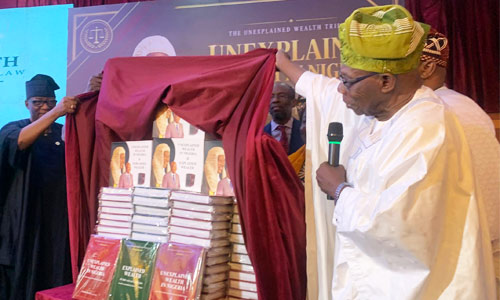
He spoke on Monday while chairing the public presentation and launch of Unexplained Wealth: A Trilogy of Nigerian Financial Law, a three-volume work by a Senior Advocate of Nigeria, Dr. Wahab Shittu, at the Oriental Hotel, Victoria Island, Lagos. The work examines the legal framework for identifying, investigating and recovering wealth suspected to have been illicitly acquired.
“Whichever way it is described, it is anti-social, it is anti-development, it is anti-progress. It is not in the best interest of any country or any human organisation,” the former President said, describing corruption as development’s greatest and deadliest peril.
“Those who suffer most in the corrupt society are the poor. And it makes them poorer.”
Explaining why he accepted the invitation to chair the event, he said the subject went to the heart of national development.
“When Wahab Shittu, SAN, the author, came to see me and invited me for this occasion, I gladly accepted. Because I know one big bane of development of any human organisation, and particularly of a country, one big handicap to development is corruption. Corruption and development are strange bedfellows; they don’t go together.”
He said no country had eliminated corruption entirely, but that many had prevented it from taking root. “There’s nowhere in the world where corruption is totally eliminated. But there are many places in the world where corruption is not allowed to grow.”
“We cannot make progress in our development as long as we allow corruption to lead,” he said, urging Nigeria and other African countries to strengthen their laws and institutions and to sustain the fight.
View this post on Instagram
The former President traced his involvement in the subject to his military career, when he served as a prosecutor under military law and sat on a court-martial involving corruption.
He said his engagement deepened after he left office as military head of state and became a farmer, when he was approached by Mr. Peter Eigen, a former World Bank official, who had witnessed what he described as grand corruption at the institution.
“He came to me and said, ‘I want you to join me in fighting corruption.’ I had never met him in my life; I had never known him anywhere,” he recalled.
He said Mr. Eigen told him that his World Bank experience had exposed him to the diversion of funds from loans granted to countries, and that the two of them went on to establish Transparency International, with Mr. Eigen as chairman and himself as chairman of the Advisory Council.
When they approached Mr. Robert McNamara, the former United States Secretary of Defence and President of the World Bank, for support, the response was discouraging.
“He said, ‘You two are trying to do the impossible,'” the former President recalled, adding that Mr. McNamara eventually offered a conditional undertaking: “He said to us, ‘I will promise you both moral and financial support when you show results.'”
He said the two men travelled to Latin America, Asia and Africa seeking support for the organisation, and that one of their earliest targets was the Organisation for Economic Co-operation and Development, which at the time allowed companies to deduct money paid as bribes as a tax expense.
“We then decided that the first thing we ought to do is to get OECD not to support money paid for corruption to be deducted for tax purposes,” he said.
The campaign took almost three years before the practice was abolished, and the success, he said, helped the organisation gain wider recognition.
Turning to his civilian administration, the former President recounted the establishment of the Independent Corrupt Practices and Other Related Offences Commission.
“I went to Transparency International, and they gave me a model of a law. And that law that became, or that brought about, ICPC,” he said.
The Bill met resistance in the National Assembly. “They said to me that if they pass the Bill as I gave it to them, most of them will end up in prison,” he said, adding that it took the lawmakers 18 months to pass the legislation.
“Then to strengthen it, I came up with the EFCC,” he said, to applause, commending Mr. Nuhu Ribadu, whom he described as a corruption fighter, for his role in that commission from its inception.
He said the country had acted before the international framework was in place. “It took about three or four years for the global body, the global organisation, the United Nations, to propose and pass the anti-corruption framework and mandate each country to make laws against corruption. So, we were even ahead of the United Nations.”
He said the trilogy appropriately focused on three critical components of the fight against illicit wealth, namely law, prosecution and recovery, and that strengthening all three would help societies tackle unexplained wealth and illicit funds.
The Emir of Kano, Muhammadu Sanusi II, said legal reform on unexplained wealth would achieve little unless accompanied by reform of the political and judicial systems.
“The only comment I’ll make is, as we continue to look at legal reform around unexplained wealth and other vices that afflict our society, these reforms need to go hand in hand with political and judicial reforms,” he said.
He warned that good laws would have limited effect if investigators, prosecutors and judges failed to apply them fairly and transparently.
“We live in a society where if you have unexplained wealth and if you have the right political cover, nobody asks you. And if you are on the wrong side of politics, you get into trouble,” he said.
He said the books provided insight into the different avenues through which wealth is siphoned from the system, including inflated contracts and subsidies, noting that the problem extends well beyond bribery, and urged the authorities to ensure that anti-corruption laws are applied consistently to everyone, and not only to those in government.
Former Vice President Yemi Osinbajo, represented by his former Chief of Staff, Mr. Ade Ipaye, said the country needed a system for recovering stolen assets that did not endanger wealth lawfully acquired.
“What we need now most urgently is a clear, fair, and constitutionally sound approach that can recover what was stolen without threatening what was lawfully earned,” he said.
He said unexplained wealth was not an academic question, because it diverts resources from schools, hospitals, roads and social welfare while undermining public confidence in the state’s ability both to punish theft and to protect legitimate earnings.
He said the trilogy addressed the issue within the rule of law and could help distinguish illicit wealth from legitimate wealth that is inadequately documented, and that the third volume was particularly important because it focuses on protecting citizens in the fight against corruption, including the need to recognise the informal economy and to guard against unfair enforcement.
The book reviewer, Professor Olanrewaju Fagbohun, SAN, warned against treating the absence of conventional documentation as automatic proof of criminality.
He said enforcement of unexplained wealth laws must balance asset recovery with the protection of legitimate property rights, particularly for people operating in the informal economy, where genuine transactions and accumulation may not be supported by the kind of documentation expected in the formal sector.
The fight against illicit enrichment, he said, should not become a mechanism for reversing the burden of proof or for exposing legitimate property owners to unjustified sanctions, and the mere inability of an individual to produce an orthodox paper trail should not automatically be read as proof that the wealth was criminally acquired.
Asset recovery remained important, he said, but it must be pursued alongside safeguards for property rights and due process.
The former Governor of Ogun State, Senator Ibikunle Amosun, said the trilogy could assist law enforcement agencies by providing guidance on the legal implications of unexplained wealth, and could put politicians and others in positions of authority on notice about the consequences of their actions. He said the books would help society understand what could and could not be done within the law, and potentially reduce the burden on the agencies involved in the fight against corruption.
A Senior Advocate of Nigeria, Mr. Femi Falana, recalled that he and his wife had recommended the author for prosecution work with the Economic and Financial Crimes Commission, saying his experience and integrity made him suitable for the role, and describing the trilogy as his magnum opus.
The former Dean of the Faculty of Law, University of Lagos, Professor Abiola Sanni, SAN, described the author as a scholar of exceptional intellectual ability with a record of academic excellence, who had combined his work as a lecturer, legal practitioner, senior advocate, scholar, human rights advocate and public intellectual with his commitment to family and community service.
In a goodwill message, Professor Akin Oyebode congratulated the author on a significant scholarly work, describing the gathering as a celebration of scholarship and expressing confidence that he still had more to contribute to the profession and to the academy.
In his remarks, Dr. Shittu said the purpose of the three-volume work was to help create a system capable of distinguishing legitimate wealth from illicit enrichment.
He said reliable records were essential to the fight against corruption, warning that without them society could end up “suspecting everyone and proving nothing.”
“Making wealth, becoming rich, is not a crime. It’s not a crime at all. But becoming rich and making wealth dubiously is a crime,” he said.
He said the fight against corruption should protect citizens who can legitimately establish the source of their wealth rather than presume guilt.
“The fight against corruption is won not on the day the thief is convicted, but on the day the honest man is believed,” he said.
[A MUST HAVE] Evidence Act Demystified With Recent And Contemporary Cases And Materials

Available now for NGN 40,000 at ASC Publications, 10, Boyle Street, Onikan, Lagos. Beside High Court, TBS. Email publications@ayindesanni.com or WhatsApp +2347056667384. Purchase Link: https://paystack.com/buy/evidence-act-complete-annotation
______________________________________________________________________ “Enhance Legal Practice With Authoritative Reports” — Alexander Payne Offers Comprehensive Law Reports, Spanning Over A Century Of Nigerian Jurisprudence Interested buyers are encouraged to place their orders and enquiries via:
0704 444 4777, 0704 444 4999, 0818 199 9888
Website: www.alexandernigeria.com
Interested buyers are encouraged to place their orders and enquiries via:
0704 444 4777, 0704 444 4999, 0818 199 9888
Website: www.alexandernigeria.com